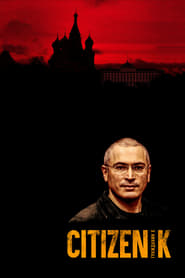
Citizen K (Гражданин Х)
Laadige alla English subtiiter
Väljalaske info
Sildid
English subtiitrite eelvaade
Esimesed 200 rida.
I;
I;
I;
I;
The richest man in Russia, Mikhail Khodorkovsky,
seized at gunpoint by Russian special forces.
Khodorkovsky is locked up
in an overcrowded Russian prison.
I;
So to stay out of prison,
why didn't you leave the country?
I;
I;
To hear Vladimir Putin tell it
Mikhail Khodorkovsky is a villain
in a real-life gangster movie.
But to Putin's opponents,
Khodorkovsky's ten years in a Siberian prison
made him a hero for the cause of human rights and democracy.
Now out of prison, Khodorkovsky is looking for a third act.
That drew my interest at a time when we all seem
haunted by Russia's role in the world.
So I started a film about him.
Okay, Mikhail, anytime.
While I could go to Russia, he could not.
He's wanted there for murder.
So like so many stories about Russia these days,
this one started in London.
I;
I;
I;
Putin and Khodorkovsky, they are both very strong.
Right.
Everyone else, weaker.
-Yes. -But...
Putin respects Khodorkovsky asarival.
He really respects him,
because he is strong.
I;
I;
I;
I;
Stalin?
I;
Just behind Red Square, there's a shopping mall
where actors get paid for posing in tourist photos
playing Russia's past leaders.
In the winter of 2018,
{ was told that the number of Stalins was multiplying.
The local joke was that this was a sign.
Russia was nearing the pageantry
of election season.
Well, there is no election season.
There's election theater.
The Kremlin has to create their own counter-candidates,
because no one wants to be a candidate against Putin,
because you will lose anyway.
I;
Today's election theater
is what has become of Russia's
experiment in democracy.
A bold attempt to shift from years of communist rule
to free market capitalism.
I;
In 1991, the Soviet Union was convulsed
in a struggle over its future.
While old guard communists clung to an empire
and a system of centralized government control,
a new generation demanded economic
and political freedoms.
Their charismatic leader was Boris Yeltsin.
Yeltsin! Yeltsin!
I;
Boris Yeltsin has become the one rallying point
for opposition tothe hardliners.
I was there as the BBC Moscow correspondent
from '88 through to the end of '91.
This is Martin Sixsmith.
-Martin Sixsmith. -Martin Sixsmith.
BBC News, Moscow.
Yeltsin was a very, very inspirational figure.
Back in 1991, he was the man for the moment.
I;
Yeltsin! Yeltsin!
It just felt like, you know, a sort of sea change
in the fortunes of a country.
I remember writing all these sort of great, optimistic
articles about how decades of communism had come to an end
and now we were going to have a new Russia,
anew Russia with democracy and freedom and openness.
And looking back, I'm a little ashamed
that I wrote all that, because the signs were there,
even then, I think, that it wasn't going to work out.
I;
I;
Khodorkovsky was a man of great intelligence
and great vision.
He was also a very decisive man.
As soon as a door opened, he was straight through it.
He'd been a member of the young communist organization,
the Komsomol.
Not because he believed in communism,
but because Gorbachev in the Perestroika era
started to relax the ban on private enterprise,
starting with the Komsomol.
By the time the collapse of the Soviet Union happened
in 1991, he had some cash in his pocket.
He created the first commercial bank in Russia.
I;
Khodorkovsky said, "I thought of this all as a game,
and I was good at playing the game."
Exactly, he was good at playing the game,
but most people were very bad at playing the game.
I;
Moving from the Soviet Union into capitalist Russia,
most Russians were completely naive,
because they had read all this propaganda
for all these years that capitalists were people with,
you know, big cigars and money coming out of their pockets.
And they imagined that you would get rich
automatically.
Where they grew up, everything was
taken care of by the state.
You know, free economy sounds nice,
but you have to make choices every five minutes.
I;
In the early '90s, Russians faced lots of choices
they didn't really understand.
Egged on by American free market boosters,
the Russian government announced a program
to hand out a chit worth around $40
to every citizen.
The chits were called vouchers
and could be traded, sold for cash,
or exchanged for shares in smaller
state-owned enterprises.
They were sold as golden tickets fo escape
the dead end of communism.
It was a time of great economic hardship,
and the ordinary people didn't realize
what this piece of paper was worth.
But the people who did sent out people with suitcases
full of cash, and they said, "Look, you don't need that
piece of paper— here, we'll give you
ten dollars, and you can go and buy some bread."
I;
The more Khodorkovsky made,
the more vouchers and companies he could buy,
either on the open market or in back-room deals.
It was gangster capitalism,
with a rule of law as weak and bendy as a rubber band.
I;
Under communism, the absence of personal wealth
meant there were few targets for violent criminals.
Now organized crime groups
prey on the new rich of the capitalist era.
Moscow has become the murder capital of Europe.
If you were rich, and people knew you were rich,
you were a target.
It was Wild West capitalism.
I;
I;
I;
In '92, we launched The Moscow Times,
and we had a lot of news.
Alot of people got killed,
and many, many companies were looking for protection.
The Moscow Times developed pretty well,
and then, two years later, I launched Cosmopolitan,
which from day one was
an enormous commercial success,
and that attracted a lot of shady people.
I thought, you know, maybe it's better
to get one of these
rising oligarchs as a shareholder.
There was one guy in particular that I got interested in,
and that was Mikhail Khodorkovsky.
He moved to a very fancy castle in Moscow.
Machine guns all over the place.
He had former KGB colonels
running his security.
This was not Russia.
This was Khodorkovsky land, you know?
Lebedev had a nice house.
Nevzlin was next door.
And then there was Khodorkovsky.
I;
I said, "The Moscow Times
is a fiercely independent newspaper,
and if we sell ten percent of our shares,
we want to remain a fiercely independent newspaper."
And he thought about it, and he said yes.
He was an extremely intelligent person,
but of course using every trick in the book
available to him.
And, at that time, this transition
from communism to capitalism
was so fast that it was impossible
for the legal structure to keep up.
I;
Citizen K subtitles in other languages
More English subtitles for Citizen K
- Citizen K 2019 720p WEB-DL x265-HDETG · 18 downloads · 2021-07-02
- Citizen K 2019 1080p WEBRip x264-RARBG · 21 downloads · 2020-06-02
Kommentaarid
No comments yet. Be the first to leave one.