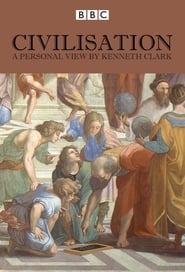
Civilisation
Laadige alla English subtiiter
Väljalaske info
Sildid
English subtiitrite eelvaade
Esimesed 200 rida.
Monteverdi: Introduction to "L'Orfeo"
The ancient church of St Mary Major, Santa Maria Maggiore,
stands in the centre of modern Rome.
The hellish Roman traffic swirls all round it.
But, if you go inside,
you'll find the original columns of the 5th-century church
built in rivalry with the neighbouring Temple of Juno, the mother goddess.
Since old St Peter's was pulled down, there is nowhere else in Rome
where one gets such a powerful impression
of the Christian church before the barbarian conquests.
This is the grandeur that the Roman Church had once achieved,
and was to achieve again.
Above the columns, the mosaics of Old Testament stories
are almost the earliest illustrations of the Bible that exist.
Brilliant, fresh colours, like early Matisse.
One sees what was lost, when almost...
the whole of early Christian art was destroyed.
(Mass for Feast of the Assumption of the Virgin Mary)
From the roof of Santa Maria Maggiore,
I can see long straight streets stretching for miles up and down,
and each ending in front of a famous church.
Down there is St John Lateran,
and in the opposite direction is Santa Trinita dei Monti.
And at each of the piazzas are Egyptian obelisks,
symbols of that god-directed state which Rome had superseded.
Papal Rome, the Rome of Sixtus V,
is the most grandiose piece of town planning ever attempted.
And it anticipated by 50 years
all the great town plans of France and Germany.
And the amazing thing is that it was done only a generation
after Rome had been, as it seemed,
completely humiliated, almost wiped off the map.
The city had been sacked and burnt;
the people of northern Europe were heretics;
the Turks were threatening Vienna.
It could have seemed, to a far-sighted intellectual,
that the papacy's only course was to face the facts.
Accept its dependence on the gold of America, doled out through Spain.
Well, as you can see, this didn't happen.
Rome, and the Church of Rome
regained many of the territories it had lost,
and became once more a great spiritual force.
But was it a civilising force?
In England, we tend to answer no.
We've been conditioned by generations of...
liberal Protestant historians who tell us that...
no society based on obedience, repression and superstition
can be really civilised.
But no-one with an ounce of historical feeling
or philosophic detachment can be blind to the great ideals,
to the passionate belief in sanctity,
to the outpouring of human genius in the service of God,
which is made triumphantly visible to us,
every step we take in Baroque Rome.
Because my eyes have seen Thy salvation,
Which Thou hast prepared before the face,
before the face, before the face,
of all peoples.
Whatever it is, it isn't barbarian or provincial.
Add to this that the Catholic revival was a popular movement.
That it gave ordinary people a means of satisfying,
through ritual, images, symbols, their deepest impulses,
so that their minds were at peace.
And I think one must agree to put off defining the word civilisation
till we've had a look at the Rome of the Popes.
Palestrina: Lamentation
The first thing that strikes one is that those who say the Renaissance
had exhausted the Italian genius, are wrong.
After 1527, there was a moment of discouragement;
a failure of confidence, and no wonder.
Historians say that the Sack of Rome
was more a symbol than an historically significant event.
Well, symbols sometimes feed the imagination more than facts.
Anyway, the Sack was real enough to anyone who'd witnessed it.
Michelangelo's "Last Judgement", which was commissioned
by Clement VII as a kind of atonement for the Sack,
fills the whole end wall of the Sistine Chapel behind me.
It's a disturbing, a crushing work.
Most of the figures are embodiments of fear or despair.
Palestrina: Lamentation
Look at the damned being ferried across the Styx.
If you compare them with "The Creation of Adam" on the ceiling,
you can see that something very drastic has happened
to the foremost imagination of Christendom.
Michelangelo had been reluctant to undertake "The Last Judgement".
Under Clement's successor, Paul III Farnese,
he was persuaded to continue it,
although with rather a different purpose.
It ceased to be an act of atonement,
or an attempt to externalise a bad dream,
and became the first and greatest assertion of the Church's power,
and of the fate that would befall heretics and schismatics.
Palestrina: Lamentation, Incipit Orario
"The Last Judgement" belongs to a period of severity,
when the Catholic Church was approaching its problems
in rather the same puritanical spirit as the Protestants.
It's curious that this period should be inaugurated by Paul III,
because he was in many ways the last of the humanist popes.
He was cradled in corruption.
He was made a cardinal because his sister, known as La Bella,
had been the mistress of Alexander Borgia.
At first sight, he looks a crafty old fox.
But, if you look at Titian's portrait of him in Naples,
one of the greatest portraits ever painted, it's a wise old head.
And the longer you look, the more impressive it becomes.
And he took the two decisions that were successfully...
to counter the Reformation: he sanctioned the Jesuit order,
and he instituted the Council of Trent.
For almost 20 years, several hundred bishops and cardinals
from all over the Catholic world, met in the Cathedral of Trent
to discuss the future of the Church.
There was a good deal of high politics, as well as theology.
But in the end, the Council did draw up a plan for the Catholic revival
which held good right up to the middle of the 19th century.
Michelangelo could refuse him nothing.
He not only finished "The Last Judgement", but in 1546,
he accepted from the Pope, the post of architect of St Peter's.
Thus Michelangelo, by his longevity no less than by his genius,
became the visual link between the Renaissance
and the Counter-Reformation.
One of the reasons why medieval and Renaissance architecture
is so much better than our own is that the architects were artists,
individual artists of genius.
The master masons of the Gothic cathedrals
started as carvers, working on the portals.
In the Renaissance, Brunellesco was originally a sculptor, Bramante a painter.
And of the great architects whom we shall see later on in the programme,
Pietro da Cortona was a painter and Bernini was a sculptor.
This has given to their work a power of plastic invention.
A sense of proportion and articulation,
based on the study of the human figure,
which knowledge of the tensile strength of steel
and other prerequisites of modern building doesn't always produce.
Well, of all non-professional architects,
Michelangelo was the most adventurous;
the least constrained, either by classicism or functional requirements.
Not that he was unpractical,... he did drawings for the fortification of Florence
which from standards of military necessities are most ingenious,
and are also like the most superb works of abstract art.
For that matter, all his ground plans are thrilling abstract designs.
But he felt himself free to play with the elements of architecture
in such a way as to express his feelings.
And, as so often happens with a great artist,
they were prophetic feelings.
You can see what I mean in the building that stands behind me,
the Palazzo dei Conservatori, here on the Capitol of Rome.
Grandeur and obedience. Well, it's grand all right.
And, if man is to take any pride in his history,
the Roman Capitol should be grand.
But the extraordinary thing is how Michelangelo
has expressed in his architecture the principle of subordination.
In an earlier Renaissance building, the parts maintained their identity
with a harmonious independence.
In the Michelangelo facade, everything is subordinate
to powerful rhythms that run right through the building.
He gave his immense authority to the device of
a single pilaster running up through two storeys.
In Renaissance architecture, and Roman buildings for that matter,
you had one column per storey, one on top of the other.
In this building, the small columns
are pressed into the foot of the giant pilaster.
They don't assert themselves; they simply add to its power.
These commanding verticals are met by even more assertive horizontals;
and the inevitable collision of these two directions
gives the building an extraordinary feeling of energy.
It seems as dramatically tense as a human situation.
Perhaps only Michelangelo had the energy of spirit
to pull together the vast, inchoate mass of St Peter's.
Four admirable architects had worked on it before him.
The central piers were already built, and part of the surrounding walls.
But he was able to give it the unifying stamp of his own character.
Monteverdi: Vespers
It's the most sculptural of all his designs;
perhaps the grandest piece of architecture ever built,
a vast, simple unit that carries the eye round
as if it were the carving of a torso.
O Lord, make haste to help me
As it was in the beginning.
Alleluia, alleluia, alleluia
Alleluia
Alleluia
People don't always appreciate the awe-inspiring grandeur of the
walls and cornices of St Peter's, but everybody knows the dome.
For centuries, lovers of art have gone into ecstasies
about its noble, energetic arc,
expressive of Michelangelo's spiritual aspirations.
It is perhaps the most commanding dome in the world,
easily dominating the other Roman cupolas
that one sees as one looks across the city.
However, all the evidence suggests that it does not represent
Michelangelo's final intention.
As you can see in this print, he wanted it to be...
much more spherical, less pointed.
It was in fact designed by an architect called Della Porta,
after Michelangelo's death.
Well, we can go on admiring it, and think rather more of Della Porta.
The last stone of the dome of St Peter's was put in place in 1590,
a few months before the death of Sixtus V.
The long period of austerity and consolidation was almost over.
The Catholic Church was victorious.
Civilisation subtitles in other languages
More English subtitles for Civilisation
- BBCCivilisation S01E13 HeroicMaterialism BDremux · 29 downloads · 2023-06-30
- BBCCivilisation S01E12 TheFallaciesofHope BDremux · 33 downloads · 2023-06-30
- BBCCivilisation S01E11 TheWorshipofNature BDremux · 30 downloads · 2023-06-30
- BBCCivilisation S01E10 TheSmileofReason BDremux · 36 downloads · 2023-06-30
- BBCCivilisation S01E09 ThePursuitofHappiness BDremux · 43 downloads · 2023-06-30
- BBCCivilisation S01E08 TheLightofExperience BDremux · 38 downloads · 2023-06-30
- BBCCivilisation S01E06 ProtestandCommunication BDremux · 35 downloads · 2023-06-30
- BBCCivilisation S01E05 TheHeroasArtist BDremux · 36 downloads · 2023-06-30
Kommentaarid
No comments yet. Be the first to leave one.