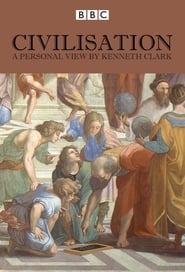
Civilisation
Laadige alla English subtiiter
Väljalaske info
Sildid
English subtiitrite eelvaade
Esimesed 200 rida.
Beethoven: Triple Concerto
For almost 1,000 years, the chief creative force
in Western civilisation was Christianity.
Then, early in the 18th century, it suddenly declined.
In intellectual society, it practically disappeared.
Of course, it left a vacuum.
People couldn't get on without a belief in something outside themselves.
And during the next 100 years, they concocted a new belief,
which, however irrational it may seem to us,
has added a good deal to our civilisation.
A belief in the divinity of nature.
Well, it's said that one can attach
52 different meanings to the word "nature".
In the early 18th century, it had come to mean little more than common sense.
As when in conversation we say: "But naturally..."
But the evidences of divine power which took the place of Christianity
were manifestations of what we still mean by nature.
Those parts of the visible world which were not created by man
and can be perceived through the senses.
Now, this particular change in the direction of the human mind
was very largely achieved in England.
And I suppose it's no accident that England was the first country
in which the Christian faith had collapsed.
In about 1730, the French philosopher Montesquieu noted:
"There is no religion in England.
"If anyone mentions religion, people begin to laugh."
Montesquieu saw only the ruins of religion.
Although he was a very intelligent man, he couldn't have foreseen
that these ruins were part of the subtle way
in which faith in divine power was to trickle back
into Western European mind.
Beethoven: Triple Concerto
The ruins of the age of faith had become a part of nature.
Or rather, they'd become a sort of lead-in to nature
through sentiment and memory.
They helped to evoke that curious frame of mind,
which in the early 18th century, was the usual prelude
to the enjoyment of natural beauty... a gentle melancholy.
Beautiful poetry was inspired by that mood.
Listen to Collins' "Ode to Evening".
Cecil Day-Lewis: "Then lead, calm votaress, where some sheety lake
"Cheers the lone heath, or some time-hallowed pile,
"Or upland fallows grey
"Reflect its last cool gleam.
"Or if chill blustering winds or driving rain
"Prevent my willing feet, be mine the hut
"That from the mountain's side
"Views wilds, and swelling floods,
"And hamlets brown, and dim-discovered spires,
"And hears their simple bell, and marks o'er all
"Thy dewy fingers draw the gradual dusky veil."
Very beautiful.
But not very like nature, any more than were the pictures
of Gainsborough and Cozens which accompanied it.
The author of that poem, William Collins
isn't a familiar name outside England.
And the same is true of all the 18th-century English nature poets,
even James Thomson, who was, in his day, the most famous poet in Europe.
An emotional response to nature is one of the
few extensions of our faculties
that don't go back to an individual of genius.
It first appears in minor poets and provincial painters,
and even in fashions. For example, the fashion
that took the straight avenues of formal gardens
and changed them into twisting paths with pseudo-natural prospects,
what were known, all over Europe for 100 years, as English gardens.
Perhaps the most pervasive influence England has ever had
on the look of things in Europe, except for men's fashions
in the early 19th century.
Trivial?
Well, I suppose that all fashions seem trivial, but are serious.
When Pope described this scene of man
as a "mighty maze of walks without a plan,"
he was expressing a profound change in the European mind.
So much for nature in the first half of the 18th century.
Then, in about the year 1760, this English prelude
of melancholy, minor poets and picturesque gardens
touched the mind of a man of genius,
Jean Jacques Rousseau.
His name involves a change of scene because although,
to some extent, he derived his love of nature from England,
it was among the lakes and Alpine valleys of Switzerland
that his absorption in nature first became a mystical experience.
Brahms: Concerto for Violin and Cello
For over 2,000 years, mountains had been considered simply a nuisance.
Unproductive, obstacles to communication
the refuge of bandits and heretics.
It's true that, in about 1340, the poet Petrarch
had climbed one and enjoyed the view at the top,
and then been put to shame by a passage from St Augustine.
And at the beginning of the 16th century, Leonardo da Vinci
had wandered about in the Alps, ostensibly to study botany and geology,
but his landscape backgrounds show that he was moved by what he saw.
No other mountain climbs are recorded.
And to Erasmus, Montaigne, Descartes, Newton,
practically any of the great civilisers I've mentioned in these programmes,
the thought of climbing a mountain for pleasure would have seemed ridiculous.
Perhaps I should add that this is not altogether true of the painters.
For example, Pieter Brueghel, on his way from
Antwerp to Rome in 1552, made drawings of the Alps
which show something more than a topographical interest,
and were later used in his paintings.
However, the fact remains, that when an ordinary traveler
of the 16th and 17th centuries crossed the Alps it never occurred to him
to admire the scenery... until the year 1739,
when the poet Thomas Gray, visiting the Grande Chartreuse,
wrote in a letter: "Not a precipice, not a torrent,
"not a cliff, but is pregnant with religion and poetry."
Amazing... might have been written by Ruskin.
In fact, I don't think the full force of Alpine poetry was expressed
till the time of Byron and Turner.
But in the middle of the 18th century, a good many people
seem to have recognised the charm of the Swiss lakes
and enjoyed them in a comfortable, dilettantish sort of way.
There even arose a Swiss tourist industry
that supplied travelers in search of the picturesque with mementos
and produced one remarkable, almost forgotten artist, Caspar Wolf,
who anticipated Turner by what,... 30 years.
But, like the 18th-century English nature poets,
this is a provincial overture, which might never have become
a part of contemporary thought without the genius of Rousseau.
Whatever his defects as a human being, and they were
clearly apparent to all those who tried to befriend him,
Rousseau was a genius.
One of the most original minds of any age,
and a writer of incomparable prose.
His solitary and suspicious character had this advantage,
that it made him an outsider.
He didn't care what he said.
As a result, he was persecuted.
For half his life he was hounded out of one country after another.
In 1765, he seemed safely established
in a small principality, Môtier.
But the local parson stirred up the people against him.
And they stoned him. They broke his windows.
He took refuge on this island in the lake of Bienne.
And there, he had an experience so intense
that one could almost say it caused
a revolution in human feeling.
In listening to the flux and reflux of these waves, he tells us,
he became completely at one with nature.
He lost all consciousness of an independent self,
all painful memories of the past or anxieties about the future,
everything except the sense of being.
"I realised," he said, "that our existence
"is nothing but a succession of moments
"perceived through the senses."
I feel therefore I am.
A curious discovery to have been made in the middle of the Age of Reason.
But a few years earlier, the Scottish philosopher Hume
had reached the same conclusion by logical means.
It was an intellectual time bomb which,
after sizzling away for almost 200 years
has only just gone off, whether to the advantage
of civilisation now seems rather doubtful.
It had a certain effect in the 18th century,
and became part of the new cult of sensibility.
But no-one seems to have realised
how far abandonment to sensation might take us
or what a questionable divinity nature might prove to be.
No-one except the Marquis de Sade,
who saw through the new god or goddess from the start.
"Nature averse to crime?" he said.
"I tell you that nature lives and breathes by it,
"hungers at all her pores for bloodshed,
"yearns with all her heart for the furtherance of cruelty."
Well, the Marquis was, what used to be called, a rank outsider.
And his unfavourable view of nature is hardly mentioned in the 18th century.
On the contrary, Rousseau's belief in the beauty and innocence of nature
was extended from plants and trees and so forth, to man.
He believed that natural man was virtuous.
It was partly a survival of the old myth of the Golden Age.
Partly a feeling of shame at the corruption of European society.
But Rousseau gave it a theoretical basis in a work entitled
"A Discourse on the Origin of Inequality among Men".
He sent a copy to Voltaire, who replied in a letter
which is a famous example of Voltairean wit.
"No-one," he said, "has ever used...
"so much intelligence to persuade us to be stupid.
"After reading your book, one feels one ought to walk on all fours.
"Unfortunately, during the last 60 years, I have lost the habit."
It was a dialectical triumph but no more,
because belief in the superiority of natural man became
one of the motive powers of the next half-century.
And less than 20 years after Rousseau had propounded his theory,
it seemed to have been confirmed by fact.
The French explorer Bougainville discovered Tahiti.
Two years later, Captain Cook stayed there for four months,
in order to observe the transit of Venus.
Well, Bougainville was a student of Rousseau.
It isn't surprising that he should have found in the Tahitians
all the qualities of the "noble savage".
But Captain Cook was a hard-headed Yorkshireman.
And even he couldn't help comparing
the happy and harmonious life he had discovered in Tahiti
with the squalor and brutality of Europe.
And soon, the brightest wits of Paris and London
were beginning to ask whether the word "civilisation"
was not more appropriate to the uncorrupted islanders
of the South Seas than to the exceptionally corrupt society
Civilisation subtitles in other languages
More English subtitles for Civilisation
- BBCCivilisation S01E13 HeroicMaterialism BDremux · 29 downloads · 2023-06-30
- BBCCivilisation S01E12 TheFallaciesofHope BDremux · 33 downloads · 2023-06-30
- BBCCivilisation S01E10 TheSmileofReason BDremux · 36 downloads · 2023-06-30
- BBCCivilisation S01E09 ThePursuitofHappiness BDremux · 43 downloads · 2023-06-30
- BBCCivilisation S01E08 TheLightofExperience BDremux · 38 downloads · 2023-06-30
- BBCCivilisation S01E07 GrandeurandObedience BDremux · 37 downloads · 2023-06-30
- BBCCivilisation S01E06 ProtestandCommunication BDremux · 35 downloads · 2023-06-30
- BBCCivilisation S01E05 TheHeroasArtist BDremux · 36 downloads · 2023-06-30
Kommentaarid
No comments yet. Be the first to leave one.