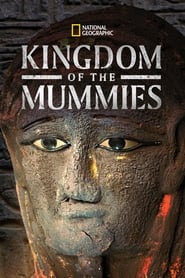
Kingdom of the Mummies
دانلود زیرنویس English
هماهنگ با نسخههای زیر
برچسبها
پیشنمایش زیرنویس English
نخستین 200 خط.
100 feet beneath the Egyptian desert, archaeologists are working in
a newly discovered tomb complex.
We're about to open a 2,600-year-old sarcophagus.
The sealed stone casket could contain a mummified body.
You're always thinking about the person
who's buried in the sarcophagus.
Who are you?
The task requires extreme care.
This is so much stress.
Very dangerous.
The lid is about 5 tons.
The tiniest mistake in this moment could be a grave mistake.
What lies inside the sarcophagus could help unlock the secrets of
life and death in ancient Egypt.
I have to go in right now.
I have to look. I need to go.
Oh my god. This is fantastic.
Among the ancient pyramids of Saqqara,
renowned egyptologist Dr Ramadan Hussein and
his team of archaeologists are excavating one of the
most important sites in Egypt today.
I started thinking about Egyptian history when I was nine years old.
But now, I have my chance to lead a multinational team.
And, pretty much enjoy that dream that I had when I was nine years old.
And, I can't imagine myself doing anything else.
Ramadan's unique discovery is a 2,500-year-old funeral home,
where dozens of ancient Egyptians, both rich and poor,
were mummified and buried deep underground.
We tend to think that only pharaohs, the kings and queens of Egypt,
would be the ones who would be mummified.
But, we're not dealing with kings and queens.
What we have here is a segment of ancient Egyptian society that we need to learn about.
Not a king or a queen.
Not a prince.
But, a normal person like you and me.
Ibrahim, ten.
Yes, yes.
Now, the team is using the latest laser scanning technology
to record and uncover the sites secrets.
So, you are scanning the shaft itself now?
No. Now we have the connection scan.
Okay.
By connection scan you mean we're connecting features above ground
to other ones that is under ground.
Yes.
By stitching together dozens of scans,
the team is mapping the site both above ground and below,
revealing a huge complex of shafts and passageways
extending nearly 100 feet down.
And, leading to a set of burial chambers dating back thousands of years.
30 meters deep we have this complex of burial chambers.
How cool.
Love it.
For project consultant, Salima Ikram,
the complex is a time capsule of evidence about
ancient Egyptian burial practices and beliefs.
The ancient Egyptians were very interested in their
afterlives and very invested in it.
One of the key parts of having a good afterlife is to preserve your body.
If your body is preserved and recognizable,
your spirit essence can go into it and reanimate it.
So, mummification was a crucial component of attaining a happy afterlife.
It's the team's mission to decode this sprawling site and rewrite the
book on mummification and burial in ancient Egypt.
At the site's core is a vertical shaft known as K.
So, 9 meters down we found this burial place packed with rows of mummies
on top of one another.
17 meters down we found ten mummies arranged in two rows, stacked on top of one another.
Almost every inch of the complex seems to have been used for burials.
20 meters, we found in the south wall this entrance.
Two people buried inside, an uncle and his nephew.
At the bottom of K is a set of burial chambers dating back to 600bc.
They contain numerous mummies,
stone sarcophagi,
and decayed wooden coffins.
There are multiple burials in every chamber, apart from one.
What is so mystifying about this burial chamber is that,
unlike the rest of the burial chambers where we have multiple burials.
In this one, we have just one person with a large sarcophagus.
It is a mystery.
Solving the mystery of why this person was buried alone
will require painstaking work.
They'll use ancient techniques and the latest technology to open this
lone sarcophagus and investigate its contents.
The opening of sarcophagi is one of the things that goes down in
history as pretty much the highlight of every archaeologist's career.
I'm absolutely lucky. My team is lucky.
This is a career first for me.
Throughout the complex, Ramadan and his team have found an array of
treasures, including the first gilded silver mummy mask
found in Egypt for nearly a century.
And a wealth of grave goods, objects placed with the dead
to help secure the best possible afterlife.
Early scans of the lone sarcophagus reveal that it too was originally
surrounded by grave goods, now kept in a secure store room.
For Ramadan, these grave goods could hold vital clues.
We found a full set of shawabti figurines, something around 405.
So, this is a large number of those figurines.
Shabtis were symbolic servants, a workforce,
to help the dead enjoy an easier afterlife.
They're so important for archaeologists because usually we have them
inscribed with the name of the deceased.
Ta-di-hor.
The occupant of the lone sarcophagus now has a name, Tadihor.
And, there's more.
Just by looking at this shawabti figurine, we are 100% sure that the person
buried here is a woman because it's a feminine name, Tadihor.
This is a woman, definitely.
Archaeology has given Tadihor back her name.
To investigate further, the team must now open her giant stone sarcophagus.
Tadihor is the only person with the single burial chamber,
and it is time to open it up and see why.
There is so many questions and so many things to worry about.
Biggest thing for me is, what is inside this sarcophagus?
Is a mummy inside or not?
They'll first try to raise the 5 ton lid, just a few inches,
to see if there is a coffin or mummy inside.
It's a task fraught with danger.
My concern is that this slide toward the back and everything would fall.
But, they're assuring me that it's not going to happen this way.
The lid is open.
Just enough to reveal what, if anything, is inside.
We get very excited when we have to open up something.
We get this excitement.
I always think of it like a child on Christmas Eve.
100 feet beneath the desert, Ramadan is on the brink of discovering
what's inside Tadihor's sarcophagus.
Yeah, hang on.
I think we're in the position to get a little peek inside.
Oh my god. This is fantastic.
What a privilege, to be able to look at something that has been hidden and
concealed from the eyes of humans for 2,600 years.
Having found Tadihor's mummy, Ramadan will now see if it can
tell him why she was buried alone.
Can I have the endoscope?
The inspection camera gives him a closer look.
Oh, it's unbelievable.
It's amazing.
I could see what I think is a wooden coffin,
and I think some inscriptions are there.
I'm not sure though.
This excitement is killing everybody around here.
If it's a decorated coffin, as Ramadan suspects,
then it would have been expensive.
A clue that Tadihor had an elaborate funeral.
As the team continues inching up the lid, Ramadan delves further
into the meaning of Tadihor's grave goods.
If you imagine the entombment of a person, it is a moment where there
is a lot of people involved.
A lot of specialists involved.
Priests are involved in the bringing of this mummy into the tomb and reciting rituals.
And, bringing all this assemblage of grave goods inside,
and arrange it in a neat way that we found in it.
There is a lot of action happening.
This is one of the things we all think about.
Reconstruct this human action.
As well as Tadihor's shabti figurines,
the team has found a collection of other ritual objects,
including jars, oil cups, and a jackal-headed charm.
But, what I personally like the most is this model of a boat.
It's symbolic because the Egyptians believed that the sun god has two boats,
in order to cross the sky.
The main wish of every deceased person is to join
the sun god in a journey into the afterlife.
Objects and rituals must have been important to Tadihor.
To reveal why, project consultant Salima Ikram is 300 miles south of Saqqara,
in a prime burial spot for ancient Egyptian royalty.
The valley of the kings.
The ancient Egyptians had a really deep belief in the afterlife,
and so a great deal of effort, economic wealth, and all sorts of things,
were put into making sure that the afterlife was going to be fantastic
because it really was an extension of this life,
except better, and for eternity.
And, having the right grave goods was essential.
Grave goods fall into two categories.
The first is to help you get from this world to the next, so they had all sorts of
magical and ritual objects that protect you or guide you.
The second are things for your soul to feed on.
Things that you enjoy in the afterlife, the same way you did in this life.
All of these objects would be put inside the tomb,
as well as having paintings of them as insurance.
This tomb belonged to a queen called Tawosret,
and is about 600 years older than Tadihor's.
This is one of the most important images in the tomb because it shows
the boat of the sun god, Ra, making his way across the night sky.
Tadihor had a very sweet little boat in her tomb.
It wasn't as grand as this thing.
But, she too was using this as her way of making it from this world into the next
together with the sun god, so she too could live eternally.
But, Tadihor's extensive set of grave goods
is evidence of more than just her beliefs.
Grave goods are a very good clue as to telling US what status
someone enjoyed in life.
The fact that Tadihor is buried in a small chamber, all by herself,
with these grave goods and a sarcophagus really do tell US
that she was amongst the wealthier people at Saqqara.
The evidence is stacking up.
It would appear Tadihor was an affluent woman.
More clues may lie inside her stone sarcophagus.
We have to continue jacking it up.
Kingdom of the Mummies subtitles in other languages
More English subtitles for Kingdom of the Mummies
- Kingdom of the Mummies S01 NORDiC 1080p WEB-DL DDP5 1 H 264-GRANiTEN · 16 downloads · 2022-12-29
- Kingdom of the Mummies S01E04 Servants of the Serpent Goddess 720p WEBRip x264-CAFFEiNE · 26 downloads · 2020-06-06
- kingdom of the mummies s01e03 the broken seal 720p WEBRip x264-CAFFEiNE · 17 downloads · 2020-05-29
- Kingdom of the Mummies S01E01 Hidden Chamber WEBRip x264-CAFFEiNE · 18 downloads · 2020-05-29
نظرات
No comments yet. Be the first to leave one.