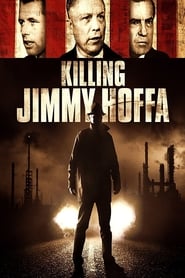
Killing Jimmy Hoffa
دانلود زیرنویس English
پیشنمایش زیرنویس English
نخستین 200 خط.
Jimmy Hoffa was an enemy of orthodox society.
Teamster leader Jimmy Hoffa
threatened John Kennedy,
Robert Kennedy, or both.
Hoffa was actually a full fledged informant
by the end.
Hoffa's association with organized crime
just quadrupled the threat to this country.
That the Teamsters were protecting
these drug traffickers.
We have no information as,
as to the fact that he is alive,
but we don't know that he is dead either.
More than 200 FBI agents
are involved in the search for Hoffa.
It is one of the most famous
and enduring American mysteries.
What happened to Jimmy Hoffa?
Hoffa is seen getting into this car,
and the car is seen driving away, never to be seen again.
Hoffa vanished,
and with this disappearance really started
the most fascinating mystery
in the criminal annals of America.
Jimmy Hoffa was born and raised
in coal mining towns in Southern Indiana
in the 1910s and 1920s,
hardscrabble towns filled with coal miners and bootleggers,
a lot of whites from the South
and emigrated to Southern Indiana.
By the 1920s, it became a hub
of the Ku Klux Klan nationally
and where violence really determined a lot of conflicts.
In the towns he grew up in,
there were more saloons than there were churches.
His mother was a single mother,
who was forced to take in laundry from neighbors
to support the family.
Hoffa lived on the edge
throughout his childhood and early adulthood,
and I think that also defined his outlook on life
and his career.
So Jimmy Hoffa and his family
arrived in Detroit in 1924,
looking for better economic opportunities.
Detroit was one of the fastest growing cities
in the country.
It was also one of the most violent.
You had the Italians with several groups,
the River Gang, the East Side Gang,
the West Side Gang,
the Jewish Purple Gang.
And then you had other factions,
such as the Lizard Gang,
which is a Polish gang out of Hamtramck.
A gangland economic boom that was taking place
not just in Detroit but around the country,
that was the situation that Hoffa was coming up in
as a young man.
Then the Depression hit,
and it hit Detroit harder than almost anywhere.
Half the city was out of work,
bread lines in the street.
Thousands of people would show up
for a single job opening.
Hoffa was lucky to get a job
as a warehouse worker unloading crates
on a dock at Kroger's.
He lived in a world in which
poverty and unemployment was the norm
and in which violence often determined
the outcome of class struggle.
In 1932, the very bottom year of the Great Depression,
the year of the national crime wave,
John Dillinger, Bonnie and Clyde,
Jimmy Hoffa was about 19 years old,
and he did something pretty amazing.
He organized his first strike.
I think it's important to see Jimmy Hoffa
as always having been an entrepreneur
and looking at the labor movement as an entrepreneur.
He saw the potential for a strike
not as a means to redo the economy
or even redo the management of Kroger's
but as a means simply to make higher wages.
Workers striking, refusing to work was leveraged
for simply economic means.
Hoffa was seeing the American system
exposed all around him,
Wall Street taking advantage of Main Street,
and the rise of gangsters and bandits.
Land speculators, banks gobbling up land
foreclosing on small farmers.
For many people, men like John Dillinger and Al Capone
became the heroes.
Doing whatever it took to get ahead in life,
that was what was important.
Jimmy Hoffa is growing up in the Midwest
during the Great Depression.
He's aware of the outlaw personality.
He's part of the community
that is marginalized.
These communities are responding
to people like John Dillinger, Pretty Boy Floyd.
So by the time that Jimmy Hoffa becomes involved
in labor politics,
this is an important part of his character.
I think the lesson that Jimmy Hoffa learned
from the Depression was to fight tooth and nail
for everything you could get
because Big Business and the government
were not the friends of the working man.
His career thrived in large part
in a very unregulated economy and political atmosphere
in Detroit in the 1930s.
He saw, in fact, that workers could succeed
more often than not
in that sort of jungle environment.
Rum owners and guys
who were moving liquor into the country,
they needed trucks.
The Teamsters were driving those trucks.
You've got the Nexus right there of the Mob,
corruption, and laborers.
And when Prohibition ends,
that connections remain,
and it just grows out of that.
Often, owners, business owners
would hire thugs with baseball bats and clubs
and sometimes pistols
to intimidate or beat union organizers.
And quite often, those union organizers would fight back
with violence as well,
and so many of these battles are fought in the streets.
Management and ownership
breaking promises and breaking legs,
it is morally acceptable to fight fire with fire.
The Mob was muscle,
and the Mob worked for whoever would hire them.
In terms of the organized labor movement,
there were times when Corporate America,
whether it's the garment industry or whatever,
would hire Mob muscle to intimidate the unions.
So it wasn't like the Mobsters were embracing
organized labor movement in America.
The Mobsters went wherever there was a payday.
And workers often found
that they could win those conflicts.
In particular, Hoffa found that those conflicts
could be settled through their willingness
to fight industries.
For union rank and file,
Jimmy Hoffa is a Robin Hood,
and like Robin Hood,
he may have to resort to extralegal acts.
He may have to get his hands dirty.
But in the end, his workers
and these marginalized communities are better off.
Hoffa was most likely involved
in car bombings.
You had to keep scabs out of those workplaces.
You had to keep replacement workers out,
or else you had no power as a union leader.
The first real documented proof
of Hoffa's connection with the Mob
comes in about 1937.
Hoffa was married by this time,
but he had an ex-girlfriend
who was sort of a gangster moll,
Sylvia Pagano, a.k.a. Sylvia Paris.
At the time,
Pagano is dating Frankie "Three Fingers" Coppola,
a bootlegger from Los Angeles
who has a criminal record extending back
to his youth in Sicily.
Pagano introduces Coppola to Hoffa,
and they become friends right away.
Frank Coppola associated with Santo Perrone,
a Detroit Sicilian Mobster
who was known for providing goons and muscle
to either unions or to businesses,
again, playing both sides of the fence
in various union battles in the 1930s.
They come up with a plan.
The Mob can provide muscle to back
this union movement that is struggling.
The odds are against them.
The Mob will offer access to muscle
to defend the workers, to counterattack.
The Teamsters, at this time,
were engaged in a brutal strike
with the Kroger's Supermarket chain,
people being shot,
heads being busted,
and supposedly, Hoffa asked his new friend,
Santo Perrone,
to hold his goons back and not help Kroger
while the Teamsters tried to fight this struggle.
The old adage about Hoffa was that
he wound up going to the Mob
نظرات
No comments yet. Be the first to leave one.