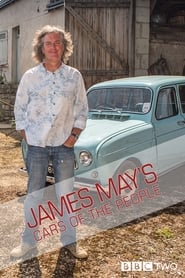
James May's Cars of the People
دانلود زیرنویس English
Download English Subtitle Files for Mobile (3)
پیشنمایش زیرنویس English
نخستین 200 خط.
The shape of the Boeing B29 Super Fortress is deeply
etched on the conscience of humankind,
being the only aircraft ever to have delivered an atomic weapon in anger.
And it bears little comparison with this -
a humble, mid-sized Japanese hatchback.
And yet you could argue that, long term, this has been the more
destructive weapon, one that lay waste to acres and acres of industry.
And it gives rise to a curious new maxim for the modern age -
to win at cars, first you must lose at war.
Go!
'This week, how conquered superpowers conquered all...'
That's amazing!
'..how British classics...'
It is perfect!
'..became British clunkers...'
- You all right? - No, I'm a loser.
'..and how American powerhouses got left in the dust.'
The Big Three, they were just so arrogant.
Also, I murder a tradesman.
Shoot the man in the plumbing van.
Back In Black by AC/DC
1945 - Britain had won the war.
Hip hip hooray!
We still had our empire, we still had our reputation
for engineering excellence, we were still the workshop of the world.
Thank God we won the war.
Once the war was over, our car factories could stop churning out
Spitfires and get back to cars.
Immediately post-war, Britain was the world's second-biggest car-maker,
and the world's biggest car exporter.
For many people in Britain, however, the end of the war
simply meant dusting off whatever was up on bricks in the garage,
and then going for a first spin in the new broad, sunlit uplands.
And for thousands of people, that car was this.
The Austin 7 had launched right back in 1922 and it was Britain's very first people's car.
It was like our Ford Model T, but a bit more modest,
and cheaper and easier to run, as you'd expect.
Was one of them Austin big 7s
That do 60 on top and no buts
Developing 25 horsepower
Not only got looks but got guts.
The Austin 7 was sold all over the world.
There were licensed built versions made in Germany, France, America.
Australia used its chassis. It was copied by Nissan in Japan.
And an Austin 7 formed the basis of the first car from the company we now know as Jaguar.
It was also the basis of the first Lotus.
This was one hell of a car.
America had also won the war. Victory had left her with
massive manufacturing capacity, loads of money, a lot of it
owed to America, in fact, and control of the vanquished nations.
Their Marshall Plan could dictate to the losers what
they had to do to get back into the global goodies gang.
America had not been bombed.
America could go back to making things like this.
This, I'm sure you know, is a 1937 Buick Special two-door sedan slope back.
Ahem.
This was the cheapest car in Buick's Series 40 range,
but even so it had a straight-eight engine giving 100 horsepower,
modern overhead valves, hydraulic brakes, a heater, a defroster
and even, if you paid a bit extra, a dash mounted radio.
There was just no stopping Buzz and Chuck and Hank.
During the war, Buick's factory was given over to making munitions,
usual sort of thing, but in 1946 the Special went back into production.
It would do for now.
Thank God we won the war.
Now imagine if you'd lived in Germany in that immediate post-war period.
Everything was bombed to bits, much worse than Britain.
Millions were dead. The Allies were in control of everything.
The great dream of the VW Beetle factory -
that was all smashed up and in the hands of the British.
But it could have been worse. You could have been Japanese.
Food was in woefully short supply.
Roads were largely unmade. There were virtually no materials.
The occupying powers had been charged with changing the Japanese system
from a military to an economic one. The Emperor had become a puppet.
But the production of passenger cars was virtually outlawed.
If you were lucky, you might get a bicycle.
If you were very lucky, it might have a small engine on it, but that was it.
And yet, a lifetime later, we buy more and more of the cars we covet
from the supposedly defeated nations, Germany and Japan.
So who really won?
It took only 30 years or so for Japan to transform itself
from a knackered nation of powered bicyclists
into a world-conquering, car-making superpower,
and that, despite being the world's first, and so far only, victims of atomic war.
It took only 20 years for Germany to transform itself
into a maker of great cars, and more to the point
the roots of this turnaround were happening just as the
old Allies thought their global position was completely unassailable.
So how did that happen?
Britain will launch a ship a day,
more than the rest of the world put together.
Britain now leads the world in aviation.
The problem wasn't that Britain and America didn't innovate.
Post-war, they led the world in aviation, electronics, machinery.
We had Nobel Prize winners.
We'd invented modern computer science and discovered DNA.
The slumps of pre-war years must never return.
I mean, cripes, by 1952 we had a new Queen, and America
still had its dream, which we could all see on the silver screen.
More to the point, it had Detroit which was a Mecca,
a city built on the automobile and the desire to possess it.
By the late '40s, Britain had moved on from the Austin 7 and was building new stuff.
Cars like Ford of Britain's V8 Pilot.
And Ford were so confident of it,
it was given its own cinema sing-along.
This was pre pah-pah-pah-pah, obviously.
And anyway, it was another hit from the late '40s that we remember today.
You will have spotted that this is a Morris Minor.
The Minor, though modest, was very middle class
and it's interesting to know that in this golden era of 1950s Britain,
any car worth its salt would be named after an establishment figure.
There was never a Ford Flatcap or an Armstrong Sydney Jobcentre.
No, no, no. Things were called the Austin Cambridge,
the Austin Westminster.
The Ford Consul, the Ford Squire, the Viceroy,
the Standard Ensign, the Ford Prefect, the Princess,
the Cambridge, the Austin Cambridge, the Daimler Regency...
I think you get the idea here.
Bill Anderson tells me the Minor's the best car he ever had.
- Marvellous on corners. - Gosh! Everyone's got a Minor.
But don't just take Bill Anderson's word for it.
Here's a woman's view.
That's why I like the new Morris car.
Rather in the way that the 2CV symbolises
everything about the condition of being French,
the Morris Minor has come to be regarded as everything that's good and proper about being British.
Let's imagine for a moment that overnight the Morris Minor
suddenly disappeared from the British conscience, would it matter?
I think we would struggle with it.
If you did a survey - should we get rid of the Morris Minor?
No! But actually, would we really notice?
Would it in fact give us a chance to move on?
It might be a little bit...
As if a very popular and very well-liked television programme
suddenly came to an end,
everybody would think it was a disaster but after a while,
well, they'd get over it,
probably find something else.
There must have been something good about the Minor as this was
the first British car to sell more than a million.
In the end, 1.6 million were made
right here at the Cowley factory near Oxford.
But the Morris Minor was not perfect.
In fact, it's something of a lasting monument to the sort
of timorousness and disorganisation
that would come to characterise so much of our motor industry.
When the designer Alec Issigonis had finished his prototype design,
he realised he'd made it a bit too narrow.
Now we have a model of it here.
This is an original one from the time and if you have a look at it
you can see he was dead right, he'd cocked it up a bit.
It was a bit too narrow.
So he took the full size prototype design
and he sawed it in half lengthways like that
and then he experimented adding different size strips
to see what would make it look right and, in the end,
he decided it needed an extra four inches down the middle.
Great! But the press shop, the people designing the tooling for this thing
had already made some of the tooling for the original narrow versions.
So in the final car they had to come up with this -
this strip that runs down the bonnet to there and then spreads out
nicely along there.
That is a fudge and I know we like to think of it as
an interesting Morris Minor design feature but I'm afraid it is, and
I know this is a bit like burping in the Queen's face, it's a bodge.
We will have to learn to live with that. OK?
And it gets worse under the bonnet.
Open All Hours
The Minor was supposed to have a brand-new flat four engine
driving the front wheels.
But penny-pinching meant it was lumped with wheezy inline jobs,
driving the rear wheels.
A pity, isn't it?
Let's shut the bonnet on this travesty
and pretend it never happened.
Morris put quality first.
Look, I'm not being down on it, the Morris Minor was brilliant,
despite a bit of management myopia.
And let's not forget that because he couldn't realise
his front wheel dream of a Minor, Issigonis went on to design the Mini,
one of the most significant small cars ever.
And with the Minor and the Mini,
he is responsible for a sizeable slice
of our British sense of automotive identity.
That's not bad for a Greek.
£100 million worth of cars
exported since the war ended.
So despite a slapdash motor here and a bodged bonnet there,
the UK motor industry post-war was booming.
And America's was too.
Before the war had even finished,
US car-makers, encouraged by the government and working in secret,
had already started creating a new era of cars.
By the 1950s, the American car was a gobsmacking monument
to the new culture of ownership.
Goodbye, three-speed manual transmissions and Art Deco fixings,
hello, the jet age, neon lights and the automatic.
Nothing could go wrong.
Could it?
James May's Cars of the People subtitles in other languages
More English subtitles for James May's Cars of the People
- James Mays Cars of the People Season 1 complete · 27 downloads · 2021-07-30
- James May's Cars of the People - Episode 3 · 33 downloads · 2014-08-26
- James May's Cars of the People - Episode 2 · 32 downloads · 2014-08-24
- James May's Cars of the People - Episode 1 - FTP Version · 36 downloads · 2014-08-17
نظرات
No comments yet. Be the first to leave one.