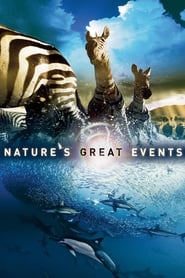
Nature's Great Events
دانلود زیرنویس English
هماهنگ با نسخههای زیر
برچسبها
پیشنمایش زیرنویس English
نخستین 200 خط.
The power of the sun drives the seasons,
transforming our planet.
Vast movements of ocean and air currents ...
bring dramatic change throughout the year.
And in a few special places, these seasonal changes ...
create some of the greatest wildlife spectacles on Earth.
Here on the western coast of North America ...
in the spring of each year,
one of the Earth's greatest travellers comes home.
Over half a billion salmon in the Pacific Ocean ...
start on a 3,000-mile journey,
returning to spawn in the rivers where they were born.
Travelling deep into the continent,
these fish will not only provide food for millions of animals,
they will also bring life ...
to one of the richest habitats on Earth.
The coast of British Columbia and Alaska ...
is rimmed by spectacular mountains.
Although it will be months ...
before the salmon enter the rivers below these frozen peaks,
one species that has spent the winter sleeping up here ...
is already anticipating their return.
In January, snug in their dens,
the females have given birth ...
and now the family is beginning to stir.
Grizzly bears.
Whether the cubs will live or die depends largely on one key event,
the salmon run.
For the next 5 months,
the bears will be focused on making their appointment ...
with the returning salmon.
Surviving the first year is hard.
Half of all grizzly cubs don't make it.
Throughout Alaska and British Columbia,
thousands of bear families are emerging from their winter sleep.
There is nothing to eat up here,
but the conditions were ideal for hibernation —
lots of snow in which to dig a den.
To find food, mothers must lead their cubs down to the coast ...
where the snow will already be melting.
But getting down can be a challenge for small cubs.
These mountains are dangerous places.
But ultimately, the fate of these bear families ...
and indeed that of all bears around the North Pacific,
depends on the salmon.
Right now, those salmon are more than 2,000 miles away.
After 4 years at sea,
half a billion Pacific salmon are going home,
back to fresh water ...
to lay their eggs in the rivers where they themselves were hatched.
How the salmon manage to find their way back home ...
across the open ocean is still largely a mystery.
It has only recently been discovered that a salmon's brain ...
contains small particles of iron that, like a compass,
help it steer the magnetic lines of the Earth,
showing them exactly where to go.
For many of these salmon, that destination is here ...
along the western coast of North America in British Columbia.
They are making their way back to their birthplace ...
in one of its many freshwater rivers and streams.
Here, amongst the network of lakes and waterways,
lies the largest expanse of temperate rainforest left in the world.
It stretches from southern British Columbia to Alaska.
It's one of the most fertile landscapes on the planet.
The temperate rainforest supports even more life than its tropical counterpart.
For thousands of years, salmon have returned to this country ...
because of the abundance of one element: fresh water.
This is some of the purest water in the world,
thanks to these forests.
Where the forests are still undisturbed,
the soil, held by millions of tree roots,
filters the water, keeping the rivers flowing clean and pure.
In May, grizzly bears come down to the coast ...
to find something to eat while they await the arrival of the salmon.
This is where spring arrives first.
The cubs, still feeding on nothing but their mother's milk,
have grown considerably.
But it has been 6 months since their mother had anything to eat.
Now they need other food ...
and the search for it can lead them into danger.
Some males will try to kill cubs.
The breeding season has begun,
and big males are here looking for females.
But at least there is something to eat here,
even if it's only grass and sedges.
These greens, in fact, can keep them going for months,
but they will need something more nutritious ...
if they are to put on enough fat ...
to enable them to survive the next winter.
In some places along the coast, bears find much richer food.
It's buried, but bears have an extremely acute sense of smell ...
and can sniff out a meal even if it's beneath the wet sand.
Clams.
It's not only bears that are drawn to the coast ...
in search of food.
There are more than 2,000 grey wolves in the Great Forest.
They leave their cubs in the tidal areas while they hunt.
This wolf is the pups' eldest brother.
He's baby-sitting while the adults are away hunting.
He doesn't have any food for the cubs,
so they eat whatever they can find,
even chewing the barnacles off the rocks.
They, like the bears, are awaiting the arrival of the salmon.
The adults return and find an intruder.
A hungry bear has wandered into their patch.
Coastal wolves will often kill and eat small bears.
But this bear is very big.
Eventually, they decide that this one is just too big.
By July, the bears are all getting very hungry indeed.
And still the salmon are not here.
And then, after 2 months of travelling across the open ocean,
the salmon reach the coast.
As they near the shore, they begin to smell fresh water.
There are thousands of rivers flowing into the sea,
and the salmon have to find the particular one ...
that will lead them to their birthplace.
They have a truly extraordinary sense of smell.
They can distinguish a single drop from their home river ...
amongst 8 million litres of sea water.
As they detect the waters of home, they converge into the narrow fjords,
which act as underwater corridors.
But other creatures also know these corridors.
Killer whales. They eat a lot of salmon.
And so do Steller sea lions.
Salmon sharks are here, too, specifically to feed on salmon.
But there is one predator that they can never see coming.
The bald-headed eagle.
Once past these coastal predators,
there is little to prevent them from reaching their home river.
It's now late July ...
and the salmon are poised at the edge of their inland realm.
In the estuaries of the larger rivers,
all 5 species of Pacific salmon mingle together.
Pink, chum, coho, sockeye and Chinook.
The drive to get into the rivers is strong.
Their eggs will only survive in fresh water.
In late July, however, the water level is often too low ...
for the first salmon to enter the smaller rivers.
That doesn't stop them trying.
But the very water that has drawn them back home ...
will eventually kill them.
As their kidneys and other organs adjust to the sudden lack of salt water,
they stop eating and even drinking.
So the energy stored in their bodies is all they have ...
to power their swim upriver and spawn.
However, the salmon in the smaller streams ...
have a more immediate problem.
The low water has stopped them ...
before their journey upstream can even begin.
But their coast, every year, is swept by great storms.
In the skies above the North Pacific, a huge eddy is forming.
It moves towards the coast and the high coastal mountains.
The clouds are driven up and over this massive barrier,
and they drop their load of water.
The Great Forest gets up to 3 metres of rainfall a year.
Bears have thick coats ...
and the heavy rain doesn't seem to bother them at all.
The steep Rocky Mountains funnel the rainwater into the rivers ...
and levels quickly rise.
This is what the salmon have been waiting for.
The first wave of travellers advance upstream.
No sooner do they start ...
than they are faced with another challenge.
But 6 million years of evolution have prepared the salmon well.
Their bodies are solid muscle and perfectly streamlined.
Clearing these falls for a salmon ...
is like a human being jumping over a 4-storey building.
In many of these falls, however, the salmon face more than just water.
The bears know that this is ...
where they can get the first proper meal of the season.
But it's not easy.
There is an art to catching a leaping salmon.
And this young bear hasn't yet acquired it.
This is what salmon were born to do.
They are driven to get up these rivers to their spawning grounds.
Their parents made it up here, and nothing short of death ...
will stop them from repeating that journey.
They are trying to get to the exact stretch of gravel where they hatched.
Some lucky ones may only have to go a few miles inland.
But others are faced with a truly daunting journey.
The farthest that salmon have been known to swim upriver ...
is 2,000 miles.
Summer rains can be short, and when they stop ...
the water levels in many of the rivers along the coast drop quickly.
The first salmon in the rivers are once again trapped by shallow water.
And worse, they're in bear country now.
In early August, mother bears begin to patrol the rivers looking for fish.
Like this one, they are usually skinny and starving.
She and her cubs have eaten nothing but plants ...
since they emerged from their den.
They are in desperate need of a proper meal.
Bears of all ages and experience come to the rivers to look for salmon.
The first fish of the season, however, are hard to catch.
This young bear is still learning how to do it.
Step number one is spotting a salmon.
A higher perspective usually helps.
In these early days, fish are few and far between.
And when they do appear, they are moving very fast.
The salmon also have lots of places to hide.
The rivers are only shallow in short stretches ...
Nature's Great Events subtitles in other languages
More English subtitles for Nature's Great Events
- Natures Great Events S01 1080p BluRay x264-aAF · 100 downloads · 2014-04-30
- BBC Natures Great Events 1of6 The Great Melt XviD AC3 MVGroup org · 55 downloads · 2011-12-29
- BBC Natures Great Events 6 The Great Feast [HDTV 720p and 1080p SRT] · 47 downloads · 2010-03-23
- BBC Natures Great Events 5 The Great Flood [HDTV 720p and 1080p SRT] · 52 downloads · 2010-03-23
- BBC Natures Great Events 4 The Great Tide [HDTV 720p and 1080p SRT] · 46 downloads · 2010-03-18
- BBC Natures Great Events 3 The Great Migration [HDTV 720p and 1080p SRT] · 49 downloads · 2010-03-17
- BBC Natures Great Events 1 The Great Melt [HDTV 720p and 1080p SRT] · 45 downloads · 2010-03-17
- BBC Natures Great Events XviD AC3 MVGroup org · 39 downloads · 2009-04-30
نظرات
No comments yet. Be the first to leave one.