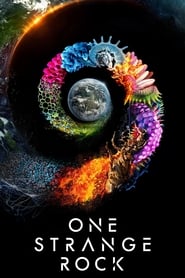
One Strange Rock
دانلود زیرنویس English
هماهنگ با نسخههای زیر
برچسبها
پیشنمایش زیرنویس English
نخستین 200 خط.
When I was little,
my grandmother gave me an old compass.
She wanted me to know where I was going.
I was always much more intrigued by where we came from.
I mean, I knew she was from Pittsburgh, but before that,
her grandmother and her grandmother's grandmother,
where did they come from?
You go back far enough and everyone, every living thing,
we all come from the same place,
a moment when a dead rock came to life.
Only a few of us have been able to see just how
extraordinary life is.
Ignition and lift-off.
Eight astronauts,
with over 1,000 days in space between them,
can tell us how being up there helped
them to truly understand what goes on down here.
I look down and I can see where we came from.
This living, breathing bubble of life in the blackness of space.
It's hard to imagine anywhere else where everything
could have fallen into place so magically.
We're so used to life that we start to think of life
as being really simple and easy to do.
It's not.
We may never know exactly how life got started,
but we do know it was a strange brew.
A dash of magical liquid...
A sprinkle of stardust...
And a crackle of energy.
Mixed together in a big bubbling cauldron to make our rock come alive.
Mae Jemison sees life differently from most of us...
And not just because she's an astronaut.
Go on my mark, three, two, one...
Okay Mae, we copy.
She's also a doctor.
She's spent her life studying life.
Houston now controlling.
Houston, Endeavour switching into roll.
Roger roll Endeavour.
At an age when I was just running around writing rhymes
in Philly, she was pondering life's biggest questions.
As a child I was fascinated by the question, who am I?
What am I?
I remember once when we were driving from Chicago to
Alabama we stopped on the side of the road and I looked up
and there was this incredibly star-studded sky.
It just made the whole universe very magical.
And 30 years later, I had a ringside seat to the stars.
When I was in space, I felt an incredible connection to the
rest of the universe.
And it's true.
We're made of the stuff of stars.
The carbon, the nitrogen, the oxygen,
the elements that are the key components to our body were
actually generated inside of stars that exploded.
All of the stardust scattered across the universe,
clumping together into rocks to form planets like ours.
And the great mystery of Genesis is about how stardust came to life.
You, me, the dog, we're all made of the same dead dust
that built the planet.
It's just mixed up different.
The big mystery is, what's the mixer?
Lechuguilla is probably one of the most difficult places to visit on Earth.
When you're deep in Lechuguilla you're more than 1000 feet underground.
Lechuguilla cave is almost 150 miles long which makes it one
of the most complex maze caves in the world.
The trail's down here.
It's a big pretty big drop-off into this room.
Got it.
That's amazing. Absolutely.
Most of these formations are a couple of hundred thousand years old.
We'd better not touch anything.
Yeah, let's get through without touching anything.
You'd imagine these deep dark caves to be lifeless.
There's no energy from the sun here,
but the cave walls are not as dead as they seem.
If you were to put on special glasses...
You'd see this kaleidoscope of organisms,
living in the caves.
Billions of bacteria on every surface you look at.
Lechuguilla is cut off from the surface.
But there is something above all else that is essential for life.
Water.
It takes up to 10,000 years for water to work from the
surface into the lake.
You take the water out of the equation and you have
no bacteria in the cave.
Water is required for life as we know it here on Earth.
One of the important things you learn in
medicine is that bacteria are made up of just one cell.
And cells are the basic units of life.
Tiny bubbles or membranes filled with water.
Floating around this solution, we've got the ingredients of life.
Yet, it all depends on water.
And when looking at our planet from space,
I was struck by just how much water there is.
It is definitely the blue planet.
These bodies of water are massive around the Earth.
You're over the ocean, ocean, ocean,
and then you hit a continent like Africa, like, ooh, Africa, big continent.
In just a couple of minutes it's gone and
you're over the ocean again.
Looking at the Nile Delta from space,
you can see how important water is,
because all along the Nile river is this thin beautiful
green strip of life.
That H2O is magic, and so when you're looking for life,
the key is to find water.
We can last way longer without eating than we can without drinking.
Food gives us energy.
What does water give us?
Turns out that plain old H2O is the universal champ at one crucial thing.
We've come here to Angel Falls to climb this huge overhang.
One of the biggest in the world.
You just feel like you're flying when you're hanging from the wall.
The sound of the waterfall is like a constant storm.
Climbing Angel Falls is very dangerous.
I want to keep climbing.
You want to take the lead?
Yeah. Of course.
Where the rock has been more exposed to the water...
The Rock is crumbly.
It's very sandy, so I'm going to put one protection here.
Got to be really careful in this, you know.
And the other hand,
where there is no water at all,
you can see the rock is completely different.
It's extremely hard.
Are you going to climb?
Yeah, I will try.
When you get to see this landscape from above...
You can see how the water is a big destroyer in a way.
It dissolves the rocks.
It continues, the flow of water, for millions of years,
like these incredible islands in the sky.
Water has special properties.
You know the same water we drink can dissolve almost anything.
It will even dissolve rock over time.
So that means lots of different molecules can be
mixed together in it.
And interact with one another, making something new.
And that's what makes Earth so special.
With all the liquid water we have,
our planet's like some type of giant chemistry lab.
Water takes dust from the stars,
breaks it down and shakes it up.
But life isn't going to bubble up just because you stirred up
some muddy stardust.
If you want to brew the soup of life,
you need to kick it up a notch.
If you want to make stardust into life...
There's a bit more to it than, just add water.
A recipe is more than a list of ingredients.
It also tells you how to put them all together.
Imagine a big pot of all these ingredients,
you throw them in, but if you throw in the celery,
tomatoes and the pepper, you're not gonna get a
spaghetti sauce, unless you add some heat.
I usually start my day with a hit of caffeine,
but Lee Koon Yau, his job gives him all the jolt he needs.
Lee is up top to check the lightning conductor.
He's testing it to make sure it conducts electricity right down to the ground.
You and I may only see lightning a few times a year,
but the Earth is constantly crackling with energy.
To see it, you have to go way higher than a skyscraper.
Viewed from space, the Earth is dynamic.
It's full of energy.
I remember seeing these big flashes of light that sort of come through the clouds.
You know, the lightning just propagates literally for
thousands of miles across the surface of the Earth.
It looks like its nervous system spreading
across the planet.
They're spectacular.
They almost seem to be communicating to each other.
There are over 100 lightning strikes per second.
That's eight million a day.
And at the start of our planet, billions of years ago,
there was even more energy on display.
That's what life needed to get started.
Energy.
The first experiment to reveal this really captivated
me as a child.
I grew up in Chicago and two scientists from my hometown
Urey and Miller, took the components that were believed
to be Earth's primitive lifeless atmosphere.
Then they subjected it to electrical charges.
They were able to generate organic molecules.
The basic building blocks of life.
The thought that energy could make lifeless stuff
come alive was just about as exciting as life could get for me.
I mean, wow.
Now we have a lot more knowledge about early Earth.
Billions of years ago, there were many more sources of
energy than just lightning.
Meteors rained down.
There were volcanic eruptions.
Super-tides churned these seas.
The Earth was a much more energy-rich, violent place.
Very lively, right?
Lots of things are happening.
One Strange Rock subtitles in other languages
More English subtitles for One Strange Rock
- One Strange Rock Season 1 Complete 720p HDTV x264 [i c] · 132 downloads · 2019-12-31
- One Strange Rock S01 720p AMZN WEBRip · 150 downloads · 2018-08-11
- One Strange Rock 2018 Complete 1080p AMZN WEB-DL DDP5 1 H 264-NTb · 179 downloads · 2018-06-02
- one strange rock s01e10 home 720p HDTV x264-DHD · 69 downloads · 2018-05-29
- one strange rock s01e09 awakening 480p webrip x264 rmteam · 48 downloads · 2018-05-22
- one strange rock s01e08 alien 720p HDTV x264-DHD · 110 downloads · 2018-05-15
- one strange rock s01e07 terraform 480p hdtv x264 rmteam · 108 downloads · 2018-05-08
- one strange rock s01e06 escape 480p web dl x264 rmteam · 107 downloads · 2018-05-03
نظرات
No comments yet. Be the first to leave one.