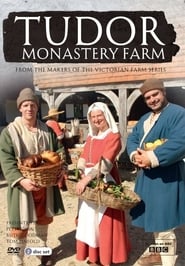
Tudor Monastery Farm
دانلود زیرنویس English
Download English Subtitle Files for Mobile (7)
پیشنمایش زیرنویس English
نخستین 200 خط.
500 years ago, England was emerging into a new era.
After years of war, plague and famine,
the kingdom was enjoying peace and prosperity
under the reign of the first Tudor king Henry VII.
A new class of business-savvy farmer was thriving,
boosting food production...
And then over she goes!
While wool from their sheep was generating half the nation's wealth.
Many of the nation's farms were under the control
of the biggest landowner in England after the King - the monasteries.
Their influence could be felt in every aspect of daily life.
They were not just places of religion,
they were at the forefront of technology, education and farming.
But with the daily lives of monks devoted to prayer,
they depended increasingly on tenant farmers
who worked and tended their lands.
Steady, girl.
Now, historian Ruth Goodman
and archaeologists Tom Pinfold and Peter Ginn
are turning the clock back to Tudor England
here at Weald and Downland in West Sussex,
to work as ordinary farmers under the watchful eye of a monastic landlord.
Gi'away.
That's the way! Nice.
To succeed, they'll have to master long-lost farming methods...
Those flanks are going again!
And get to grips with Tudor technology.
ALL GASP
Quite noisy!
It's a really violent process!
While immersing themselves in the beliefs...
customs...
and rituals that shaped the age.
This is Merrie England for Heaven's sake, so to speak, let's enjoy it!
SQUEALS AND LAUGHTER
This is the untold story of the monastic farms of Tudor England.
Ruth, Tom and Peter are travelling to their new farm
at Weald and Downland in Sussex on England's south coast.
In 1500, England was 15 years into the rule
of its first Tudor king Henry VII.
The previous two centuries had seen the country ravaged
by war, economic depression and plague.
The Black Death had cut England's population from four million
to just two-and-a-half million.
But under the new Tudor dynasty the nation was slowly emerging
from the darkest of times.
This is our marketplace.
This is our little town.
What a day to start out on, eh? Look at it - blue skies!
- Welcome to Tudor England, eh? - Morning!
The early Tudor world is a Catholic world,
suffused with religious thought.
Even very practical stuff, it was always there.
Whatever you did, whatever you talked about, whatever you thought -
there was no other system of understanding the world.
It was undisputed.
In 1500, monasteries were almost as powerful as the state itself.
They exerted their influence over the entire population,
not only in matters of religion,
but in every aspect of daily life.
This was a God-fearing nation.
People believed they risked eternal damnation, even social isolation,
if they didn't attend church at least once a week.
In this period, most people were living in small wooden structures
focal point of these communities were these massive cathedrals
- awe-inspiring, stone built, dominating the landscape.
And this shows how central the church and religion were
to people's everyday lives.
It was a time when religion rather than science
was relied upon to explain everything,
from the weather and the growth of crops
to health and well-being.
Our lives, this country, the values we have, the laws we have,
the way we approach life -
it's all shaped by the past.
I mean, this is one of those periods
that really forges the identity of England.
Professor James Clark, an expert in medieval monastic life,
is introducing them to their new farm.
What was the relationship between monasteries and farms such as this?
By the early Tudor period monasteries are preferring, increasingly,
to put out a large proportion of their agricultural property to tenants.
So we're not employed directly by the monasteries, but rather
a sort of little enterprise paying rent to the monasteries,
and we're taking all the business risks?
Absolutely so.
And it's down to your ingenuity,
and perhaps your ability to read the dynamics of the market,
to make a success of it.
As well as having a good head for business,
monastic farmers needed shelter -
not just for themselves, but also to accommodate and feed their workers.
It's huge!
Hm. Heating bill's going to be a bugger, isn't it?
LAUGHTER
Wow!
This is a house! Wow!
How many people would've lived in here?
There'd be the tenants and their immediate family,
but there would also be live-in domestic servants.
So, maybe eight to ten in total.
This was the heart of the house, where the farmers would eat,
carry out business, and house extra labourers at harvest time.
Wow, so where do we sleep?
Well, that'll be, for us, upstairs.
The upper chamber, called the solar,
was the farmer's private bed-sitting room.
It's started already!
And a pull-out truckle.
- A truckle? - Yeah, yeah, it's on wheels.
It shoves underneath during the day.
- That's where you'll be, Peter! - On the truckle.
To pay their monastic landlords,
Tudor farmers had to turn a decent profit.
Their farm has five acres of enclosed fields,
as well as access to hundreds of acres of common land and woods.
They have cows to pull ploughs and carts,
a barley crop, poultry,
and a flock of Southdown sheep.
What kind of farming are we going to be doing then?
Your main focus will be sheep.
And here's where the relationship between the tenant and the monastery
is absolutely central to your productivity.
Your wool crop may well be required by the monastery,
to satisfy the merchants that it's under contract with.
- But we can't be completely wool-specialist,
we do also have to grow arable crops...?
Yes, certainly, you'll probably have a barley crop, for example.
Also, at this time, we see tenant farmers taking up pig farming -
in a small way - as an additional small enterprise.
Peter, I think we should definitely get some pigs.
Well, if we're getting some pigs we need to place to put them.
This project, right there.
It's spring.
Ruth, Peter and Tom have to get their money-spinning enterprises
up and running as soon as possible.
They have just a few weeks to sow crops,
and get in livestock before Easter.
Wool was central to the early Tudor economy.
It was known as the jewel in the realm,
as it generated half the nation's wealth.
Sheep were the backbone of the British economy -
for clothing, mostly - and not just for us.
British wool was clothing most of Europe.
It was the finest quality.
Come on, girls.
It was all about grazing -
the quality of grass influenced the quality of the wool.
The British system involved quite a lot of moving sheep about.
In the winter months, you wanted them down on your arable land,
nibbling at the weeds, dropping their dung on your fields,
but come spring he moved them up into the hills,
into areas where he can't run a plough.
There the grass has come fresh and lush and will sustain your sheep through the summer
and allow them to grow that perfect coat.
Only when the sheep are sheared in a couple of months' time,
will they know the quality of the wool.
Most Tudor households kept a pig.
Since pigs ate almost anything,
they were a good way of turning kitchen scraps into meat.
But in the early 1500s, monastic farmers began rearing pigs
to sell on a commercial scale.
I suppose, modern age, you've got a lot of pig breeds,
but the closest to the Tudor breed is the Tamworth, isn't it?
Yeah, a little tamer now though, aren't they?
Much wilder, more aggressive back then.
SUDDEN SQUEALING
The monasteries laid down strict rules for their tenants.
It was forbidden for pigs to run free,
as they could destroy crops and attack people.
So Peter and Tom must build an enclosure.
I suppose pigs... I mean, they're forest dwellers,
so to keep them inside, they'd want to get out...
So it'll be a proper construction project.
Yeah. - No messing around.
The monasteries most valuable asset, was their land.
In an age when almost every craft relied on wood,
management of the coppices was essential.
John Roberts looks after this coppice
and is helping Tom cut some hazel to build a pig enclosure.
This is all based around the broadleaf's ability
to regenerate very quickly, isn't it?
Yeah, basically it releases all sorts of hormones
that kids it into thinking it's young again.
So can make it virtually immortal.
After the wood is cut, new branches quickly sprout
and within a few years it will have produced another crop of hazel poles.
As a tenant farmer, how much wood can I actually take?
Well, that would sort of depend on your tenancy, really.
And, like today, you gets what you pays for.
So the more rent you're paying, generally, the more rights you have.
They might restrict you to how many cartloads you can take,
or they might restrict you to how long you can be in there cutting for?
- You're just spending your time basically. - Time and effort. - Yes.
Materials gathered, Peter and Tom begin to build the pig enclosure.
Tudor farmers had to master all types of building skills to survive.
These things are never as easy as they look.
They've found an area that's already fenced on three sides,
so they just need to close it off.
We're making good progress with this, Peter.
نظرات
No comments yet. Be the first to leave one.