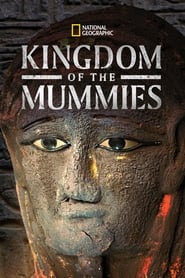
Kingdom of the Mummies
دانلود زیرنویس English
هماهنگ با نسخههای زیر
برچسبها
پیشنمایش زیرنویس English
نخستین 200 خط.
In a tomb deep underground,
archaeologists carefully remove the lid
from an ancient stone sarcophagus.
Inside lie the mummified remains of an Egyptian priest,
hidden for the past 2,500 years.
Oh, my god. This is beautiful!
On closer inspection, though,
the mummy isn't what it seems.
No way.
And the investigation takes a surprise turn...
There is something quite mind-blowing.
...forcing the team to question
all that it's found so far.
I might be wrong, but I would be very surprised
if there is no more surprises in this complex.
Inside the ancient cemetery of Saqqara,
renowned egyptologist Dr. Ramadan Hussein
and his team of archaeologists
are excavating a remarkable new site.
When I started archaeology,
I never thought I would be discovering
something on that magnitude.
Extensive 3D scans
reveal a unique ancient Egyptian funeral complex,
dating from around 600 BC,
where the dead were brought to be mummified and buried
in an assortment of chambers deep underground.
This tomb complex dates to the 26th dynasty,
and that's about 700 years after Tutankhamun
and about 600 years before Cleopatra
and the end of Egyptian history as we knew it.
This time period is interesting, because this is when Egypt
had had a huge renaissance in religion and burial ideas,
so this find is really a snapshot in time
and crucial to our understanding of mummification.
Today, Ramadan and his team are investigating
a pair of stone sarcophagi.
They lie in a small chamber,
almost 100 feet below the surface.
We have two sealed sarcophagi.
One in what we call an anthropoid sarcophagus...
It means it takes the human form...
And another one that is a rectangular sarcophagus.
What makes them so special
is that unlike the other sarcophagi in this complex,
they're both inscribed with text.
Once we discovered this writing,
we understood how valuable this is,
so we have put protective paper here.
This is our means of communication with the ancients.
The inscriptions are carved on one sarcophagus
and painted on the other,
and they provide fascinating clues
about the people buried inside.
For me, it is a moment
that I can read the minds of these two persons,
to be able to know what they wanted to convey us,
what they wanted to tell us.
The ancient Egyptians believed that remembering
the name of the deceased by writing it down
would lead to their immortality,
and the text on the caskets reveals a pair of male names,
Tjanimit and Ayput.
But the text also contains
another vital piece of information: Their jobs.
And interestingly, they both match.
So far, from the text material we have collected,
we have two priests.
This is Tjanimit.
Right behind me here is another priest, and his name is Ayput.
While this is priceless information,
it raises an important question.
Why are these two priests here?
Is it purely by chance that they share the same tomb,
or could they be in some way connected?
That is pretty much the mystery.
Why do you have two priests right next to one another?
This is a question to be answered
when we lift up this lid.
To learn more about the two priests,
Ramadan must open up the sarcophagi
and investigate their contents in forensic detail.
Led by their foreman, Ammar,
the team is starting with
the rectangular sarcophagus of Tjanimit.
The first task is to break open the thick layer
of mortar running round the edge of the lid.
Intended as a seal to deter grave robbers,
its presence can mean only one thing.
This sarcophagus is 2,600 years old,
and it hasn't been touched since Tjanimit was buried inside it.
This is a three-man job,
so we'll see how successful this is going to be.
It is a very intense moment for me.
What is inside this sarcophagus?
Seems to be working.
Now the casket is partway open,
Ramadan uses an inspection camera
to take a preliminary peek.
This is unbelievable.
What it reveals is like nothing else
from the complex.
Ah. Glittering stuff.
A 2,600-year-old mummy,
adorned from head to toe
in an elaborate beaded burial shroud,
and amazingly, still in one piece.
This beautiful beaded net, it is so elegant.
This is so beautiful.
Not as pristine as you would see it in museums,
but this is a mummy
that carries the dust and aging of 2,600 years.
This is a remarkably decorated mummy.
This definitely stands out
as one of the most remarkable sarcophagus
that I have ever opened.
I have a job to bring Tjanimit back to life.
We want his story to be told,
and I think I'm going to tell the story of Tjanimit
from now until I die.
I have so much to do.
Beneath the ancient pyramids of Saqqara,
the task of opening Tjanimit's stone sarcophagus
is well under way.
After glimpsing a beaded shroud
lying on Tjanimit's mummy,
project director Ramadan is keen to learn more
about this mysterious priest.
Ammar and his team has just lifted up the lid.
It's a difficult job.
It's a lot of labor, a lot of sweat.
Before we roll it out, we need to make sure
that nothing will fall on this beautiful mummy,
so we're spreading a cloth underneath the lid.
Ammar?
We're good to go.
The lid, carved from solid limestone,
weighs almost 2,000 pounds,
and the team will slide it out on steel rollers.
When you move a large piece of stone like this lid...
You don't want this stone to smash somebody's bones.
That's first.
Second is not to damage and destroy any object
inside the sarcophagus.
So those are the two main concerns.
The safety of the living, and also the safety of the dead.
Now I think we're gonna have a full look
at the mummy of Tjanimit.
Oh, my god!
It's just unbelievable.
It is as if, actually, it was made yesterday.
It's just beautiful.
Made from hundreds of glazed clay beads,
Tjanimit's perfectly preserved burial shroud
was intended to protect him in the afterlife.
Its quality and craftsmanship are a clear sign
that Tjanimit was a wealthy individual.
This is the work of an artist
that was done 2,600 years ago,
and now we're getting a first look at it, bit by bit.
The color is coming out.
It's so beautiful, also beaded right here.
The head of the mummy.
It's still wrapped,
but see his eyes and the nose and the eyebrows
and even the mouth drawn on these linen bandages.
This is one of the most beautiful mummies
I have ever seen in my life.
What is so amazing is the preservation of the beaded net
and the necklace after 2,600 years.
It's unbelievable.
It's just beautiful.
But now the question that is on my mind,
who is this person
to have deserved such an elaborate burial?
To shed light on why a priest like Tjanimit
was able to afford such luxuries,
project consultant Salima Ikram
has come to one of the most iconic sites in all of Egypt.
The historic city of Luxor on the banks of the river Nile.
Among the many nearby tombs is a vast mausoleum
belonging to a priest called Pediamenopet.
It was always in ancient Egypt good to be a priest,
because, of course, religion was of the utmost importance,
and also you enter into this hierarchy of the temples
and the religion, and so it's sort of like a brotherhood.
For most priests,
serving one of the many Egyptian gods or goddesses
was a full-time job,
but for an elite few, like Pediamenopet,
it was a career that brought wealth and status.
One of the most striking things about Pediamenopet's tomb
is the fact that it is huge.
It's the largest non-royal tomb in all of Luxor.
The workmanship is exquisite, and it's lavishly decorated,
and it would originally have been painted,
and you can still see some of the vestiges of paint,
which means that he must have been one of the richest
and most influential men when he died.
Almost every wall of this enormous, 22-room tomb
Kingdom of the Mummies subtitles in other languages
More English subtitles for Kingdom of the Mummies
- Kingdom of the Mummies S01 NORDiC 1080p WEB-DL DDP5 1 H 264-GRANiTEN · 16 downloads · 2022-12-29
- kingdom of the mummies s01e03 the broken seal 720p WEBRip x264-CAFFEiNE · 17 downloads · 2020-05-29
- Kingdom of the Mummies S01E02 The Lone Coffin WEBRip x264-CAFFEiNE · 24 downloads · 2020-05-29
- Kingdom of the Mummies S01E01 Hidden Chamber WEBRip x264-CAFFEiNE · 18 downloads · 2020-05-29
نظرات
No comments yet. Be the first to leave one.