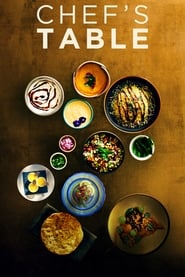
Chef's Table
دانلود زیرنویس English
Download English Subtitle Files for Mobile (6)
پیشنمایش زیرنویس English
نخستین 200 خط.
Early on in Alinea, we had this realization that...
there's other disciplines that we can draw on for inspiration.
We would go to art galleries and you would see these giant-scale pieces of art.
And I would always say, "Why can't we plate on that?"
It frustrated me that, as chefs,
we were limited to scale that was determined by plate manufacturers.
Why not a tablecloth... that we can eat off of?
Why do you have to eat with a fork or a spoon?
And why does it have to be served on a plate or in a bowl?
Why can't we come up with something new?
Every element of the restaurant we try to break down and go,
"Is this the best way it could exist, or is there a better version?"
Rules?
There are no rules. Do whatever you want.
So when I was in culinary school,
Grant was named one of Food & Wine's Best New Chefs,
and my chef instructor was like, "This is bullshit."
He was so incensed by the description of one of Grant's dishes
where you pour boiling water into rosemary to get the rosemary scent while you eat.
And he's like, "That's the most pretentious thing I ever heard.
If you want rosemary, you put it in the damn dish."
And you know, fast-forward however many years later, I'm at Alinea,
and you put a dish on a pillow,
and there's a scent coming out of the pillow,
and every time you cut into the dish,
and there's a little puff of the scent.
And I'm like, "This is magic. This is magic."
I really can't think of another restaurant where,
when I tell people about the experience of it,
I don't even wanna tell them how you get into the place.
Because even the experience of walking into Alinea
is disorienting and weird
and kind of uncomfortable, but kinda magical.
You open the door and it looks like a hallway that goes on for 100 feet.
And maybe eight steps into it,
a door to the side of the hallway just opens.
You're like, "Wait, where was the rest of the hallway?"
And you look, and it's an optical illusion.
But in retrospect, it's also this thing where you realize...
they're totally gonna mess with you.
They're totally gonna screw with your brain.
And for ever-how-long you're there, you really don't know what's gonna happen.
The questions that Grant asks himself are so unlike
the questions that any other chef that I know have asked themself.
He's asking himself questions like, "Can I make that float?"
Or, "Can I make that invisible?"
Or, "Can I hide this food in front of the guests?"
For Grant, creativity means doing something that's impossible,
and has never been done and is new.
I think really what they did when they built Alinea
was start from the very bottom and think about...
"What is every element of a restaurant guest experience?
And how can we change it?"
What they've done is
make something that looks and feels enough like a restaurant
for you to think that what you're doing is having dinner,
when in reality, you're having an experience
that you can decide is dinner or theater,
or performance or therapy, or, you know...
whatever the hell you walk away from feeling and thinking about it.
But I need centerpiece runners, 12 by 23.
- You ready for these corn? - Yes, Chef.
Okay, where's my runner?
Walking the centerpieces now, Chef. I'll get you corn runner, Chef.
The leading chefs in the world know that they can make delicious food.
So, we have to take it a step further.
At Alinea, we're actually trying to curate an experience.
I want the guest to have a sense of wonderment.
"What's gonna happen next?"
They shouldn't go, "I know what this is gonna be like."
They should expect the unexpected.
There's always been a bit of a misconception, I feel, that...
we are growing things in test tubes and petri dishes.
Actually, we're sourcing as responsible chefs.
And so, we're starting with a fantastic product,
and then we're twisting it along the way.
We throw out those challenges, where we go,
"We've got this beautiful thing. How can you uphold this integrity,
but make it look like something... nobody's ever seen before?"
We can cut it different ways,
we can purée it, we can foam it.
Or, we can make it look like something else.
And so the idea was...
What if something looks like a strawberry but it actually is a tomato?
And have something that looks like a tomato, but it tastes like a strawberry.
Is it a tomato? Is it a strawberry?
It's kind of a mind game.
I can give you a slice of bread and a tomato,
and you could eat it and go, "Wow, it's delicious."
And you can have the tomato/strawberry course
with pumpernickel crumb, and you can go...
- Order in, two. - ..."Wow, that's delicious, and...
that's really cool."
That's what we have to do, right?
Otherwise, I just give you a slice of bread and a tomato,
and you go, "Why am I paying $500 for this?"
Right?
So this is a bread--
French fries for you, garlic aioli,
- then two of the regulars... - Me?
- What did you get? - The hamburger.
I was four and a half
when my mother and father got their first diner.
I spent more time in a diner than I did in my actual house.
What do you want?
Uncle Norm worked at the diner as a cook.
And he was the bully uncle.
You never knew when he was trying to pull a prank
or he was being sincere.
So, we had these pickles.
He would grab a bundle of French fries
and wrap the pickle around the French fries,
and he would pop one in his mouth.
And I happened to see him.
In my head, I'm going,
"He's doing it so that I do it, so that he can laugh at me,"
is basically what I was thinking.
I go, "All right. Let me try it."
Reluctantly, I took a little bite,
and it was delicious. And I go,
"That sounds terrible. It sounds gross. Why does it... why does it taste good?"
He went through the steps of explaining why it worked.
You have starch, you have fat, you have acid, you have salt.
Everything balances. And at that moment, I fell in love with cooking.
And it wasn't about physical cooking.
For me it was about curiosity, it was about toying with things.
When I was probably 16, I would garnish a Western omelet
with an orange twist and a sprig of parsley or something.
And my dad would be like, "You're wasting your time.
Food just needs to be hot and fast."
There was never any elements of expression,
or storytelling or art...
To my father, it was nothing more than a paycheck.
I thought there has to be something more than Western omelets and hamburgers.
Well, I wonder if you were able to trick people.
- Right. - It'd be cool if there was
a silhouette of...
- an orange slice under there. - Yeah.
And it was dropped in front of somebody, and they would look through that
and say, "Oh, well, there's an orange under here."
And then you would lift it and...
it wasn't an orange. It was something else.
That would be interesting, if we can have
the food actually play off of the pattern in the piece.
Then we can basically build a pattern that
you wouldn't necessarily read as anything other than a decoration.
That could be really neat. Yeah.
It's a fun dynamic to be able to surprise people with food.
That's always the thing for us.
At every turn, there's, like, a little twist.
For this current course, it started tiny.
It was the idea of a centerpiece
that's evocative and produces conversation,
and then, ultimately, it becomes part of the meal.
Now you have something that is both beautiful and functional.
So then we take that idea and we just go,
"How many times can we do that in the course of the meal?"
We took all the tools out of the belt and we used them all.
You have what appears to be just a pile of wood on fire.
There's a sense of intrigue and mystery there
because you don't really know why the fire is there.
Then we trick you into thinking
the fire is there so that you can take the pine branches off
with the unagi and the plum and warm it up.
And then at one point, as you're eating your way through
all of these other components,
the captain will come over to the table, remove the fire...
pull apart the fire.
In the middle, you have
a piece of chicken thigh that's been wrapped in kombu...
roasting in that fire, hidden.
They go, "You're actually cooking in front of us. We didn't even know it."
And now they have basically eight courses within a half hour
that are all somehow weaved together.
The thing that's important for me is the guest has...
the a-ha moment,
where they feel that they've "discovered" something.
It's like being a kid and opening the present at Christmas.
Until you lift that lid and peer inside, you don't really know what's in there.
And then there's the reveal. And then there's the reward.
It's a magic show.
Thank you. Thank you. Good night. Thank you.
I remember, when I was at culinary school,
I was just ripping through cookbooks.
And Charlie Trotter's first book had just come out.
He was taking food to a new place.
That's ultimately what drew me there.
I was diner and culinary school educated.
So, I can cook a mean breakfast.
But I was young and green, and...
I didn't know what fine dining was.
I walked in the kitchen.
It was nothing like I'd ever experienced.
It was... cutthroat.
The cooks would sabotage you. They wanted to see you fail.
There was no teamwork.
And at the pinnacle of this, at the head of the totem pole,
stands Charlie Trotter.
He was a master manipulator.
He could get inside your head and make you move like a little puppet,
Chef's Table subtitles in other languages
More English subtitles for Chef's Table
- Chefs Table S04 · 66 downloads · 2018-04-14
- chefs table s03 · 65 downloads · 2017-08-25
- chef's table s01 · 58 downloads · 2017-08-20
- Chef's Table season 3 episode 1 · 37 downloads · 2017-05-13
نظرات
No comments yet. Be the first to leave one.