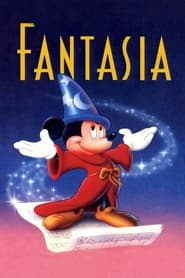
Fantasia
دانلود زیرنویس English
هماهنگ با نسخههای زیر
برچسبها
پیشنمایش زیرنویس English
نخستین 130 خط.
How do you do?
My name is Deems Taylor,
and it's my very pleasant duty to welcome you here
on behalf of Walt Disney, Leopold Stokowski
and all the other artists and musicians whose combined talents
went into the creation of this new form of entertainment, Fantasia.
What you're going to see
are the designs and pictures and stories
that music inspired in the minds and imaginations
of a group of artists.
In other words, these are not going to be
the interpretations of trained musicians.
Which I think is all to the good.
Now, there are three kinds of music on this Fantasia program.
First is the kind that tells a definite story.
Then there's the kind that, while it has no specific plot,
does paint a series of, more or less, definite pictures.
Then there's a third kind,
music that exists simply for its own sake.
Now, the number that opens our Fantasia program,
the Toccata and Fugue, is music of this third kind,
what we call absolute music.
Even the title has no meaning beyond a description of the form of the music.
What you will see on the screen is a picture of the various abstract images
that might pass through your mind
if you sat in a concert hall listening to this music.
At first you're more or less conscious of the orchestra.
So our picture opens with a series of impressions
of the conductor and the players.
Then the music begins to suggest other things to your imagination.
They might be, oh, just masses of color.
Or they may be cloud forms or great landscapes
or vague shadows or geometrical objects floating in space.
So now we present
the Toccata and Fugue in D Minor by Johann Sebastian Bach,
interpreted in pictures by Walt Disney and his associates,
and in music by the Philadelphia Orchestra
and its conductor, Leopold Stokowski.
You know, it's funny how wrong an artist can be about his own work.
Now, the one composition of Tchaikovsky's that he really detested
was his Nutcracker Suite,
which is probably the most popular thing he ever wrote.
It's a series of dances taken out of a full-length ballet
called The Nutcracker
that he once composed for the St. Petersburg opera house.
It wasn't much of a success and nobody performs it nowadays,
but I'm pretty sure you'll recognize the music of the Suite when you hear it.
Incidentally, you won't see any nutcracker on the screen.
There's nothing left of him but the title.
[* The Nutcracker Suite, Dance of the Sugarplum Fairy]
[* The Nutcracker Suite, Chinese Dance]
[* The Nutcracker Suite, Dance of the Reed Flutes]
[* The Nutcracker Suite, Arabian Dance]
[* The Nutcracker Suite, Russian Dance]
[* The Nutcracker Suite, Waltz of the Flowers]
And now we're going to hear a piece of music that tells a very definite story.
As a matter of fact, in this case, the story came first
and the composer wrote the music to go with it.
It's a very old story, one that goes back almost 2,000 years.
A legend about a sorcerer who had an apprentice.
He was a bright young lad, very anxious to learn the business.
As a matter of fact, he was a little bit too bright
because he started practicing some of the boss's best magic tricks
before learning how to control them.
One day, for instance, when he'd been told by his master
to carry water to fill a cauldron, he had the brilliant idea
of bringing a broomstick to life to carry the water for him.
Well, this worked very well, at first.
Unfortunately, however, having forgotten the magic formula
that would make the broomstick stop carrying the water,
he found he'd started something he couldn't finish.
Mr. Stokowski. Mr. Stokowski.
- My congratulations, sir. -
Congratulations to you, Mickey.
Gee, thanks.
Well, so long. I'll be seein' ya.
- Goodbye. -
When Igor Stravinsky wrote his ballet, The Rite of Spring...
I repeat,
when Igor Stravinsky wrote his ballet, The Rite of Spring,
his purpose was, in his own words, to "express primitive life. "
And so Walt Disney and his fellow artists have taken him at his word.
Instead of presenting the ballet in its original form,
as a simple series of tribal dances, they have visualized it as a pageant,
as the story of the growth of life on Earth.
And that story, as you're going to see it,
isn't the product of anybody's imagination.
It's a coldly accurate reproduction of what science thinks went on
during the first few billion years of this planet's existence.
Science, not art, wrote the scenario of this picture.
According to science, the first living things here
were single-celled organisms,
tiny little white or green blobs of nothing in particular
that lived under the water.
And then, as the ages passed, the oceans began to swarm
with all kinds of marine creatures.
Finally, after about a billion years,
certain fish, more ambitious than the rest,
crawled up on land and became the first amphibians.
And then, several hundred million years ago,
nature went off on another tack and produced the dinosaurs.
Now, the name "dinosaur" comes from two Greek words
meaning "terrible lizard. "
And they certainly were all of that.
They came in all shapes and sizes,
from little, crawling horrors about the size of a chicken
to hundred-ton nightmares.
They were not very bright.
Even the biggest of them had only the brain of a pigeon.
They lived in the air and water as well as on land.
As a rule, they were vegetarians,
rather amiable and easy to get along with.
However, there were bullies and gangsters among them.
The worst of the lot, a brute named tyrannosaurus rex,
was probably the meanest killer that ever roamed the Earth.
The dinosaurs were lords of creation for about 200 million years.
And then... Well, we don't exactly know what happened.
Some scientists think that great droughts and earthquakes
turned the whole world into a gigantic dustbowl.
In any case, the dinosaurs were wiped out.
That is where our story ends.
Where it begins is at a time infinitely far back,
when there was no life at all on Earth.
Nothing but clouds of steam,
boiling seas and exploding volcanoes.
So now, imagine yourselves out in space
billions and billions of years ago,
looking down on this lonely, tormented little planet,
spinning through an empty sea of nothingness.
And now we'll have a 15-minute intermission.
Fantasia subtitles in other languages
More English subtitles for Fantasia
- Fantasia 1940 Uncensored 1080p 10bit 35mmRip DDP x265 HEVC-Tomoya en · 95 downloads · 2026-03-26
- Fantasia 1940 WEB-DL DSNP · 303 downloads · 2021-03-11
- besthd-fantasia-1080p · 226 downloads · 2017-08-11
- Fantasia 1940 NORDiC 1080p BluRay REMUX AVC DTS-HD MA 7 1-SS · 379 downloads · 2016-12-27
- Fantasia[1940]BDrip[Eng]-FXG · 281 downloads · 2010-12-09
- Fantasia 1940 720p BluRay x264-BestHD · 330 downloads · 2010-10-25
- Fantasia 1940 DVDRip AC3 XviD-MDCTeam · 252 downloads · 2009-06-13
- Fantasia 60th Anniversary1940[DISNEY] · 245 downloads · 2009-01-29
نظرات
No comments yet. Be the first to leave one.