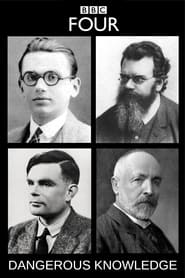
BBC: Dangerous Knowledge (Dangerous Knowledge)
دانلود زیرنویس English
پیشنمایش زیرنویس English
نخستین 200 خط.
Beneath the surface of the world...
are the rules of science.
But beneath them, there is a far deeper set of rules.
A matrix of pure mathematics,
which explains the nature of the rules of science,
and how it is we can understand them in the first place.
To see a world in a grain of sand,
And a heaven in a wild flower,
Hold infinity in the palm of your hand,
And eternity in an hour.
What is the system that...
that everything has to adhere to,
if there is no God?
You had these ideas, and... and you had to be very careful
because at any moment, they would bite you.
They sounded great but they were very dangerous.
But then of course, people get scared.
So they pull back from the edge of the precipice.
Well, this is not a matter of liking it or not...
You have here this proof and... one has to live with it.
This film, is about how a small group of the most brilliant minds,
unraveled our old cozy certainties about maths and the universe.
It is also about how once they had looked at these problems,
they could not look away...
and pursued the questions to the brink of insanity,
and then over it, to madness and suicide.
But for all their tragedies,
what they saw, is still true.
Their contempories largely rejected the significance of their work,
and we have yet to fully inhered it.
Today, we still stand only on the threshold,
of the world they saw.
My name is David Malone.
And this is my hommage, to former great thinkers,
who without most of us, even having heard of them,
have profoundly influenced the nature of our age,
and who's stories have, I think,
an important message for us today.
This is Halle.
A provincial town in Eastern Germany,
where Martin Luther once preached the reformation.
Our story starts here, at the towns university
with a mathematics professor. A man called: Georg Cantor,
who started a revolution he never really meant to start.
But which eventually threatened
to shake the whole of mathematics and science on it's foundations.
And he started this revolution by asking himself a simple question:
how big is infinity?
Cantor is wonderful because it's so crazy.
It's the equivalent of being on drugs.
It's just an incredible feat of imagination.
Georg Cantor is one of the greatest mathematicians of the world.
Others before him, going back to the Ancient Greeks at least,
had asked the question.
But it was Cantor, who made the journey no one else ever had,
and found the answer.
But he paid a price for his discovery.
This is the only bust there is of Georg Cantor.
It was made just one year before he died,
and he died utterly alone, in an insane asylum.
The question is:
what could the greatest mathematician of his century have seen,
that could drive him insane?
If all that Cantor had seen was mathematics,
then his story would be of limited interest.
But from the beginning,
Cantor realised his work had far wider significance.
He believed, it could take the human mind,
towards greater, trancendent truth and certainty.
What he never suspected, was that eventually his maths
would make that certainty ever more elusive.
Perhaps even destroy the possibility of ever reaching it.
If you want to understand Georg Cantor you have to understand
he was a religious man.
Though not in a conventional sense.
He almost certainly came to this church,
but that's not his God.
He wasn't interested in a God
who's mysteries were redemption and resurrection.
Ever since he was just a boy, he had heard what he called:
a secret voice, calling him to mathematics.
That voice which he heard all his life,
in his mind, was God.
So for Cantor,
his mathematics of infinity had to be correct,
because God, the 'True Infinite', had revealed it to him.
These things which are now hidden from you,
will be brought into the light.
If you look at Cantor's last major publication,
about Set Theory, in 1895.
It starts with three aphorisms,
and it's third motto is from the bible,
and it's from Corinthians.
And it's, you know: that which has been hidden
to you, will eventually be brought into the light.
And Cantor I think, really believed he was the messenger.
That this theory had been hidden.
He was God's means,
of bringing this Theory of the Infinite to the world.
There is no contradiction for Cantor between his religious
thinking and his mathematics.
He understood or he was thinking that,
his ideas were a gift of God.
My view was that Cantor was trying to understand God
and that this was really...
like a mathematical theology that he was doing.
Cantor's God was the 'Creator God'.
The God who set the planets spinning in their orbits.
Who's mysteries were the eternal and perfect laws of motion.
Laws who's discovery had launched the modern world,
and allowed us to see the world as curves, trajectories and forces,
and which would one day even put men on the moon.
The eternal certainties layed down by God
which Newton and Leibniz had discovered.
And it was infinity which lay at the heart of it all.
But, there was a problem with it.
If you look at that beautiful smooth curve of motion,
you notice it's not actually smooth.
It's made of an infinite number of infinitesimally small straight lines.
And each line is an instant in which nothing moves.
But like frames of film, if you run one after another, you get motion.
And it works. The whole thing relies on infinity but it works.
And because it worked, everyone said:
alright, we don't understand infinity.
Just leave it alone.
Cantor comes along and says
no, if this whole thing rests on infinity,
we have to understand it.
And now remember Cantor is a religious man.
So for him, that symbol...
isn't just a scientific mystery. It's a religious mystery as well.
Here's the maths that God uses to keep creation in motion.
And at it's heart, lies the deeper mystery of infinity.
But it was a mystery,
that had so far defied every mind that had looked at it.
The first Modern Thinker to confront the infinite was Galileo.
And he tried to do it using the circle.
This is how he did it.
He said: first of all, draw a circle.
Now put a triangle inside it, then a square and keep on going.
Keep adding sides.
Eventually he realised that what the circle is...
is a shape with infinately many, infinitesimally small sides.
Which seems great. Now you can hold the infinite
and the infinitesimal in your hands.
But as soon as he done that,
he realised it actually opened up a horrible illogical paradox.
Because he said: alright, let's draw a bigger circle outside.
And now with an infinitely sharp pencil, draw from the center...
infinitely sharp lines. One for each of the lines on the inner circle.
There's an infinate number of them,
that should be enough for the inner circle.
But now extend those lines out till they meet the outer circle.
Now, those lines are diverging...
which means when you get to the outer circle,
if you look really carefully, there will be gaps.
There won't be enough.
Galileo just said: that makes no sense.
If there's an infinite number it should be enough!
At which point he said:
we just can't understand the infinite!
Maybe God can, but with our finite minds, we can't.
So, let's use the concept if we must...
but let's not try and understand infinity.
And that's exactly how they left it...
until Georg Cantor came along.
At first it must have seemed to Cantor,
that God really was on his side.
In the space of only a few years,
he married, began a family, and published his
first ground-breaking paper about infinity.
Where previously infinity had just been a vague number without end,
Cantor saw a whole new world opening up.
Cantor did a new step and he said: I want to add one plus one.
And Cantor said:
ok, why can I not add infinity plus infinity?
That's also possible!
And this was a starting point of his theory.
Cantor found he could add and subtract infinities...
and in fact discovered there was a vast new mathematics
of the infinite.
You really finally feel for the first time,
that the infinite is no longer this amorphous concept:
well, it's infinite.
And that's all you can say about it.
But Cantor says: no!
There's a way you can make this very precise
and I can make it very definite as well.
By 1872, Cantor is a man inspired.
He's already grasped and understood, the nature of real infinity,
which no one before him had done,
but in that same year, he come's up here to the Alps...
to meet the only other man who really understood his work:
a mathematician called, Richard Dedekind.
And this time,
is probably the happiest and most inspired period of Cantor's life.
Within a year of there meeting, he announces an astonishing discovery:
that beyond infinity, there's another larger infinity,
and possibly even a whole hierarchy of different infinities.
Though it is contrary to every intuition,
BBC: Dangerous Knowledge subtitles in other languages
نظرات
No comments yet. Be the first to leave one.