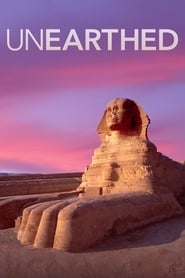
Unearthed
دانلود زیرنویس English
هماهنگ با نسخههای زیر
برچسبها
پیشنمایش زیرنویس English
نخستین 200 خط.
The great sphinx of Egypt,
more than 4,000 years old,
and perhaps the most iconic statue in the world.
Never had Egypt seen sculpture on such a scale.
This human-headed lion has puzzled archaeologists
for generations.
What was the sphinx for?
The Egyptians actually thought
that these statues did things.
They had power.
Today, pioneering technologies...
Reveal new truths.
There's no smoking gun.
There's no signature left on the sphinx,
but there are clues.
To unravel the mystery of the sphinx,
we will venture deep inside this astonishing monument.
We will explore its extraordinary temples
and investigate its abandoned waterways
to reveal the hidden secrets
at the heart of this ancient wonder.
captions paid for by discovery communications
the great sphinx of Giza sits
in the outskirts of modern-day Cairo.
It appears to guard
an ancient complex of temples and pyramids.
These towering monuments were built as tombs
for the great kings of Egypt.
We know which pharaoh each pyramid was built for,
because the Egyptians left plenty of clues behind.
The pyramids are more obvious.
They seem to be colossal, gigantic tombs
to the deceased pharaoh.
We know that from texts.
We don't have those texts for the sphinx,
so we have to go on context instead of hieroglyphics.
The identity
of the pharaoh that built the sphinx
is one of the most enduring mysteries in Egyptology.
Today, investigators use new forensic techniques...
And mapping technology
to see the sphinx as they never have before.
The head of the sphinx is bigger
than the head of the statue of Liberty.
It's carved from layers of ancient limestone
and towers 65 feet above the desert sand.
It has a massive body,
as long as a jumbo jet.
And under hundreds of protective limestone tiles...
its gigantic paws stretch out longer than a city bus.
But surprisingly,
the steep-sided hollow that the sphinx sits in
offers the best clue to who built it.
Egyptologist Mark Lehner believes the Egyptians dug down
to create the sphinx,
removing thousands of tons of stone
to shape the statue's massive body.
Today, the steep-sided pit walls that surround the sphinx
still bear the ancient scars
of this mammoth excavation.
You have to imagine what it looked like.
This entire volume of quarry was being worked.
Blocks were being taken away in the form of, you know,
massive stones, 100 tons in weight.
Mark believes finding these quarried stones
is the key to revealing who built the sphinx.
He suspects the blocks didn't go far.
These ruins that sit at the paws of the sphinx
were once lavish temples
built by the great pharaoh Khafre.
Mark is convinced the same pharaoh
created both the sphinx and the temples
at the same time.
I think they must've taken the stone from the quarry
that made the sphinx
and moved them directly to the front
for making the temple.
To prove his theory, Mark needs hard evidence.
He compares the distinct layers that run through both
the temple stones and the chest of the sphinx,
hoping to find a perfect match.
If you look at the bedrock body of the sphinx,
for example, its chest, you see the same layering,
the same soft, hard, soft, hard sequence
that we see running through
the massive stones of the sphinx temple.
These distinctive bends
that run through both structures
are natural layers,
formed long before the Egyptians came to power.
More than 50 million years ago,
Giza was a warm, tropical lagoon
teeming with life.
Dead creatures collected on the seafloor...
And transformed into distinct layers of limestone.
As earth's climate changed, the seas retreated,
leaving behind an open space
without crops of limestone.
Mark believes that more than 4,000 years ago,
the Egyptians cut away this layered rock
to form the sphinx.
Mark works with fossil expert Richard Redding
to search for geological signatures
hidden within the stone blocks.
The thickness of the different colored layers
and the types of fossils they contain
give each block a unique fingerprint.
What do you see in there, Richard,
in this yellow marly band?
Well, it's a lot of fossils.
You do have a number here.
Here. oh, right here.
That's a spiny oyster shell, right there.
And we've got bunch of nummulites,
these coin-shaped things.
There's...
After years of work,
Mark now has a unique fingerprint
for every block in this temple.
To show the temple and the sphinx were built
at the same time, by the same pharaoh,
he hopes to match the temple stones
back to the locations they were cut from
around the sphinx.
First, Mark compares the thickness of the layers
to see if he can find a perfect match
with any of the temple blocks.
Yeah, 15.75.
The layers are a good match,
but to seal the deal,
Richard looks to see if the fossils match, too.
That is another spiny oyster.
Spiny oyster, which matches perfectly our block down there.
You've got a lot of the small nummulites,
hardly any of the large nummulites.
So, yeah, this is a... This fossil community is very,
very similar to what we were looking at down
at the sphinx temple.
So it's a good match.
There is still work to do,
but these findings suggest that Mark's theory is correct.
Every stone in the temple was originally quarried
from the sides of the giant lion.
Using this mythological approach,
Mark believes he can match each
and every block in the temples
to their original position inside the sphinx enclosure.
Two blocks from the front wall of the temple
match the mid-chest of the sphinx.
The geological layers and the fossils inside them
are the same.
More blocks from the temple perfectly align
with the floor of the sphinx enclosure.
And the matches keep on coming...
Layer after layer of stone...
Completely filling the quarry.
Identifying the source of these temple blocks
provides irrefutable evidence
of which pharaoh built this monument.
So if Khafre built the sphinx temple,
it had to have been Khafre who made the sphinx,
because they were part of the same process.
Inspired by the colossal pyramids
of his predecessors,
Khafre seemed determined to go one better.
He not only built a huge pyramid,
but a giant statue that historians believed
was carved with an image of his own face.
But why did the great pharaoh Khafre decide
to place his likeness
on the body of a giant lion?
New technologies may be about to reveal...
The astonishing truth.
¶¶
The great sphinx of Giza...
This ancient sculpture is unsurpassed
in its scale and ambition.
Never before had anything like this
been seen in Egypt.
No colossal statue this size,
this scale existed.
Egyptian stone masons
cut the sphinx from limestone bedrock
more than 4,000 years ago,
most likely to honor the great pharaoh Khafre.
Historians believe the human features of the sphinx
are a direct likeness of the pharaoh himself.
But over thousands of years, the harsh desert wind
has sandblasted Khafre's carved features away,
leaving just a few tantalizing clues
as to how the sculpture originally looked.
The deep cuts in the face are chisel marks left by vandals
who chopped off the nose.
Based on other statues of the time,
this is what the nose may have looked like.
Stone fragments found between the paws are clues
that the sphinx had a beard.
Traces of paint behind the ears
could mean that it used to wear heavy makeup
and what looks like hair
More English subtitles for Unearthed
- unearthed 2016 s02e11 internal 720p HDTV x264-DHD · 10 downloads · 2017-08-09
- unearthed 2016 s02e10 internal 720p HDTV x264-DHD · 13 downloads · 2017-08-03
- unearthed 2016 s02e09 internal 720p HDTV x264-DHD · 10 downloads · 2017-07-26
- unearthed 2016 s02e06 internal 480p hdtv x264 rmteam · 20 downloads · 2017-07-22
- unearthed 2016 s02e08 internal 720p HDTV x264-DHD · 14 downloads · 2017-07-21
- unearthed 2016 s02e07 internal 480p hdtv x264 rmteam · 24 downloads · 2017-07-13
- unearthed 2016 s02e05 internal 720p HDTV x264-DHD · 24 downloads · 2017-06-21
- unearthed 2016 s02e03 internal 720p HDTV x264-DHD · 24 downloads · 2017-06-07
نظرات
No comments yet. Be the first to leave one.