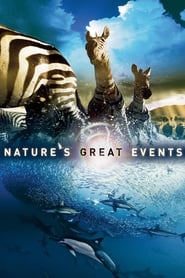
Nature's Great Events
دانلود زیرنویس English
هماهنگ با نسخههای زیر
برچسبها
پیشنمایش زیرنویس English
نخستین 176 خط.
The power of the sun drives the seasons,
transforming our planet.
Vast movements of ocean and air currents ...
bring dramatic change throughout the year.
And in a few special places, these seasonal changes ...
create some of the greatest wildlife spectacles on Earth.
The most dramatic event in the world's oceans ...
happens off the eastern shores of South Africa.
These cool waters create the perfect conditions ...
for a spectacle of epic proportions.
And everything revolves around the humble sardine.
Each year millions of them are swept up Africa's coast ...
on a desperate winter journey.
Following them comes what will become the biggest army of predators ...
anywhere on the planet.
The climax to this chase depends on many crucial elements coming together ...
for one brief moment in time.
This can well claim to be the greatest ''shoal'' on Earth.
In the deep water off the southern tip of Africa ...
lie the rich fishing grounds of the Agulhas Bank.
It's home to billions of sardines.
They live in immense shoals as defence against their many predators.
Moving together as one in a shoal ...
gives an individual sardine its best chance of survival.
Sardines are so numerous,
they're on the menu of most fish-eating predators here.
It's summer, and the sardines are lost in the vastness of the ocean.
The shoals are so dispersed they're hard to find.
Common dolphins are specialist sardine hunters.
Dolphins aren't the only ones on their trail.
Gannets also rely on a diet of sardines.
The best way for them to find the shoals is to follow the dolphins.
When the fish are far out to sea,
the dolphins need great perseverance to track them down.
The dolphins use their own form of sonar,
sending out a stream of clicks and whistles,
listening for returning echoes.
At last they've found what they're looking for.
Working as a team, the dolphins isolate a group of fish ...
and corral them into a tight ball close to the surface.
The gannets can now make their move.
Gannets can't dive deep,
so they must rely on dolphins to keep the sardines near the surface.
The feeding frenzy is short-lived.
Most of the shoal escapes to the deep and the hunters are left still hungry.
It's December, the height of the southern summer,
and the sardines have the advantage.
With the shoals dispersed, life is hard for all the predators.
But in six months' time, if conditions are right,
the scene will be set for astonishing and sustained drama.
For a few short weeks each winter,
cold ocean currents can sweep great shoals of sardines up the coast.
Trapped close to shore within this corridor of cool water,
the fish are vulnerable and their predators will follow in droves.
If it happens, this will be the Sardine Run,
one of nature's great events, unique to these shores of South Africa.
But for this epic event to take place, many elements have to come together,
and with our changing climate they're less predictable every year.
For the predators, the winter Sardine Run, if it happens,
can make the difference between life and death.
Dolphins rely on the easy hunting during the run to wean their calves.
But the omens aren't good.
Last year the sardines didn't run at all.
Gannets follow the same pattern. They have their chicks in summer,
so they, too, leave the nest in time for the Sardine Run.
This is Bird Island, just off the Eastern Cape,
the biggest gannet colony in the world.
No less than 100,000 breeding pairs ...
come here every summer to have their young.
These incredible numbers show the wealth of life ...
the annual Sardine Run can support.
They also show how many lives may be in jeopardy ...
if the sardines don't run.
Right now the African summer is taking its toll.
With temperatures soaring and no cover on these exposed islands,
the birds are in danger of overheating.
The young are especially vulnerable.
They have to be fed every day.
Even with both parents taking turns, it's an exhausting task.
In summer the sardines are a long way out to sea.
The birds fly hundreds of miles in search of a meal.
Once they've sighted their target, they plunge from heights of 30 metres...
striking the water at 60 mph.
Every dive subjects them to enormous forces.
The slightest miscalculation could be fatal.
Gannets dive no deeper than 10 metres,
so once again they rely on the dolphins to keep their prey near the surface.
But with so much traffic, there's always the danger of a collision.
This one has broken her neck.
Her death will mean that back on the colony ...
her chick will probably starve.
The rest make the long flight home with their catch.
One partner stays on the island to guard their chick.
The pair welcome each other with a ritualised greeting.
They have a strong bond and many couples mate for life.
During the hours of daylight the sardines stay deep ...
in an attempt to avoid their predators.
As the sun sets, the little fish themselves can begin to feed.
They swim upwards to sieve the water for plankton,
microscopic plants and animals.
At daybreak they sink once more into the safety of the deep.
It's not just dolphins and gannets that rely on sardines.
There are other, more mysterious predators.
The Bryde's whale hardly breaks the surface to breathe ...
and never so much as shows a tail fluke.
For a 15-metre whale, they can vanish with remarkable ease.
We know little about these stealthy leviathans,
other than that they are sardine-hunters, too.
Summer is a lean time for the Bryde's whale,
as it is for all the predators.
Sharks follow the same patterns,
tracking the shoals offshore through the summer,
waiting for the winter Sardine Run when the hunting will be easier.
But being cold-blooded,
they don't have the high energy demands of the whales, dolphins and gannets.
All the predators have to endure the lean months,
relying on the southern winter in June to bring a change in their fortunes.
Now the changing seasons create a switch in the ocean currents.
As summer gives way to autumn,
the southerly-flowing warm current weakens ...
and cold Antarctic water pushes further north, nearer to land.
The sardines are carried along by these cool waters ...
and pushed closer to shore.
If these ocean currents continue to change,
the Sardine Run should be only three months away.
It's time for the gannet chicks to leave the safety of their colony.
Parents stop feeding their young when they're three months old.
This forces the chicks to take to the sea.
The young have enough fat reserves to survive for just 10 days.
And in this brief window,
they must learn how to fly and hunt for themselves.
This is the most critical time in a gannet's life.
Failure will mean starvation.
To prepare for their maiden flight,
they test their wings and strengthen their flying muscles.
Eventually, hunger drives them onwards and upwards.
Some get up and away first time.
But many don't make it past the crashing surf.
Some bedraggled chicks struggle back to shore.
But for others, the pounding has been too much.
Fewer than half of all the chicks on this colony ...
survive their first three months of life.
The coast of South Africa is an unforgiving place.
The baby dolphins are still dependent on their mothers.
They suckle for six months before they, like the young gannets,
have to start fishing for themselves.
There is such an abundance of fish during the Sardine Run,
that even the calves can catch some and so begin to learn their hunting skills.
But the Sardine Run might not even happen this year.
For now the dolphins will have to continue to scour the vast ocean.
Back at the coast, other youngsters are getting ready to go it alone.
Cape fur seals are also waiting for the sardines to come close to shore.
But seals have a broad diet,
so they can make the most of other feeding opportunities ...
until the sardines come within range.
Young seals are forced from the colony by the dominant males.
Once they're cast out, the adolescents roam the coastline looking for food.
They won't turn their noses up at a plump young gannet.
Hungry seals patrol the surf,
ready to pick off any birds that don't get airborne straight away.
When the wind is light, the gannet chicks are stuck on the island.
Surely they're safe here?
But even on land the seal is surprisingly fast on his flippers.
In this one season, on this one colony alone,
seals kill up to 10,000 fledglings.
And, as ever, it all comes down to sardines,
for the seals are only after the fish within the stomach of their victims.
For the young birds who do make it past the seals,
there are fresh challenges.
Learning the skills of their parents.
First they have to find their quarry, the sardine shoals.
And the best way to do that is to follow the expert trackers.
They're hungry. It's been days since their parents last fed them.
As the search goes on,
the chicks are learning the most sophisticated ...
survival technique of all ―
Nature's Great Events subtitles in other languages
More English subtitles for Nature's Great Events
- Natures Great Events S01 1080p BluRay x264-aAF · 82 downloads · 2014-04-30
- BBC Natures Great Events 1of6 The Great Melt XviD AC3 MVGroup org · 55 downloads · 2011-12-29
- BBC Natures Great Events 6 The Great Feast [HDTV 720p and 1080p SRT] · 47 downloads · 2010-03-23
- BBC Natures Great Events 5 The Great Flood [HDTV 720p and 1080p SRT] · 52 downloads · 2010-03-23
- BBC Natures Great Events 3 The Great Migration [HDTV 720p and 1080p SRT] · 49 downloads · 2010-03-17
- BBC Natures Great Events 2 The Great Salmon Run [HDTV 720p and 1080p SRT] · 44 downloads · 2010-03-17
- BBC Natures Great Events 1 The Great Melt [HDTV 720p and 1080p SRT] · 45 downloads · 2010-03-17
- BBC Natures Great Events XviD AC3 MVGroup org · 39 downloads · 2009-04-30
نظرات
No comments yet. Be the first to leave one.