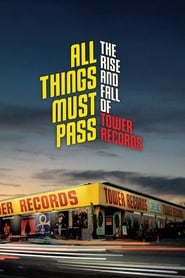
All Things Must Pass
دانلود زیرنویس English
هماهنگ با نسخههای زیر
برچسبها
پیشنمایش زیرنویس English
نخستین 197 خط.
[Slowly building orchestral music playing]
Way back when,
when young teenagers had a collection of 45RPM records,
to me that was kind of exciting.
that was almost better than having
a big collection of CDs,
albums, and everything else.
but imagine, 45 records, 45RPM records
a better quality and less breakable than the 78
of ten years before,
but with all the music you ever wanted.
and you could carry it around in a little box.
That's what Tower was about.
believe me.
it was the music that was meaningful
to young people's lives.
And we were how they got it.
The first record I ever bought was
Bob Wills, New San Antone rose.
It was like 35 cents.
The year was 1941, and my dad had a drug store
called Tower Drugs.
It was in the Tower Theatre Building.
the drugstore was tiny,
and yet they had everything in there.
He had toys, he had liquor, he had magazines,
cigarettes, perfume, cosmetics, candy,
heh, you name it.
So we had a soda fountain in that store as well,
and on the soda fountain we had the jukebox.
One day, my dad said, "why don't we sell used records?"
He asked the jukebox operator to bring in
his used records, which he brought in
and sold us the records for three cents
and we turned around and sold them for a dime.
We sold them out right away, so my dad said,
"if we can sell used records,
we ought to be able to sell new records."
Went in to San Francisco where you could buy
all the records wholesale.
200 records cost about
less than a couple a hundred bucks.
So we said, "fine, we'll spend the 200 dollars,
give us a franchise,"
and bang, we're in the record business.
During that period, my dad actually broke through
the wall of the drugstore into the empty space next door,
a little empty storefront, and he said,
"We'll put the record department back there."
so we decided to call it Tower Record Mart.
He couldn't complain too much because he was getting some free labour,
but at the same time, he didn't like the idea
that I should've been in school.
And we realized right off the bat that this was a big deal.
I went to my dad, I said, "Well, I want to expand.
I want to go in to this rack-jobbing business,
expand our jukebox, and get this and that."
All kinds of wonderful things I wanted to do.
He says, "No way, absolutely, no way.
"Don't bother me."
"You want this thing,
"you buy the record store from me,
and then you do what you want, but I'm not financing it."
I said, "All right."
He says: "Fine, it's yours tomorrow."
"And here's the deal:
"you have the inventory
and you have the bills that the company owes. Goodbye."
And overnight, I was the owner of this thing.
Everything he did influenced me.
It's, how do you say, that one imparts
a whole style of life
just by being close to you
and you pick it up.
He was a skinny guy
who liked to have a lot of fun,
loved music, loved dancing.
there was always music on in our house.
It seems like every evening
my parents were dancing and partying.
I'm sure there was some drinking.
I probably started when I was five years old.
I would go in to work with him
and sort singles.
It was quite a family affair, so my mother would be there.
I think she was doing the bookkeeping at that time.
My father had a fantasy and a dream
and a desire to open up a supermarket of records.
He then opened a record store at Watt and El Camino.
It was a tiny little store,
about a thousand square feet, maybe.
My wonderful friend who had been doing advertising
for the drugstore, Mick Mickelson,
he said, "Well, we're changing your name."
"Tower Record Mart. That's too..."
"We're going to call it Tower Records
and we're going to use Shell oil company colours."
"And I'm going to design a letter that'll stand out,
that nobody's ever seen before."
And he literally drew that letter.
You know, in Sacramento there weren't very many places for kids to hang out.
There was, like downtown, there was places,
so it was, you know,
Tower Books and Records we're in like this parking lot
surrounded by nothing.
And for kids in high school, that's what you did.
You know, you went to Tower Records.
It was the beginning of the folk era,
and so we would sit in the parking lot at Tower
on our little sports cars and play music.
So the guitar guys would come, and the banjo guys would come,
and we'd play music in front of the record store
and then you'd go into the record store and into the listening booths
and listen to as much as you could
because you couldn't afford to buy any records.
There were make out sessions in the listening booths,
people had sex in listening booths.
We put really big lights in there
so they'd be as hot as possible
so that you couldn't stay in there too long.
This store opened in 1961, I was eleven years old,
it was the only place I knew.
You'd walk down the aisle and you could just see
from the front of the store to the back of that aisle,
just these stacks of LPs.
You know, somebody came up with that terminology,
stack them high and sell them low.
Yeah, the managers and the employees were young,
they loved music, they were enjoying themselves.
They were having a lot of fun, which was a good thing,
because they weren't getting paid very much.
And that was the beginning of Tower Records.
I worked for Tower for 37 years.
I started when I was 19 years old,
and it started out at the Watt Avenue store.
Stan was this kid that was the son
of one of the pharmacists that worked for my father.
He came to work and he said, "You got to give the kid a job."
I said, "Okay, put him to work."
I walked out in to the Watts store,
and this guy George Horton came running up to the counter
and looked at me and goes, "Who are you?" and I go,
"Oh, uh, I'm the new guy. My name's Stan, how are you?"
And he says, "Oh, great, you're here.
Charlie and I are going to lunch."
And I went, "Okay."
He says, "Good, everything's $3.88
"except for Frank Sinatra, Phase four, and Command.
"That's $4.88, see you later.
"We'll be back in an hour."
And there I was, that was my training.
Tower was like the place to work at
because it was so open.
Plus, you could play whatever you want on the record player,
so you could be an amateur DJ, too,
and it was definitely the place to work.
What happened in the very early '60s,
'63, '64, was a couple of artists
happened on the scene that just changed the world around.
When the Beach Boys' early album
"Surfin' Safari" came out,
all of a sudden, the business kind of shifted
from a singles business to a LP business.
Then, of course, throughout the '60s
as the baby boomers kind of came of age
and there started being more and more potential buyers of these records.
The great thing for the record industry was that they cost a lot more.
So instead of spending 49 cents
or whatever it was on a single back then,
people were spending $3.99 or $4.99
or $5.99 on an album.
We could literally sell a thousand copies of a record
over a weekend, or something like that,
which was incredible.
The hits began to sell in quantity,
the kids came in more and more,
they grew up with it,
they widened their taste in music.
By the late '60s, radio began to explore
something besides top 40.
You had these really free form radio stations.
They were changing the way that everybody looked at music,
and we just rode that wave.
But as the '60s went on,
you had one LP after another
that was a huge artistic statement.
Sergeant Pepper and Pet Sounds and on and on and on.
then suddenly, you started to have
more and more cash coming in to the record industry.
And that was exactly the time
that Tower Records really started to peak
in that first wave where Russ had opened his store.
Well, he would talk about it all the time,
how important it was to have a big inventory,
and how he wanted to open up a very big store.
The largest store in the world in a big city.
She was pretty. I wish I could remember her name.
All Things Must Pass subtitles in other languages
More English subtitles for All Things Must Pass
- The Rise and Fall of Tower Records 2015 1080p BluRay SadPanda · 43 downloads · 2016-11-07
- All ngs Must Pass The Rise and Fall of Tower Records 2015 720p BluRay x264-SADPANDA · 31 downloads · 2016-04-10
- All ngs Must Pass The Rise and Fall of Tower Records 2015 DOCU BRRip XviD MP3-RARBG · 26 downloads · 2016-01-25
نظرات
No comments yet. Be the first to leave one.