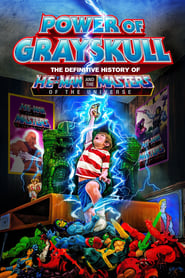
Power of Grayskull: The Definitive History of He-Man and the Masters of the Universe
دانلود زیرنویس English
هماهنگ با نسخههای زیر
برچسبها
پیشنمایش زیرنویس English
نخستین 200 خط.
They always talk about that guy that went into a bar
and kicked everybody's ass.
That's what they talk about. "You should have seen this huge...
You know, he had scars," and they'd go on.
And I wanted that hero mixed with the Galahad legend.
But you have a hero who has an intellect, a He-Man.
You also have an alter ego for the hero, who is Adam.
Prince Adam raises the sword and the planet shakes,
sends all this energy up, transforms him into He-Man.
Without the sword, he cannot achieve the power.
The sword is a bridge. It's like the Force.
When He-Man says, "I have the power,"
it's saying to the kids, "You don't have to do what you're told anymore.
You can be your own person."
The idea of being transformed into your own inner true self
is very attractive.
We were in the business of making things out of plastic, man,
and all of the sudden, all the stuff that we created became live.
Well, let me take you back. Let's go in the way-back machine.
The way-back machine starts in 1975, when...
the world of male action figures changed.
The Six Million Dollar Man was introduced.
'Cause prior to that, things like G.I. Joe and Big Jim
were the sort of norm.
Historically, male action figures
only were licensed, only.
They were either a license from a cartoon or a film.
Mattel had a number of really key brands
and Barbie and Hot Wheels were two of the best.
But it was very product-oriented rather than, say, brand-oriented.
The marketing people would say,
"We need these kinds of products,"
and then we'd invent them.
They'd say, "Yes, no, yes, no."
You couldn't scratch your butt there without a research project.
Mattel would get a license
and then try it,
and then the film would open and close in March.
Then in December, they're sitting there with a bunch of inventory.
Up to that point, there really had never been
a successful movie that had become a toy.
Someone at Mattel bought the license for Clash of the Titans
and so I started talking with the movie people
and getting all the art I could and stuff, and...
I got the product out there three or four weeks before the movie.
It was selling like crazy, till the movie came out.
The myths.
The magic.
The mystery.
Who's buying these licenses?
Who's deciding to buy Clash of the Titans and Flash Gordon?
Who's doing this?
For Clash of the Titans, we'd spend $500,000 for the license,
$500,000 for the tooling and getting it all together,
a million dollars in inventory.
Then you're sitting there going,
"Now what?" 'Cause it opened and closed in March.
We get a call from Lucas, they've got this thing they wanted to show us.
So the president says, "When could you have product?"
"We could get it tooled up and everything. We could probably get product by March."
The kids are gonna want this for Christmas, right?
What's the point?
He says, "Pass."
Bernie Loomis, who was at Kenner, says, "Screw that,"
and he ended up doing the figures
with a piece of paper inside that says, "We owe you a figure."
I mean, talk about balls.
Five-year-olds, what did you get for Christmas? "A coupon."
Now Ray is really upset
'cause he's seen what happened and we missed the opportunity.
So we say, "What can we do?
We can do, uh, cowboys and Indians.
Let's do Westerns, is that popular?"
Star Wars had already come out, so that was space.
Military was tried and true.
I'd done a lot of reading in sci-fi so I was a Frank Frazetta fan.
The third one out was Barbarian.
Space, army, and Barbarian.
Then along comes Conan, they said, "Hey, we got a movie."
They wanted to sell us the license.
My boss, a very nice guy, Shel Platt,
he said, "Can you do some stuff, like Conan stuff?" I said, "Sure."
We took the license and we presented it to the trade.
We modeled it, we made all the samples.
We did all the packaging.
Went through the expense work.
Then Mattel, to their horror, found that Conan
was gonna be an R-rated film with nudity and violence and stuff.
And they're like, "We can't do a toy line based on that."
They came back and claimed that we
just took the license to bury it.
And we didn't. We presented it. I presented it myself.
I presented it to Toys 'R' Us, to Walmart. I presented it to every account.
We also presented He-Man at the same time.
Mark would sit in his office and just sketch.
He was really into comic books.
One of the marketing people was passing his office.
He had done this thing. It was the Torak, the original drawing.
And this guy passed by and said, "What's that?"
He said, "Just something I'm messing with."
He said, "Let me present it."
Then Roger and the other prelim guys, they came around and they wanted to show it to Ray Wagner.
Roger Sweet was a big part of this.
He said, "All these male action figures that Kenner was doing,
and Big Jim for that matter, they're all so wimpy"; he said,
"Why don't we do a massive figure?"
So he went to the product conference with this figure,
and they presented it to Ray.
And Roger Sweet comes out with three sculptures about so big.
I think he took a Big Jim and he used clay to buff it up.
I think he had a tank that was like a hat, with a gun.
And another guy, his whole head looked like a bullet.
And the third guy had a face and a bearskin cape.
And he called this one Tank Head, and he called this one Bullet Head,
and he called this one He-Man.
And we said, "He-Man."
Here's the man, here's the hero. Here's the template.
You notice his feet are not straight ahead like action figures were at that time.
He has his weapon, he's ready to whack you one.
And this is more a comic book, but done in 3-D.
That's what's important about He-Man.
That's how we took a nip out of Kenner's business,
'cause Kenner was killing us.
And how we did it was by bringing this kind of action to the figure.
If you have a good guy, you measure the good guy by the bad guy.
And this is, this is Skeletor.
I said, "He-Man's the hero, he's the good guy, so he's He Man."
So I said,
"Well, we'll have other 'mans'."
Sea-Man.
Which we had to change.
We had Man-At-Arms. Man on the front side.
And the bad guys, I had D-Man, like demon.
Became Skeletor later on.
The girl that we had, we called it Wo-Man,
and it became Teela.
All the first names I came up with were really dorky.
Like Wo-Man? Come on.
But I...
It was keeping with my man theme.
And also there was female members of our brand group,
and they would come in and say, "No."
And once we got comic-book writers working on it, they came up
with better names; they're the ones that came up with Mer-Man.
I'm like, "Oh, Mer-man, thank you. That's genius."
Because I couldn't stick with Sea-Man for long.
Mark was very energized about creating a new scale of product.
Most of the figures were like this. Now we have a much bulkier figure.
But that's getting a visual shelf presence
and a signature that you can stick to.
Something that was just a little more maneuverable
with moving arms and legs so they could strike power positions,
and, you know, over-the-top muscles, and nobody had done that yet.
And, of course, we were all influenced by Conan and Frank Frazetta
and, you know, that whole genre.
They never did a figure in 3-D that would be correct proportions.
They would try to do the figure so they could take pieces of it
and turn it into tooling directly and not have to resculpt it.
So Tony came up with the idea, he said, "I'll sculpt the whole thing,
one-to-one, as it should look, with no articulation.
And let's look at what that looks like and put it next to the vehicles
and when you do the castle, put it next to the castle."
In effect, he was talking about doing a really nice 3-D study.
By doing those, we could test them at Child Test when they looked good.
And that's where we saw
little kids going, "You do this because I tell you to do it!"
You know, exactly the words their mother would say.
So, they wanted the power.
So that's where the power theme came up.
They want the power to do whatever they want to do,
without being told...
by mom or dad or someone else.
So we just said, "I have the power."
When they took the figures out, these kids went bats, they went crazy.
"Oh, look, look, look!"
I didn't realize what was going on. These kids went nuts.
And then the kids start trying
to steal He-Man and Skeletor
and Teela.
Because Teela was sculpted like
she was really a babe.
Tony got carried away.
And the little boys liked that.
Then, especially in dolls, it's the...
little stuff, you know.
The little stuff actually gives a lot of play value.
So if you look at every one of the male action figure lines we did in He-Man,
they all have swords and axes and stuff like that.
We picked this up from the girls' Barbie and all that stuff
in terms of the value, so there's always a little packet in the He-Man thing.
Then I came up with
a couple vehicles, which they were good enough to let Ted help me,
and Ted is a real industrial designer.
He can work out the engineering and everything as he goes.
I was originally trained before design school as an engineer,
and in technical illustration.
I'd do a sketch like this, I'd discuss it with Mark,
and you see, he'd say, "You know, like we need a cannon,"
so I'd add the cannon here.
And then it would evolve...
Power of Grayskull: The Definitive History of He-Man and the Masters of the Universe subtitles in other languages
More English subtitles for Power of Grayskull: The Definitive History of He-Man and the Masters of the Universe
- Power of Grayskull The Definitive History of He Man and the Masters of the Universe 2017 720p BluRay x264-GUACAMOLE · 51 downloads · 2023-04-19
- Power of Grayskull The Definitive History of He-Man and the Masters of the Universe 2017 WEBRip x264-ION10 · 60 downloads · 2021-07-24
نظرات
No comments yet. Be the first to leave one.