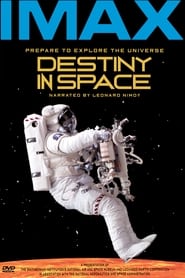
Destiny in Space
دانلود زیرنویس English
هماهنگ با نسخههای زیر
برچسبها
پیشنمایش زیرنویس English
نخستین 200 خط.
In the Milky Way galaxy, circling a star called the Sun ...
is a small planet inhabited by intelligent life.
Earthlings have always been curious creatures.
Even as we discovered our own world, we dreamed of exploring others.
Perhaps other beings inhabit planets around distant stars.
If they are sending signals ...
we could detect them with this powerful radio telescope ...
and maybe send a signal back across the cosmos.
But might we ourselves leave our home on Earth ...
to explore new worlds?
We have already taken the first small steps outside our planet.
We designed this shuttlecraft to carry people and cargo up into orbit.
Here, far above the Earth's atmosphere ...
we're learning how to live and work in space.
You've got a go to maneuver the orbiter.
It's doing nose sweep, going towards the starboard side.
The exterior shows just a little of the expected wear and tear ...
of many trips back and forth.
The shuttle is equipped with a robotic arm ...
to move large payloads ferried up from Earth.
Houston, do we have a go for maneuver?
It has lifted from the cargo bay ...
a spacecraft which carries a German telescope named ORFEUS ...
and a remotely operated IMAX camera.
Through its lens, we are seeing as never before ...
the exterior of the shuttle as it orbits the Earth.
Discovery, Houston. You have a go for release.
Copy that.
Now the ORFEUS telescope has been released into orbit.
We are riding with it, floating free in space.
Beneath us the shuttle pulls away, its cargo bay empty.
ORFEUS will spend several days ...
observing the hottest and coldest gases in our galaxy.
Then the shuttle will take it back to Earth.
Over three decades, we've learned how to travel back and forth to space ...
and live in low Earth orbit.
Now that we have taken these first steps, are we ready ...
to cross the great black void to explore the other worlds in our solar system?
The journey will be hundreds of times farther than any we have ever undertaken.
First, we need to understand how we adapt to weightlessness.
The nine hours of work scheduled for the blue shift ...
one and a half hour for green.
Connected by tunnel to the crew cabin, a laboratory known as Spacelab ...
is carried in the cargo bay on certain flights.
Inside it, scientists are performing experiments ...
developed by 13 different countries.
Two medical doctors, Norm Thagard and Roberta Bondar, a Canadian ...
are studying how our sensory systems behave ...
when introduced to microgravity.
More than half the astronauts experience space motion sickness ...
the first day or two.
We're getting one last calibration, Dave.
German payload specialist Ulf Merbold is conducting an experiment ...
to find out more about how it happens.
I've got vection.
The subject sees one thing, but he feels another.
His brain is confused by these conflicting messages ...
and he becomes disoriented.
Is the spacecraft rotating ...
or are we?
While Roberta spins, a tiny camera inside her helmet ...
is recording the movements of her eye as it reacts to the motion.
Data are collected at mid-flight, then again near its end.
When the results are compared ...
it becomes clear that the more time people spend in space ...
the more they rely on the visual sense alone for orientation.
But these results tell us only about how we adapt in the short term.
Spores three goes to centrifuge 204. Make sure it says spore 31G.
Spores ― Which one?
To find out how we're affected by longer stays ...
people must live continuously in a space station.
There, we could learn how to maintain a closed life-support system ...
for months or years at a time.
One more. Interesting.
Recycling is a must.
Future astronauts will be accomplished gardeners.
They will tend small farms in space ...
like this hydroponic garden at the Kennedy Space Center ...
that uses recycled water and oxygen to grow food.
The plants must be kept free of contamination.
Halfway to another planet, a crop failure would be a disaster.
A hundred and eighty reps left.
Keeping fit is another challenge.
With no body weight to support, our muscles get weaker.
Bones become brittle.
The longer we stay, the worse the problems become.
Hey, Bobby! Come on up here. We're going by Canada.
People traveling to other planets ...
will spend years living in a very confined space.
What kinds of emotional stress will we face?
Will we get homesick, so far from everything we know ...
isolated from family and friends and the familiar comforts of home?
There she is, John. Don't run into our home.
Our first journeys to another world were to our nearby Moon.
Tranquility Base, Houston. You are cleared for takeoff.
But those round trips took barely a week.
Today, on the Mir station ...
Russian cosmonauts live in space for many months.
From time to time, new crews arrive from Earth in the Soyuz craft.
Now, after almost a year in orbit ...
the cosmonauts will return home in Soyuz.
And even though they've spent up to six hours exercising each day ...
when re-exposed to Earth's gravity, they are temporarily unable to stand up.
Imagine arriving on an alien planet in this condition.
But what if we could produce an artificial gravity ...
as we travel to our destination?
In 1968, Stanley Kubrick's classic film ...
2001: A Space Odyssey ...
featured spaceship designs which would allow us to do this.
As the ship spins around, anyone inside ...
feels an outward, or centrifugal, force that acts like gravity.
In another design, parts of the ship spin around a stationary hub.
But the rotation of a small spacecraft ...
could make the occupants disoriented or sick.
We could avoid this ...
if we built a spacecraft large enough and with a slower spin.
But it would have to be about as long as the Golden Gate Bridge.
How could we build such a large ship in space?
To get to Mars, for instance ...
we might design a spacecraft with two modules ...
one attached to each end of a very long cable, or tether.
Once underway, the tether would be extended to separate the two modules.
The whole assembly, rotating about once per minute ...
could provide the synthetic gravity needed.
But until recently, tethers were merely an elegant idea.
The concept would have to be tested.
So far we have good satellite stability.
So an experiment was flown on the space shuttle.
An Italian satellite was deployed on a very long tether.
The crew was then to retrieve it.
Let's do it like we simmed it.
You're gonna keep the tether under control, right? Okay.
At first, the tether behaved exactly as predicted.
- You don't want to yank on the satellite. │- You've got good tension.
And the Rdot is just oscillating a little bit, but it's based at zero.
- Slack tether. - Wait a minute.
But then the reel jammed and the tether went slack.
Houston, we have slack tether. Ldot has stopped.
By firing jets on both the orbiter and the satellite ...
the crew learned that they could tighten it once again ...
showing that we can control tethers in space.
Tether's under control.
Unexpected snags are bound to arise.
But we learn from them and keep moving forward.
To build more reliable spacecraft, we need light but tough materials.
To test them, in 1984 we launched a satellite ...
with dozens of materials attached to its surface ...
exposing them to the wear and tear of space.
Columbia, Houston. We have a tally-ho on LDEF.
We left it in orbit for six years, long enough for an interplanetary trip.
Ready to go get it?
Then the shuttle retrieved it and took it back to Earth.
We found a wealth of information embedded in these panels.
Splatters.
As the microscopes reveal ...
the vacuum of space is anything but empty.
This pattern, I don't know what this is.
A continuous bombardment of micrometeorites ...
pitted the surfaces with craters.
But the most serious hazard in space is radiation.
As the shuttle hangs suspended above the Earth's horizon ...
we see only the lights of its cargo bay in the darkness.
But we can't see the harmful cosmic radiation that is everywhere here.
High-energy charged particles ...
are streaming out from the Sun and other stars.
On Earth, we are protected by the atmosphere ...
and the surrounding magnetic field.
In space, the radiation can penetrate the walls of our craft.
A Japanese x-ray satellite reveals vast clouds of radiation ...
erupting from the Sun.
On interplanetary trips ...
we'll have to retreat to heavily shielded onboard shelters ...
whenever solar storms are sighted.
Most of the planets are too hostile for people to visit.
But that doesn't stop us from exploring them.
Okay, understand. We have a go for deploy, so we're starting out.
Five, four, three ...
two, one, mark.
- Do we have motion? - I see motion.
It's stable? It's clear of the ASE.
Where humans cannot safely go ...
we send remotely controlled robot explorers.
Commanding them from Earth ...
we use their electronic eyes and sensors to explore the alien landscape.
In 1989, the Galileo spacecraft ...
began a five-year journey to Jupiter ...
the largest planet in our solar system.
Galileo just kind of dissolves out into nothingness ...
as it goes into the darkness of space.
And that's the last we saw of it.
Early images of Jupiter were sent back to Earth in 1979 ...
by two robot probes named Voyager.
This was our first opportunity to marvel at its Great Red Spot ...
three times the size of Earth.
The molecular building blocks for life ...
may be swirling within Jupiter's turbulent atmosphere.
If Galileo's probe confirms this ...
we should gain new insights into the origins of life.
Though it is our nearest planetary neighbor, Venus was always a mystery.
Thick cloud layers blocked our view of its surface.
نظرات
No comments yet. Be the first to leave one.