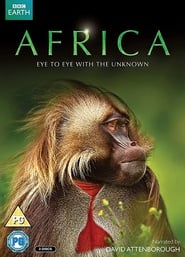
Africa: The Greatest Show On Earth
دانلود زیرنویس English
هماهنگ با نسخههای زیر
برچسبها
پیشنمایش زیرنویس English
نخستین 200 خط.
ROARING YAWN
I'm flying over the Great Rift Valley in East Africa.
And below me, is a landscape in turmoil,
torn apart by the twisting and buckling of the Earth's crust.
It's also a landscape of huge and unpredictable change,
that forces animals, day by day, season by season,
to gamble with their lives.
But for those that win,
this is one of the most fertile landscapes on Earth.
Nyiragongo, the largest lava lake in the world...
...bubbling up from nearly ten miles beneath the surface.
Nowhere takes you closer to the fiery heart of the planet.
Mount Nyiragongo is one of the most active volcanoes in Africa.
Its eruptions can be seen from space.
As magma churns below the Earth's crust,
the land to the east of here is being torn apart.
Volcanoes like this are continually changing the face of Eastern Africa.
The volcanoes here may have a violent side...
...but life flows from these infernos.
Fertile ash from countless eruptions carpets the land...
...creating the ideal conditions for grasses to flourish,
on an immense scale.
And with the grasses come animals in numbers found nowhere else on Earth.
Wildebeest.
Nothing stands in their way.
All this, just to reach fresh grass.
WILDEBEEST GRUNT
The ever-travelling herds are only one element of life here.
Look closer and there are new stories to tell.
Living on the savannah is about making the most of the hand
the landscape deals you.
But here, it's always a gamble - everything may change tomorrow.
From their vantage point, agama lizards
wait for the arrival of the herds, ready to seize their moment.
It's payday - over a million wildebeest on their doorstep.
And with the wildebeest come flying insects - billions of them.
BUZZING
Food - if only they could catch them!
Time for a rethink.
This agama lizard has spotted an opportunity.
Only one thing attracts more flies than the wildebeest...
...lions that have eaten wildebeest.
Lions are famously bad tempered...
they could swat the lizard like the flies he's hoping to ambush.
He will need to pick his target carefully.
LOW GROWL
Not her.
Or her.
Maybe?
But no.
LIONESS RUMBLES
To be within striking distance, he's got to hold his nerve.
Got one!
Now he's getting his eye in.
LIONESS RUMBLES
But this might be a bit ambitious.
It may take courage to hunt on the back of a lion...
LION RUMBLES
...but it takes sense to know when to run away!
The wildebeest won't stay for long, and when they leave,
most of the flies will follow.
Change is everywhere in East Africa.
This grassland was once covered by a forest that ran
unbroken from west coast to east coast.
Today, high above the plains,
swirling clouds hide mountains that tower three miles into the sky.
These frozen summits now form part of a mountainous barrier separating
the ancient jungles in the west from the savannahs of the east.
Up here, lies the largest glacier in Africa,
just a few miles north of the equator.
These are the legendary Mountains of the Moon.
The height of these peaks means they create their own weather.
The local name for these mountains is "Rwenzori"...
"the rain maker".
WATER DRIPPING
Meltwater flows down from the glaciers.
And on the lower slopes, all this water supports thick jungle...
PIPING AND TRILLING BIRDSONG
...remnants of the dense,
steamy forests that once dominated the whole of East Africa.
But driven by a drying climate beyond the mountains,
the forests began to wither away.
Today, only small pockets of upland jungle remain...
home to animals who once roamed the ancient forests.
The largest living primates on Earth.
GORILLA GRUNTS
Mountain gorillas.
GORILLA BABY SQUEALS
This little one's ancestors have lived in forests like these
for millions of years.
But all around, the world has changed to swamp and savannah.
This is the furthest these mighty giants
now venture into Eastern Africa.
They're marooned on their islands in the African sky.
Below the highlands,
vast wetlands cut swathes through the open savannah.
BIRDS CHIRRUP
Bangweulu Swamp is huge...
its name means, "where the water meets the sky".
Hidden amongst this maze of waterways
is a creature like no other.
A giant, prehistoric-looking bird.
A shoebill.
Standing well over a metre tall...
she roams these swamps...
...trying to catch catfish.
Not exactly what she was after.
Deeper into the swamp, lies the reason for all this fishing.
This chick is just three weeks old and a little bit wobbly on its feet.
Its vast bill means it has trouble balancing.
It won't be able to fly, or even walk properly for several weeks.
HONKING CALL
It's entirely reliant on its parents for food and water.
SQUEAKING CALL
There is also a smaller chick,
who isn't doing so well.
CHICK'S LOW HONKING CALLS
The larger chick pesters its mother for a drink.
While she goes off to fetch water,
it reveals a dark side to the relationship with its nest mate.
It's three days older than the other chick,
and has always won the race for food and attention.
This is more than just a scrap between two siblings.
As their mother returns, she sees what the larger chick has done.
The smaller chick seeks its mother's comfort.
CHICK SQUAWKS
But she has already made her choice.
Only her first-born will get a drink.
Shoebills very rarely raise more than one chick.
The younger chick was only ever an insurance,
in case the elder didn't make it.
Now it's old enough, the adults know that
they're better off putting all their efforts
into bringing up just one fit and healthy youngster.
The swamp's changing water levels mean fishing
is too unpredictable for them
to gamble on trying to raise two chicks.
Nothing here stays the same for long.
This is the time of year when Eastern Africa is beginning to dry.
HIPPOS SNORT AND ROAR
The rivers and waterholes are shrinking.
The land continues to dry out.
Tensions rise.
Hippos seek what relief they can.
This time of relentless drying
is also when another force of change ravages the land.
Without warning, fires rip through these tinder-dry plains.
The flames sweep across the savannah at 50 miles an hour...
reaching temperatures of nearly a thousand degrees,
consuming everything in their path.
Each year, an area larger than Britain goes up in smoke.
But this destruction can bring opportunity,
if you're prepared to take a risk.
Drongos, bee-eaters
and rollers bravely pluck fleeing insects from amongst the flames.
There's little better than a char-grilled grasshopper.
These fires may appear devastating, but they are, in fact,
part of a natural cycle that is essential for the regeneration
of East Africa's grasslands.
But sometimes the cycle is broken, just when a change is most needed.
Here, on the plains of Amboseli, in the shadow of Mount Kilimanjaro,
the seasonal rains have failed for the last two years.
And this year, they are already long overdue.
It's the hardest drought for half a century.
ELEPHANTS TRUMPET
ELEPHANTS TRUMPET
Amboseli is usually a haven for elephants.
These plains should be green and covered with grass.
Now there is nothing but dust.
This family is forced to travel
constantly,
searching for anything they can eat.
ELEPHANTS GRUNT
The young must keep up, sometimes there's not even time to suckle.
ELEPHANT BABY SQUAWKS
With the grass gone,
all the elephants can scratch from the dust is withered twigs.
The adults might just survive on this,
but it will not support a calf for long.
Every mother in the herd
is struggling to provide milk for her calf.
The search for food is increasingly urgent.
As the herd moves on, this female faces a terrible choice.
To carry on with her family,
or stay behind with her calf,
who's becoming too weak to even stand.
They will soon be out of sight.
But her instinct is to stay.
CALF SQUEALS
MOTHER ELEPHANT BAYS
She won't abandon her baby.
CALF SQUEAKS
MOTHER ELEPHANT BAYS
MOTHER ELEPHANT BAYS
MOTHER ELEPHANT BAYS
BABY ELEPHANT WHEEZES SOFTLY
With the calf's last breath, she knows that her battle is lost.
MOTHER ELEPHANT RUMBLES
There ARE places even more hostile than the dust-choked plains.
These alien landscapes are actually the sun-baked salt crusts
Africa: The Greatest Show On Earth subtitles in other languages
More English subtitles for Africa: The Greatest Show On Earth
- Africa 2013 BluRay 720p DTS x264-CHD · 58 downloads · 2023-09-18
- David Attenboroughs Africa S01E05 HDTV x264-C4TV · 77 downloads · 2019-09-24
- David Attenboroughs Africa S01E03 HDTV x264-FTP · 68 downloads · 2019-09-24
- David Attenboroughs Africa S01E01 HDTV x264-C4TV · 94 downloads · 2019-09-24
- Africa 2013 Part6 BRRip XviD MP3-RARBG · 73 downloads · 2017-01-26
- Africa 2013 Part5 BRRip Xvid MP3-RARBG · 72 downloads · 2017-01-26
- Africa 2013 Part1 BRRip XviD MP3-RARBG · 70 downloads · 2017-01-26
- Africa 2013 Part2 BRRip XviD MP3-RARBG · 75 downloads · 2017-01-26
نظرات
No comments yet. Be the first to leave one.