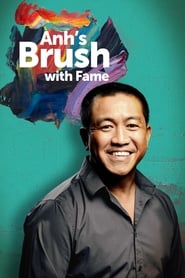
Anh's Brush with Fame
دانلود زیرنویس English
هماهنگ با نسخههای زیر
برچسبها
Download English Subtitle Files for Mobile (8)
پیشنمایش زیرنویس English
نخستین 200 خط.
I'm mostly known as a comedian.
More!
But what a lot of people don't know
is that I'm also a keen painter of portraits.
In fact, I've been a finalist in the Archibald Prize.
In this series,
I'll be combining my passion for getting to know interesting people...
You're makin' me cry!
You ask pretty probing questions, Anh.
..with my love of painting.
Wow!
Oh, my God! It's incredible!
Oh, it's mad, bro. That's amazing, mate.
Welcome to Anh's Brush With Fame.
Magda Szubanski is one of Australia's most loved and celebrated performers.
I'm Sharon Strzelecki. Hi. Nice to meet you too.
Through a raft of characters, she's been making us laugh for years
but behind the funny faces she's also had some difficult times.
I want to get to know her better
and paint a portrait of this remarkable woman.
I'm not actually nervous about having my portrait done
because I've seen the work that Anh's done
and I think, no matter what, it'll be really interesting.
I really hope that Anh can capture something in this portrait
that I've never seen about myself.
That would be really fascinating, actually,
to bring out some dimension, you know, having spent years in therapy
and written a book about myself,
I'd love it if he comes in at a different angle
and sees something altogether different again.
Really looking forward to this. Magda, I grew up watching her.
She's one of my all-time favourites, you know?
I remember coming home from school, stressed out about exams or whatever,
I'd turn on the TV and Magda would make me happy
so I really want to paint a portrait that she likes
and that she'd want to keep
when I show it to her at the end of the day.
Come and take a seat in this comfy chair, Magda.
Excellent.
So this is gonna be so much fun. I'm really looking forward to it.
Yeah! Me too!
I'm gonna keep moving really fast, make myself a blur
so... as a challenge to you.
So you just have this impression.
Yeah, it will go abstract, you know? Yeah!
I want to jump right into the deep end, Magda.
Yep.
In World War II, your father was an assassin who shot people.
Yep.
What was your dad's role?
He... my father was, um, an assassin
in a top secret counter-intelligence unit
working for the Polish Resistance.
He was on the 'good side', as we would call it, fighting the Nazis,
helping hide Jewish people.
But he... he killed people, you know, in order to do that.
Um, these people were traitors or collaborators
who were giving secrets to the Gestapo
or telling the Gestapo where Jewish people were hiding.
And he would... would shoot them at point-blank range?
Yeah.
My father's unit would be given this directive
and then they would conduct surveillance
on the person who was convicted
and then they would find the person, um, run in, read them the sentence,
the charges against them, and then shoot them.
So, you know, really full on.
Do you know how many people he might've shot?
He was... oh, he would've shot a few
because he was involved in 12 of those actions, I think it was.
So it's dark, it's bloody, it's awful, you know?
There was a story I remember hearing from quite young.
Um, he was, er... he was just outside the ghetto
and there was this Jewish boy who was climbing through the barbed wire
and he nearly got to the end of the barbed wire
and, um, a Gestapo, a German solider
picked the Jewish boy up by the scruff of the neck,
and, laughing, shot the boy through the head.
And I said to my father, "What... what did you do?"
And he said, "Well, what could I do? I stood there like a bloody idiot."
And then some time later, my father said, um,
the situation was reversed.
He saw the German soldier again and this time my father had the gun.
And I said, "What did you do?" And he said, "Shot the bastard."
And I'm kind of like going, "OK. I have sort of pacifist inclinations."
But in another sense I'm going, "Well, that's one less psychopath."
My father was very young. I can understand it, you know?
I can understand that horror of the things that he was seeing
and, um, er, invaded by another country
and, er, I mean, these were Nazis, you know?
Magda's father was being retrained as a paratrooper in Scotland
when the war ended
and that's where he met Magda's mum.
Magda was born in Liverpool
and in 1965, when Magda was five, the family moved to Australia.
What was it like for your family to move here?
Everything was different and new.
The landscape was quite shockingly different,
um, and it took a while to find the beauty of the landscape
and to get our eyes adjusted.
And sensory perceptions, the smells.
My mum said there was like a great...
In a Scottish accent she said, as we were flying in,
there was, "A great, perfumed cloud of eucalyptus over the land."
And I knew then...
She said it was, "Gorgeous. I knew then I was going to love it."
You know? And we got off the plane and it was 105 degrees in the shade.
Oh, gosh! So it was like from ice to hellfire.
And we really thought the gates of hell had opened
and we were about to be flung in.
It was terrifying.
And your family really wanted to fit in, didn't they?
My dad did. He was the king of, like, fitting in.
Although he himself didn't fit in at all!
He couldn't quite fit in because he was such an individualist.
Um, but also he just, you know, had little quirky ways about him
like European men, they wear these shorts, little-boy shorts,
little shorty-shorts, and they're frickin' disgraceful.
And he would wear those walking down Main Street in Croydon whistling.
Now, if that's what he thinks fitting in is, I don't... (LAUGHS)
Did he pull his socks up real high as well?
Eventually he got the high socks, yeah. Yeah, no, he had all of that.
Your dad also coached you at tennis.
Yeah, well, you know, one phrase.... My father was my coach.
So one phrase which is 'Eastern European father tennis coach'
and that just gives you such an image, doesn't it?
I'm not saying he was Damir Dokic.
He was not like that. But he was tricky.
He would very melodramatically, if I missed a shot,
prowl at the back going, "Aye, aye, aye! What are you doing?!"
You know, he was really vocal, sort of...
Terrible. I would get so furious with him. He was really merciless.
He would play against me and do whatever it took to beat me.
And he would kind of humiliate me, to be really honest. He was...
You know, he had a side to him, you know?
And I think it really was... So he was competitive against you?
And you were 12! Oh, shocking! Yeah!
I was nine! He was a... Nine! (LAUGHS)
And he was tough on you when you started putting on a bit of weight.
Yeah, when I started putting on weight,
he used that against me 'cause he used to run me around the court
and do drop shots and then lobs over my head.
Why would he do that? I don't know.
I think... I think he... He...
Oh, it was so sad. Years later, he apologised.
It makes me feel a bit teary even thinking about it.
He apologised. He said, "I'm so sorry for all of that."
He said, "I didn't understand, you know?"
And he was robbed of his childhood, you know?
And he thought that was the way to motivate someone,
to sort of, you know... to kind of push them.
He was trying to teach me, you know, but he knew no better
'cause his whole childhood was just destroyed by the war
so, you know, he had...
Take me back to that time when he apologised to you.
Oh, that was... Oh...
It was very emotional.
Actually it was really one of those moments when...
..people have those realisations that...
You know, he'd been a bit of a bastard and he knew it.
And who isn't, at some point?
And it was really sweet and I really appreciated very much
that he had that insight and that he told me that
and that he apologised, you know?
'Cause frequently people don't.
Um, and I understood it. I knew he had... what he'd been through. God.
He'd grown up, um, surviving a very tough war and fighting, you know?
He was someone who not just survived the war,
his family chose to actually do something, you know?
There are a lot of people who just sort of kept their heads down,
um, and, er... and set about surviving what was going on.
But he and his family thought that
particularly what was happening to Jewish people was so wrong.
I mean, Poland was the only country
where the penalty for hiding a Jew was a death sentence.
So my family and my grandparents risked not only their own lives
but the lives of my father and my aunt, to do what they did.
Um... So your family hid Jews?
Yeah, they hid Jews all through the war. Yeah. Yeah.
And, um, they had Resistance meetings at their house.
I mean, they were brave people, you know?
'Cause if they were caught, they would've been killed,
if they were lucky, but much more likely tortured.
Gosh.
And my grandmother, who was a fat, middle-aged, middle-class woman,
slept with a Polish flag under her head and a pistol in her pocket,
more likely for use on herself and her children
if they were caught. Oh, gosh.
Because that would've been better than the fate that awaited them.
So they were really brave people.
And so my father had that...
At the same time as they had compassion,
my father had to be toughened up as well.
Yes. You know?
So there was a part of him that was desensitised
and he'd seen so much, you know, and then done so much.
So, you know, to...
You can't expect someone like that
to then be this, you know, warm and cuddly...
Although in many ways he actually was - amazingly so.
More English subtitles for Anh's Brush with Fame
- Anhs Brush With Fame S06 WEBRip iview · 39 downloads · 2021-07-06
- Anhs Brush With Fame S05 WEBRip iview · 23 downloads · 2020-10-13
- Anhs Brush With Fame S04 WEBRip iview · 13 downloads · 2019-07-24
- Anhs Brush With Fame S03 WEBRip iview · 13 downloads · 2018-09-12
- Anhs Brush With Fame S02 WEBRip iview · 15 downloads · 2018-06-11
نظرات
No comments yet. Be the first to leave one.