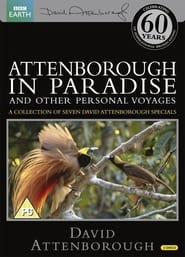
Attenborough in Paradise
دانلود زیرنویس English
هماهنگ با نسخههای زیر
برچسبها
پیشنمایش زیرنویس English
نخستین 200 خط.
When I was a boy of nine, I read a book called The Malay Archipelago,
by the great 19th century naturalist,
the co-proposer with Charles Darwin
of the theory of evolution by natural selection,
Alfred Russel Wallace. This is it.
And in it he describes his travels and explorations
through Borneo and Sumatra,
eastwards through the islands that are now Indonesia
to the western end of New Guinea.
And in it, I saw one illustration that thrilled me to the marrow.
It shows greater birds of paradise displaying in the forests of New Guinea
and being hunted by native plume hunters.
It seemed to me then as now, that to see the greater bird of paradise in display
must be one of the most thrilling sights in nature.
And it became my childhood ambition to go and do just that.
Well, it's taken me 60 years, but here I am.
I first tried to see the birds back in 1957.
But then I could only get to eastern New Guinea,
where the species Wallace saw doesn't occur.
And there was another problem - the people used the plumes as money.
These are wedding gifts - pearl shells, mats sewn with cowrie shells
but, most valuable of all birds of paradise skins,
prepared in the traditional way by cutting off the legs and the wings,
to fully reveal the plumes. There were 21 of them.
The bride seemed pleased, but for us, looking for live birds,
there was worse to come -
a celebratory dance.
Each man wore plumes of at least 40 birds of paradise,
of several different kinds.
Most astonishing were the sawtooth quills they wore through the nose.
These came from the King of Saxony's bird, that then,
very few naturalists had even seen alive.
There seemed little chance of finding living birds here,
so we decided to go into wilder country to the north.
The headman called for porters.
We got 50. Once in the mountains,
our baggage was taken over by people who didn't wear feathers in their hair.
Instead, they had huge wigs, covered with bark cloth.
We heard calls of birds of paradise, we glimpsed them high in the trees,
but we couldn't find a place where we could film them.
And then, after three weeks one morning at dawn,
our luck changed.
Low down, in a casuarina tree
a plumed bird of paradise.
And there, his unplumed female.
With these pictures, we had achieved something.
As far as I knew this was the first film ever taken
of a bird of paradise displaying in the wild.
But our film was not in colour
the species was smaller than the one that Wallace had seen
and there were not a dozen dancing birds,
there was just one.
This was hardly the fulfilment of that boyhood ambition.
But now, 40 years on, I'm trying again.
Wallace arrived in the Far East in 1854
but it was three years before he caught the first glimpse
of a living bird of paradise.
And even then it must have been a very distant one.
For, as he wrote, the birds only display in the loftiest of trees.
And they are doing so in this one, right here.
I reckon they are at least a hundred feet above the ground.
Even with modern binoculars, it isn't easy to see exactly what they are doing.
As far as I know Wallace wasn't able to climb the tree
to get a closer view of the birds,
but these days we've got ways of doing so relatively simply.
You fire a thin line, with a catapult, over one of those high branches,
haul up a thicker rope, attach a system of counterweights,
then all you have to do, is to clip yourself on, and up you go.
Down goes the counterweight.
And now, I'm leaving that dark world of the forest floor
and really entering a completely new one.
Now I'm getting up into the canopy.
Into the world of the birds of paradise.
And here's the top.
The birds are in another emergent tree, just like this one,
and I've got an absolutely clear view of them.
It's unlikely that they're going to take fright
at my sudden appearance above the canopy,
because they've been using that tree for generation after generation,
and it will take a lot more than just me to put them off it.
This, at last is Wallace's picture come to life.
He was the first European to glimpse this extraordinary spectacle,
and he knew well in general terms, what was happening.
This is a female and she's come to pick a mate
from among the gorgeous males who are displaying.
A young male. He's dancing even though he hasn't yet got his plumes.
They don't develop until he's six or seven years old.
There are several young males here, putting in a little dancing practice.
This, however is almost certainly a female,
because the males are starting the second stage of their performance -
the bow, head down.
The female has hopped onto the perch of the male of her choice -
that's a straight invitation to mate.
Act Ill - the approach.
Head up.
Act IV - the first physical contact.
It looks rough, but presumably she likes this sort of treatment.
She could easily move away if she didn't.
And that's it.
And now there's another to be attended to.
Apparently, there's a queue on this particular perch.
This is all he does as a father.
Now she'll fly away and raise her young unaided.
The males on the other perches, in spite of all their efforts,
have no success at all.
He's at it again!
But his partner is not reacting properly.
She's facing away from him.
He's got it wrong, this is a young male.
All the matings are taking place on this perch, with this male.
But are the females choosing the perch or the dancer?
It's difficult to tell.
But it's easy to see why these wonderful plumes
should be so treasured by local people,
and why, when the first examples arrived in Europe in the 16th century,
they should have created a sensation, as they did.
Those first specimens had been prepared in the traditional way,
and had neither wings nor feet, and the books of the time showed them that way.
But how could such creatures fly or perch?
This book explained. The birds had no need to do either
because they floated in the sky, feeding on dew,
and only fell to earth when they died.
They were literally birds of paradise.
Even 200 years later, the illustrations involved a lot of guesswork.
For still no European had seen the living birds.
This kind, for example, had not only feathers,
but 12 long, naked quills sprouting from its flanks.
The artist did give it legs, but he was completely baffled by the plumes.
By the end of the 19th century, thanks to the discoveries of Wallace and others
the illustrations are much more accurate.
This is that 12-quilled bird again.
But could it really have its strange quills, or wires, as they're called,
bent back over its body like this?
It seems hardly likely.
Perhaps the artist had been working from a specimen
that had been badly packed.
And what about this?
This is the sicklebill bird of paradise.
Could it, in life, have great fans of plumes projecting above its wings,
like fancy epaulettes with a purple rim?
Even today, some of these species are little-known.
Many display in the thick forest at dawn, when there is not enough light to film.
That was what had caused us such problems 40 years ago.
But now we can resolve that difficulty with special video cameras.
And one of the species I most wanted to see
is that bird with the improbable epaulettes, the black sicklebill.
Its display in the wild has never been photographed or filmed,
it hasn't even been scientifically described.
But the local people say that a male does display on a perch just near here,
but it only does so at first light, just before dawn.
So the only thing to do, is to sit down and wait.
He's there! That dim, black shape on the sapling.
This really is seeing in the dark.
He's calling to attract females, but also to keep other males away.
This is his territory and he'll dance by himself.
Those things like arms are not his wings, they're those epaulettes.
So that's what he does with them!
It's even more unlikely than the drawing.
It's getting brighter.
Soon we should be able to see him just a little more clearly.
There's that purple line on the epaulette.
But there's still no sign of a female.
Ah, well, obviously time for breakfast.
A pandanus tree. Sicklebills are particularly fond of its fruit,
and there's lots of it around.
That's what he's after - and there's a female half-hidden in the leaves.
There's a second female.
A third!
All three are almost certainly his mates,
each building her own nest and feeding in his territory.
Many birds of paradise species have females coloured like this -
brown above and speckled or barred beneath.
And looking at them, it's easy to see that they're all related,
even though their males are so very different and various.
The New Guinea forest has an atmosphere all its own.
From one point of view, it's rather disappointing -
you don't see many mammals, far fewer than in Africa or South American forests.
But what this place lacks in mammals, it makes up for in birds.
Not that it's all that easy to see them.
You know they're around because you can hear them,
but if you want to watch them, you have to move fairly quietly.
And there is one of the smallest of the whole family.
This is the one with those extraordinary sawtooth plumes -
the King of Saxony's bird.
There's nothing else remotely like these plumes in the whole of the bird world.
He's calling for a female.
And it's not just his plumes that are unique - so is his way of dancing.
That hissing noise is his call.
You can tell he's getting particularly excited
because he's erected the black feathers on his shoulders into a cape,
another of those transformation tricks
that seem to be a speciality of this family.
He's so worked up, he's trying to mate with a tuft of moss!
A female, at last.
Typical female colouring.
And that's never been filmed before.
New Guinea is a huge island.
A thousand miles long from east to west, lying between Australia and the equator.
It was rucked up from beneath the sea some 10,000,000 years ago,
as Australia drifted northwards
Attenborough in Paradise subtitles in other languages
More English subtitles for Attenborough in Paradise
- 7of7 Amber Time Machine xvid ac3 www mvgroup org ENG · 16 downloads · 2007-10-04
- 6of7 Life On Air xvid ac3 www mvgroup org ENG · 18 downloads · 2007-10-04
- 5of7 The Song Of The Earth xvid ac3 www mvgroup org ENG · 12 downloads · 2007-10-04
- 4of7 Bowerbirds The Art Of Seduction xvid ac3 www mvgroup org ENG · 12 downloads · 2007-10-04
- 3of7 Lost Gods Of Easter Island xvid ac3 www mvgroup org ENG · 16 downloads · 2007-10-04
- 2of7 A Blank On The Map xvid ac3 www mvgroup org ENG · 16 downloads · 2007-10-04
- -=COMPLETE=- xvid ac3 www mvgroup org ENG · 35 downloads · 2007-10-04
نظرات
No comments yet. Be the first to leave one.