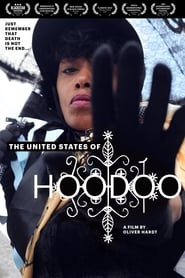
The United States of Hoodoo
دانلود زیرنویس English
هماهنگ با نسخههای زیر
برچسبها
پیشنمایش زیرنویس English
نخستین 200 خط.
When I stepped out of the cab in Brooklyn, I didn't know it
but I was about to meet Glinda The Good
you know, the witch who pranced through
enchanted poppy fields in the north of Oz,
and get a pair of ruby slippers.
Hi, Darius. Nice to meet you.
Her real name was Val Jeanty.
And she was raised on the island of Haiti,
not with a litter of prune-faced Munchkins.
Val fused the ancient skills of the ritual drummer
with the tools of the DJ in the Digital Age.
She was a sorcerous shamanic talent
with a gift for speaking to both the living and the dead.
I was impressed.
But I also realized,
this was just the first step on my long journey.
It was initiation. My ruby moment.
You have to cue me, because I can go on and on.
This space is totally energized.
I mean, I have experienced that in certain other circumstances.
But I only know energy like this,
like walking into very old churches.
I mean, it's electric, it's like very electric, very calming.
And of course, there is a whole thing about
art, spirituality, religion, magic.
If you put your hands close to a speaker
while there is some heavy bass,
you gonna feel something in your hands - that's frequency,
that's the physical
manifestation of frequency, right?
So there is some energy coming out of there that
you can't see but you feel it in your hands, sort of thing,
so frequencies coming from the Haitian culture
Haitian voodoo culture,
we're dealing with specific rhythm patterns,
specific chants.
So it's already kind of pre-coded.
And certain songs you don't sing
after three p.m. on Thursdays,
you just don't.
And everyone knows not to sing it
because there is a frequency in that song
that you don't want to manifest.
So pretty much the sound manifests in physical reality.
So the sound that I am creating in here
is also what you are feeling.
So when you walk into the church or the temple,
because the frequency is still there,
there is a reminiscence of it that is in the space,
that stays there,
you can't really get rid of it
- it becomes part of the fabric of that space.
This is the house I grew up in.
It sits on a patch of overly-taxed landfill
in Hamden, Connecticut.
I've sailed to South and Central America.
I've lived in Los Angeles, New York, and Montreal.
Finally, I settled in Berlin.
After ten amazing years in that city of ravens,
a place I felt was my natural home,
Hamden was the last place
I ever imagined I would end up in life.
I'd rather fight flesh-eating zombies
in a isolated pocket of Pennsylvania.
My name is Darius James.
If you're familiar with me at all,
its because I published two books
"Negrophobia" and
"That's Blaxploitation: Roots of the Baadasssss'Tude"
back in the nineties.
I came back to this house in January of 2007.
My time in Berlin had come to an abrupt end.
My father had died.
He was 81 years old.
All that remained of my father was his mask collection
and a cardboard box filled with ashes.
I have not touched either since my return.
My childhood home had become a mausoleum.
I live in this house with my younger sister, Jeri.
She is the sweetest person I know
and she is the only reason why I am still here.
In an early stage of my search I went to an exhibition
at the Caribbean Cultural Center in Manhattan,
titled "Standing with Papa Legba - Vodu at the crossroads".
It was an unusual look at Haitian spiritual traditions
through the lens of contemporary art.
That's where I met its young curator, Shantrelle Lewis.
Shantrelle reminds me of a young Muhammad Ali.
She has the distinct lines
and grace of a dancer and the mind of a boxer.
I wanted to know more about her.
I had a feeling she was more than professionally involved
with the themes of her exhibition.
So a few weeks later
I dropped by at her home in Brooklyn.
Hey - welcome to mi casa.
So, I practice Lukumi,
which is a derivative of Yoruba spirituality.
A part, a basic part of that is the understanding of the role
that ancestors play in your existence
and the way you move about the world
on a daily basis and you know. Ancestors walk with you...
They're not just off somewhere in this random kingdom
but they protect you every single day
and so on basic altars you may see glasses of water
and again each glass representing
a different group of ancestors...
What is what you actually acknowledge in your ancestors?
This is a daily practice.
I try to acknowledge them on a daily basis.
I generally try to refresh my altar,
the glasses of water on Sundays.
Maybe this has something to do with my Catholic upbringing,
the Christian upbringing but that's the day
where I kind of starting my week of so
I like to do that on a Sunday.
I understand that.
It's kind of interesting, too, cause there is a wall,
in my home is surrounded by masks
and things which is my family,
of the paternal side in my family...
although my father insisted that
he wasn't influenced by voodoo at all.
Everything that I've discovered
since moving back in the house seems to contradict that.
On another visit to New York
I happen to be invited to spend the afternoon
in the home of Danny Simmons.
Danny is a worldly and unpretentious man
who is much more than the sum of his parts
- painter, writer, art collector and,
with his brother Russell,
producer of HBO's "Def Poetry-Jam".
He is a system of refuge and support for a broad artistic
and intellectual community in New York and beyond.
Thinking about my father
- this is an extraordinary collection.
My father collects masks from all over
and he has got some good pieces.
But when I've tried to talk with him about it in the past
in terms of spiritual powers of Africa
- he was kind of blind to that,
he was looking at it purely...
For aesthetic reasons?
That's what he was telling me - you know what I am saying?
Which kind of let to this project.
That there are these African influences in peoples lives...
Sure.
...that they don t want to acknowledge.
And I am - obviously, based on what I know about you,
you recognize those powers and you respect them.
Well, yeah. We've been taught, and people have been taught,
especially these generations prior to ours have been taught
that anything associated with Africa was bad.
Unless it was an aesthetic thing.
You can relate to the aesthetic of a mask
or you can relate to
the aesthetic of fabric or the aesthetic
but the actual culture,
the actual people that was eshewed.
You can go to any museum and you can see African masks.
But they don't concentrate.
They call it art and it's not really art.
These are ritual items and objects
that people use for points of power
and for points of spiritual reference.
They don't talk about that and it s eshewed,
anything that's non-christian in this society is looked at
You can look at the same object as a European
and say this is a great mask.
Let me put some wax on it and shine it up
and put it next to a Picasso or something.
Once if you start talking about it
in its natural setting as a religious object,
people get upset and that s what we were taught.
You are one hundred percent right.
They're afraid because they really don't know it.
But if we look at what we have here
we will see what the truth is in that.
People have walked in here and looked at this stuff
and turned around and walked out.
People talk a lot of black stuff and say:
Oh no no, I can't be in a room with that stuff.
No its doen't work that way.
It's the absence of faith.
To begin with...
The more we look at what we have here - from Africa -
the more we look and get to understand
and let some of it be revealed to you
than you really see how fortunate you are.
And you see where your power lies
Absolutely.
The Power lies in your history...
For me I started collecting African art.
My father taught Black History.
But when I started painting years and years and years ago
and I started looking at the European Masters,
immediately I was attracted to Picasso and his cubist stuff
not knowing that that time he had been referencing African Art
or African objects to create this paintings
نظرات
No comments yet. Be the first to leave one.