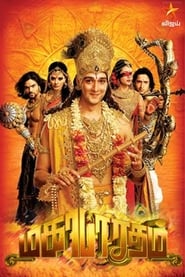
Mahabharat
دانلود زیرنویس English
هماهنگ با نسخههای زیر
برچسبها
Download English Subtitle Files for Mobile (2)
پیشنمایش زیرنویس English
نخستین 136 خط.
Is it a fist of arrogance
or a cupped palm of sacrifice that you have assumed?
Can you digest this fact?
What is this world, Arjun?
Humans, demons, animals, birds
parasites, insects, fishes, trees.
How are all these created?
What substance are they created from?
How do they function and how do they survive?
How do they die?
And what happens after death?
Ponder upon this secret.
A human body is made from dirt, Krishna.
Water flows through it as blood and other humours.
Fire gives the body heat.
And the blank voids in the body consist of space.
Therefore, earth, wind, water, fire and space...
The body is created from these five base elements.
Therefore, Grandsire Bhishma, Master Drona
are nothing more than earth, water, wind
fire and space.
Even the learned scholars are comprised of five base elements
and so are the tyrants.
So, what are you pining for, Arjun?
For dirt?
But Krishna, it is through this body made of dirt
that humans assume their identities.
All bonds are rooted in this body made of dirt.
No, Arjun!
If this were true
then why is one's body destroyed post death?
In reality
neither is one's identity from his body
nor are his relationships rooted in his body.
One's behaviour and his nature
and his deeds are his identity.
How are behaviour, nature
and deeds even created?
Comprehend that, Arjun!
A human life
is a mere harmony of visible and invisible entities, Arjun.
Yet every human's nature
and his deeds
seem to vary vastly.
The reason for it is the three 'Gunas'* of nature. *Operational principles or tendencies.
'Tamas',* 'Rajas'** and 'Sattva'***. *Negative, lethargic, dull, or slow. **Change, movement or dynamism. ***Balance, order, or purity.
What are these three properties, Krishna?
'Tamas' means darkness.
Spending one's life without presuming about good or bad
is said to be 'Tamas' oriented behaviour.
Just as birds and animals live
solely to fulfill their bodily cravings.
'Sattva' means the light of knowledge.
When a person, in every circumstance
thinks about justice, truth
and tradition before acting
then it is termed as 'Sattva' oriented way of life.
Amidst these two is such a person
who does possess knowledge
but he is also tethered to the desires of body and mind.
Such a person lives with an arrogant
which means, 'Rajas' oriented mindset.
By the very balance
of 'Tamas', 'Rajas' and 'Sattva' 'Gunas'
a man's nature is determined.
Look ahead, Arjun!
What 'Gunas' do you see in all of them?
Prince Duryodhan knows what is just
but he never acts upon them.
His life revolves around arrogance.
Therefore, he possesses less of 'Tamas'.
He possesses more of 'Rajas'
and 'Sattva' is totally absent.
And over there is Prince Dushyasan.
He has always obeyed his elder brother's orders
without any forethought.
Therefore, he possesses only 'Tamas'.
Look at Grandsire Bhishma as well, Arjun.
He possesses balanced amounts of 'Sattva' and 'Tamas'.
He harbours no arrogance.
But he is bound by outdated thoughts and old traditions.
Even when the need arises he cannot break his oath.
Look at Master Drona!
He possesses both knowledge and arrogance.
Knowledge liberates a human.
But his arrogance won't let him attain liberation.
But Krishna
if a human's nature is the union of these three 'Gunas'
is a human's actions predestined?
That a lion shall devour a gazelle
and a gazelle is bound to fear a lion.
Then why is justice vital?
Why do crimes need to be punished?
What is the purpose of that?
A brilliant question, Arjun!
But first comprehend what a human being is!
A human isn't just the union of the five base elements.
Not just five entities.
Five 'Gyanendriyas',* five 'Karmendriyas'** *Sensory organs: Akshi (The Eyes), Karna (The Ears), Nasika (The Nostrils), Jihwa (The Tongue), Twacha (The Skin). **
and three 'Gunas'...
Not even just the union of 23 such entities.
In order for a human to walk around function
he needs energy.
And energy is termed as 'Chetana'.* *Chaitanya: 'consciousness' or 'universal CHUT' or 'spirit' or 'intelligence' or 'sensation'.
So, Krishna, is a human comprised of 'Chetana'?
No, Arjuna!
Along with a human's 'Chetana' the union of those 23 entities
is creation.
Residing in this device called human made of 24 entities
is a 'man', which means a fragment of God.
That is termed the soul.
When the creation and man become one
which means, when a fragment of God
resides in one's body as a soul
that is when a human comes to life.
What is a soul, Krishna?
And what is the means of comprehending it?
Just as a human uses a chariot
similarly the soul uses this device called a body.
Through the medium of a body
it experiences the joys and sorrows of the body.
But the soul is not the body, Arjun.
The body can be destroyed.
But a soul cannot be destroyed.
"Nainam chhindanti shastrani, nainam dahati pavakah"
"na chamam kkadayanti apo, na sosayati marutah."
A soul can neither be pierced by weapons
nor can it be burnt with fire.
Nor can water render it weak, nor can the wind dry it.
Even though a soul resides in the body
it is immortal!
"Na hanyak: hanyamane sharire."
Arjun, a body can be killed
but the soul cannot be killed!
A soul is omnipresent, intangible, stable.
It is eternal.
Mahabharat subtitles in other languages
More English subtitles for Mahabharat
- Mahabharat - [Full Episode] - 28th October 2013 Ep 31 · 237 downloads · 2019-04-07
- 267 - 16th August 2014 · 176 downloads · 2014-10-05
- 266 - 15th August 2014 · 175 downloads · 2014-10-05
- 265 - 14th August 2014 · 93 downloads · 2014-10-05
- 264 - 13th August 2014 · 185 downloads · 2014-10-05
- 263 - 12th August 2014 · 83 downloads · 2014-10-05
- 262 - 11th August 2014 · 173 downloads · 2014-10-05
- 261 - 09th August 2014 · 78 downloads · 2014-10-05
نظرات
No comments yet. Be the first to leave one.