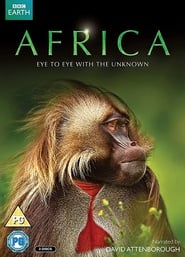
Africa: The Greatest Show On Earth
دانلود زیرنویس English
هماهنگ با نسخههای زیر
برچسبها
پیشنمایش زیرنویس English
نخستین 200 خط.
North Africa.
High in Morocco's Atlas Mountains,
Barbary macaques shiver in the icy cedars.
The ancestors of these monkeys fled here
from a disaster that overwhelmed their homeland.
Now, trapped in this isolated corner of Africa,
there's no going back to the land farther south.
Even in this snowy refuge,
there's a reminder
of what drove them here.
The unbridled power of the African sun.
Under its intense gaze,
the snow can't last for long.
Melt water should bring life to the lowlands.
Hundreds of torrents cascade southwards.
But each is flowing towards extinction.
Just 200 miles south of the mountains,
the rivers are vaporised.
Life has been burnt off the land.
This was the apocalypse from which the Barbary macaques fled.
The sudden and unstoppable advance
of the greatest desert on the planet.
The Sahara transformed North Africa.
Today, it covers an area
the size of the United States.
One-third of the entire African continent.
This is one of the hottest places on Earth.
The merciless sun,
a colossal 15-million-degree nuclear reactor,
blasted life from the surface of the land.
It still wreaks havoc.
A faint breath of wind can be the beginning of disaster.
Nomads tell of entire villages being engulfed...
...camel trains disappearing,
and people buried alive inside their tents.
A sandstorm can be 1,000 miles across.
It seems miraculous that anything can survive such devastation.
The Saharan apocalypse wiped out many creatures,
but, today, some still cling on,
in the lands around the margins of the great desert.
It's very dry here.
Some years, the rains fail entirely.
A lone Grevy's zebra.
He weighs close to half a tonne,
and could go for three days without drinking.
Like the macaques,
his forebears were refugees from the advancing Sahara.
The land is scrubby and dry.
But this stallion has claimed it as his own.
He's been waiting months for visitors.
Female visitors.
If they like his territory,
they might stay a while.
It's his first chance to mate for a very long time.
HE BRAYS
Hardly a success.
Perhaps his visitors are looking for a more impressive partner.
There's another setback.
The females were being followed,
a posse of young males,
every one, a rival.
It's time to separate the men from the boys.
HE SNORTS
HE BRAYS
HE BRAYS
One by one, the stallion sees them off.
HE BRAYS
The females had ringside seats.
And his prowess has not gone unnoted.
Machismo gives way to tenderness.
Around here, you have to take every opportunity,
be it for food, for water or for mates.
Female Grevy's are a fickle bunch.
The herd have decided to move on.
All of them.
HE NEIGHS
The stallion may never see them again.
But there's a chance that one is now carrying his foal.
In this harsh land THAT must count as a triumph.
The sun's power cannot, however, reach far underground.
Below, in stark contrast,
conditions are stable and tolerable.
And home to one of the planet's strangest mammals.
Meet the naked mole rats.
These sabre-toothed sausages wouldn't last a day in the desert.
Special filming tunnels allow us to see
how well adapted they are to the subterranean life.
They can run equally well in both directions,
so tight space is no problem.
They have lost their fur.
And, most bizarrely, they live in social colonies,
much like termites or ants.
After time spent digging,
the workers come together to relax.
But one here is very different from all the rest.
Their queen.
Twice as heavy as her subjects,
and not afraid to throw her weight around.
She is the mother of every worker in the colony,
and exists in a near-continuous state of pregnancy.
Even now, two dozen babies are pulsating within her swollen belly.
Just occasionally,
one of her brood is raised differently.
A daughter becomes a princess.
Until now, this youngster's enjoyed a lazy, privileged life.
But not for much longer.
She has a destiny to fulfil.
The surface is a place where no naked mole rat can survive for long.
But a princess will risk everything to search for a partner.
The quest is urgent.
IT SNIFFS
There's an enticing smell in the air.
A seductive scent draws her downwards, to safety.
She's sniffed out a partner.
He too is alone,
and eager to start a new colony in his lonely burrow.
Two months later,
the princess has become a queen.
And a new tyranny begins.
Tough though they are,
such refugees living on the edges of North Africa
cannot survive in the heart of the Sahara.
And yet here, in southern Nigeria,
there are creatures preparing to journey right across the centre
of that great desert.
Barn swallows.
IT SINGS
They spent the winter roosting in a forest of elephant grass.
But now, it's time for them to leave.
All two million of them.
They're tiny, each weighing the same as a couple of one pound coins,
yet the journey to their breeding grounds in Europe
is over 3,000 miles long.
Ahead of them lies a vast death trap.
The Sahara is too large to go around.
The swallows have no choice but to meet it head-on.
It will take one of nature's greatest feats of navigation
to cross this lifeless wasteland.
A wilderness that stretches not just to the horizon,
but almost beyond imagination.
It's an immense blank space on the map.
In spite of the Sahara's reputation,
less than one-fifth of it is sand.
The rest is stone
and wind-scoured rock.
The sun not only bakes the land,
it warps its appearance.
The superheated air, rising upward from the desert surface,
distorts the distant scene.
A reflection of the sky shimmers on the sands - a mirage.
The sun is an illusionist.
To thirsty travellers,
a mirage can resemble a lake
which agonisingly recedes as it's approached.
And swaying camels coming to the rescue
transform into dry, spiny acacia trees.
To cross this confused, shimmering landscape,
many swallows will need to find real water amongst the mirages.
Even in the Sahara, rain does sometimes fall
and that is sufficient for plants to survive
providing they have the right adaptations.
Rising from the sand,
a dried-out ball of twigs.
In strong winds, it can travel.
This plant may have been dead for 100 years.
Yet its name suggests that all is not lost,
for this is a resurrection plant.
Around here, rain might only fall once or twice a year.
But if you're searching for decades,
that might be enough.
Dead limbs absorb water
and unfurl in a matter of minutes.
But the resurrection plant needs one more miracle.
THUNDER
Rain must fall on its branches
before they dry out and close up again.
Within hours, shoots emerge.
In just a few weeks, they flower
and develop seeds of their own.
Then, before they can grow any larger,
the sun kills them.
But their seeds live on,
ready for when the rains return,
even if that is a century from now.
North Africa wasn't always so brutal.
Scattered across the Sahara are glimpses of life
before the apocalypse swept over the land.
In the north, a petrified forest...
trees turned to stone.
Remains from a far distant, wetter past.
White sediments in the heart of the Sahara are the dried-out remains
of what was once the world's largest lake.
In the east, ruined cities hark back to a time of plenty.
And here, deep inside Libya,
is Messak Settafet.
Carved here are hundreds of images of animals, all drawn from life.
Ghosts from a greener time.
Remarkably, a remnant of this old North Africa survives.
Bou-Hedma, in Tunisia, is sustained by mountain rains.
It's a relic of the savannah
Africa: The Greatest Show On Earth subtitles in other languages
More English subtitles for Africa: The Greatest Show On Earth
- Africa 2013 BluRay 720p DTS x264-CHD · 58 downloads · 2023-09-18
- David Attenboroughs Africa S01E03 HDTV x264-FTP · 68 downloads · 2019-09-24
- David Attenboroughs Africa S01E02 HDTV x264-FTP · 87 downloads · 2019-09-24
- David Attenboroughs Africa S01E01 HDTV x264-C4TV · 94 downloads · 2019-09-24
- Africa 2013 Part6 BRRip XviD MP3-RARBG · 73 downloads · 2017-01-26
- Africa 2013 Part5 BRRip Xvid MP3-RARBG · 72 downloads · 2017-01-26
- Africa 2013 Part1 BRRip XviD MP3-RARBG · 70 downloads · 2017-01-26
- Africa 2013 Part2 BRRip XviD MP3-RARBG · 75 downloads · 2017-01-26
نظرات
No comments yet. Be the first to leave one.