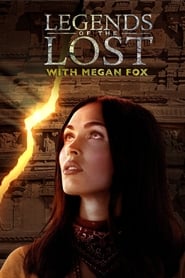
Legends of the Lost With Megan Fox
دانلود زیرنویس English
هماهنگ با نسخههای زیر
برچسبها
پیشنمایش زیرنویس English
نخستین 200 خط.
For nearly 300 years,
the Vikings were one of the most brutal
and feared armies in the history of the world.
Some say their military prowess was a gift from the gods.
Others say it came from their unrivaled skills
on the battlefield.
But new controversial evidence
points to another source altogether.
This has been unprecedented.
Was the fearsome Viking army so powerful...
It's crazy.
...because women were warriors, too?
I'm going on a journey back 1,300 years to Viking times...
It's like a really cool "Game of Thrones" set.
...through historical Norse texts...
It looks like Merlin.
...actual Viking remains...
This is the richest Viking Age grave ever found.
Wow.
...and Scandinavian magic...
...to uncover the truth...
...of Viking women warriors.
And this forces us to rewrite everything
that we thought we knew about all ancient cultures.
All across the world, our ancient ancestors
left behind towering mysteries and enchanting myths.
That looks like a magic wand.
As an actress, I've been lucky enough
to peek behind the curtain at some of these ancient sites.
I've never been in a crypt before.
And it's ignited an insatiable curiosity in me
to know more about these lost worlds...
It's amazing that under our feet,
there's so much history.
...some of which are still buried
deep in our distant past.
That is amazing.
This looks really beautiful.
And then there's also all this incredible archeology
in, like, every direction.
Just pick a spot, start digging,
and you'll find something amazing.
I've traveled to the small town of Borre, Norway,
a land of misty fjords and unspoiled beauty.
But over 1,000 years ago, this was a center of power
and influence for the Viking empire.
There's much written about Viking legend and lore,
but in actuality, we know very little about
who they were and how they lived.
Megan. So nice to meet you. Great to meet you.
So I'm at the Midgard vikingsenter
to meet Marianne Moen,
an archeologist who has dedicated her professional life
to deciphering the mysteries of the Viking people.
So, we're here at the reproduction
of what we think a chieftain's hall would have looked like.
So it's not your average house.
This is where the chieftains would have
shown off their wealth and their power.
At this site, archeologists have studied
thousands of Viking artifacts to try to reconstruct
how this mysterious people would have lived.
Like a really cool "Game of Thrones" set.
It really is, actually.
You're quite right.
Everything that you see here
is more or less reconstructed or based on
archeologically found artifacts.
What was the Viking Age like?
So, the Viking Age comes at around about 750,
and it finishes about 1050.
In the Viking heartland, it's a fairly peaceful society.
But then you get the view of the Vikings abroad,
and it's a completely different story.
Well, if you're trying to conquer a land,
I mean, it's hard to do that in a kind, gentle way. Yes!
Yeah, it really is, isn't it?
For 300 years, from 750 to 1050 A.D.,
the Vikings were arguably the most feared
and powerful army in the world.
They began as small Scandinavian tribes
that banded together to raid towns,
but by 793, their power had grown,
conquering the island of Lindisfarne
off the coast of modern-day England.
Their success on the battlefield centered around
their ambush tactics
and the use of thousands of advanced longships.
These boats could sail deep oceans,
as well as rivers as shallow as three feet,
allowing the Vikings to launch surprise amphibious attacks
on wealthy waterfront targets.
At the height of their power,
the Vikings controlled settlements
in over 50 of today's modern countries,
from Newfoundland to Europe to Russia.
In total, the Viking territory stretched more than 5,500 miles.
That's larger than the Roman Empire.
I think when most people think of the Vikings... Mm-hmm.
...myself included,
we picture a very patriarchal society.
- Yeah. - Do you agree with that?
When you talk about the Viking Age,
a lot of people have this idea that women ruled the inside
and that men basically ruled everything else.
Just a few months ago,
a Viking warrior grave in Birka, Sweden,
first discovered in 1889,
underwent state-of-the-art DNA analysis,
and the results have set the archeological world ablaze.
This is the Birka grave? Yeah.
The Birka warrior is fascinating in so many ways.
What is the most interesting thing
is that it contains things that indicates military rank
that are pretty much purely associated with
a male typical burial.
So, you have your sword, and you have your ax.
There are arrows in here. There are shields.
So, this was talked about and written about
as a male grave for well over a century.
People spoke about it being a typical example
of a very high-status warrior at this town,
until last year when the DNA study was published,
and it turns out to have been a woman all along.
For an archeologist, this has been unprecedented.
For centuries, many have believed that Viking women
were merely subservient housewives.
But is it possible that the ferocious Viking army
had women warriors in its ranks?
It is now a fact that this person is a woman.
What you do with that and where you go with the interpretation...
That's what the open question is.
It brought out such strong feelings in people
who so much wanted this to be a female warrior,
and then it brought out such strong feelings
in those who really didn't want her to be a female warrior.
These new findings have sparked a massive debate
among archeologists,
with some insisting that just because
this woman was buried with weapons,
it doesn't mean that she actually used them
on the battlefield.
What is the likelihood of these weapons were gifts
from a husband or things that she had inherited?
Personally, I don't think so
because there is nothing else here,
so that would be that her entire identify
is made up of her husband's.
- Her husband. - Yeah.
So I think a very interesting placement of that body
in sort of communication with the rest of the grave.
Well, yeah, the sword is on either side of her hands... Yeah. Yeah.
...where she would put them up if she was gonna use them.
Exactly, exactly.
Why do you think it's so controversial?
One of the main objections is that, you know,
she wouldn't have been able to use her weaponry.
We have women in the military now that carry those guns...
Oh, yes... that are about 50 to 80 pounds.
Exactly. Just because you're small
doesn't mean you can't be strong.
- Do you have a husband? - Yeah.
Have you ever been mad enough at him
that you could swing a sword?
- Every day. - Right?
I know. I'm a small person.
Brian's a lucky man we don't have those
laying around the house.
If there were female warriors,
then centuries of well-established history
that says the Vikings were an archaic culture
with rudimentary gender roles would be shattered.
And that would force us to rewrite everything
we thought we knew about the Viking culture
and possibly about all ancient cultures.
But solving this 1,300-year-old puzzle won't be easy.
It's about finding the bread crumbs
and connecting them.
So I'm heading to a small island 50 miles off the coast of Sweden
where an active archeological dig is currently unfolding.
Dan?
Hi. Megan. How are you?
Dan Carlsson is the site's lead archeologist.
His recent discovery of Viking graves on the island
could be the key
to putting these centuries-old pieces together.
How many graves do you think are here?
Mm-hmm.
Of the dozens of graves in the area,
Dan is excavating nine of them,
and he's determined that all of them hold the remains of women.
Yeah, yeah, please.
Hundreds of artifacts were discovered
in these female graves,
which provide an unprecedented look
into the lives of Viking women.
Okay.
Okay.
Okay.
Yeah.
Legends of the Lost With Megan Fox subtitles in other languages
More English subtitles for Legends of the Lost With Megan Fox
- Legends of the Lost with Megan Fox S01 WEBRip AAC2 0 x264-TBS · 16 downloads · 2020-01-23
- legends of the lost with megan fox s01e04 720p HDTV x264-W4F · 39 downloads · 2018-12-27
- legends of the lost with megan fox s01e03 720p webrip x264-tbs · 29 downloads · 2018-12-19
- legends of the lost with megan fox s01e02 720p webrip x264-tbs · 23 downloads · 2018-12-19
نظرات
No comments yet. Be the first to leave one.