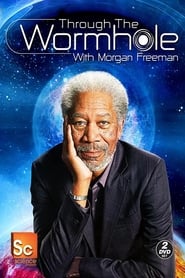
Through the Wormhole
دانلود زیرنویس English
هماهنگ با نسخههای زیر
برچسبها
Download English Subtitle Files for Mobile (10)
پیشنمایش زیرنویس English
نخستین 200 خط.
Ancient evidence suggests humans have practiced religion
since they first walked the planet.
But is God being worshiped
in the other worlds across the cosmos?
The answers might be buried here on earth...
...in animals that mourn their dead,
in robots who learn to experience spirituality,
and in an equation so powerful,
it could one day kill the idea of God.
Is earth the universe's only home for religion...
...or is God an alien concept?
Space, time, life itself.
The secrets of the cosmos lie through the wormhole.
For thousands of years,
humans have gazed up at the heavens
and contemplated the divine.
But today, we also wonder
what other forms of life might be out there.
It's possible that some of those points of light
are home to advanced civilizations.
What do the aliens think when they look up at their skies?
Perhaps they pray to a higher power like we do.
Is the concept of God truly universal?
Growing up, I was told
the Bible could help answer questions that baffled my mind,
questions like, "why am I here?"
It made me wonder if I was the only one pondering these things.
What if there are aliens somewhere in the universe?
Are they looking to God for answers, too?
Are all creatures born asking the same burning question?
Why?
Why?
Why?
Deb Kelemen is a renowned child psychologist
at Boston university's child cognition lab.
She deals with clients who demand answers.
Around 3 or 4 years of age, as any parent will tell you,
your kid starts to ask you lots of "why?" Questions.
Why do we have ears?
Why does a pig roll in mud?
It seems constant, the "why, why, why, why, why?"
Why do numbers never stop?
Some of that's just to kind of get a conversation started,
but a lot of it is because children have these really strong explanatory urges.
We've been interested in the kinds of explanations
children seem to naturally generate for themselves
and which kinds of explanations they find palatable.
Most religious texts, including the Bible,
teach that a divine mind
created everything around us for a purpose.
Deb designed a study to see if our brains
innately think of the world in that way.
Hey, Gabrielle. You ready?
All right.
All around the country,
there were these pointy kinds of rocks,
rocks with points on the top.
Why do you think the rocks were so pointy?
One person thought they were pointy
because little bits of stuff piled up on top of one another over a very long time.
Another person thought they were pointy
so animals could scratch on them when they got itchy.
Which answer makes more sense to you?
The one with the scratch.
Okay. So they could scr...
Animals. Okay.
Gabrielle prefers to believe
that pointy rocks were created for a purpose...
to scratch those hard-to-reach places on animals.
Deb poses questions like this to kids of all ages,
and most of them favor the same purpose-based answers.
There were these ponds that never had any waves.
One person thought they were still
so that animals could cool off in the them
without getting washed away.
Another person thought they were still
because no moving water ever ran into them.
Which answer? So they could be cool.
So they could be cool. Okay.
On balance what we found from about 4 years of age
and it gets stronger by about 7 or 8 years of age
is that children prefer purpose-based explanations
for all kinds of natural phenomena.
What they are seeming to show signs of is something
that we see recurrently across the religions of the world,
is this kind... this idea that there is some purpose,
that things exist for a purpose potentially
because of some intentional agent's purpose.
Once we are taught how nature works,
we learn that rocks are not concerned with itchy animals.
Rather, they go through geological cycles
and become pointy.
Our purpose-based explanations seem to go away.
But is there a part of our brain that still believes them?
To find out, Deb designed a pointy-rock test for adults.
In some cases, very highly scientifically educated adults
who have a very strong bias against purpose-based explanations
of natural phenomena,
and what we did was to ask them to look at
a series of purpose-based explanations
under conditions of speed, so they had to respond very quickly
based on their gut reactions.
Deb has found that most adults, when pressed for time,
tend to prefer purpose-based explanations.
One thing that we're really phenomenal at as human beings
is reasoning about purposes and thinking about
intentionally designed or intentionally caused things
comes very easily to us.
And so the kinds of explanations that you see in religions
tap very much into very core aspects of human intelligence.
Many adults consciously reject creationist explanations,
but at our core, we appear prone to believe
all things were created for a reason.
If there are intelligent aliens out there,
would they have the same instincts that we do?
Would they see divine forces at work wherever they look?
If they have something that's equivalent to a human evolutionary pathway
but also something similar to a human cultural context,
that they would be generating purpose-based explanations
and potentially even religious explanations.
Do aliens believe in God?
We might be more inclined to think so
if we knew that other animals on earth
shared our innate need to believe.
Joshua plotnik is a comparative psychologist
in Northern Thailand.
He has come to this remote jungle
to learn about the brains of a non-human species.
I've set up a research center here
where we're able to study elephant intelligence
using the 26 elephants that are based here.
Joshua's research group,
think elephants international, is a proving ground
for the finer points of elephant psychology.
I would say that they are certainly
one of the most intelligent species in the animal kingdom.
The more we learn about elephant cognition,
the more we learn about the evolution
of behavior and intelligence in general.
Joshua wants to find out if there are parallels
between elephant intelligence and our intelligence.
Oh, okay.
He's interested in a behavior that we humans do every day...
take a look at ourselves in a mirror.
Humans take this for granted, right?
We wake up in the morning, we brush our teeth,
we groom ourselves,
but we don't really think about the fact
that actually that ability to recognize yourself in the mirror
may be a complex cognitive capacity
that we call self-awareness.
Is self-awareness something only humans are capable of,
or do elephants also have this sophisticated ability?
Come on.
To find out, Joshua has set up an experiment
that requires one mammoth mirror.
This is Sum Ji. He's one of our males.
He's 20 years old, and this is actually his very first day
looking at himself in front of the mirror.
When an animal is first presented to the mirror,
they initially, usually, think it's another animal.
So they might reach out and touch the mirror.
They might try and get behind it, above it, underneath it.
Many creatures on earth
completely ignore their reflections.
Others forever think it's another animal
staring back at them.
But Sum Ji moves on to do something quite remarkable.
And the elephant starts to do things
that we as humans would do in front of the mirror.
They might lift up their feet.
They might look inside their mouths.
They might put their trunks inside their mouths.
Again, using the mirror to inspect themselves.
Several of the elephants Joshua test react just like Sum Ji.
They use the mirror to study themselves
and look at parts of their bodies they can't otherwise see.
It's a behavior that suggests they are self-aware.
They see themselves as separate from other elephants.
To Joshua, this is a sign
they have an ability called theory of mind.
It is a term psychologists use to explain the capacity
to see the world from someone else's point of view.
They believe it is a basic ingredient
for religious behavior,
because in order to imagine the mind of God,
you must have a theory of mind.
Could elephants have this mental tool
that underpins spirituality?
Joshua thought of a way to find out.
It's a test to see if elephants
can think about the minds of other elephants.
This green table is holding two bowls of tasty elephant snacks.
A single rope is thread through and around the table,
the idea being that it's kind of like a pulley system,
so if one end is picked up by one elephant and pulled,
the other end becomes unthreaded from the table and the table doesn't move.
The elephant has to learn to wait for his partner
before he pulls the rope.
Once his partner arrives,
Through the Wormhole subtitles in other languages
More English subtitles for Through the Wormhole
- Through the Wormhole S02E06 Are there parallel universes · 51 downloads · 2018-02-08
- through the wormhole s08e04 is gun crime a virus internal 720p HDTV x264-DHD · 67 downloads · 2017-05-17
- through the wormhole s08e03 can we hack the planet internal 720p HDTV x264-DHD · 56 downloads · 2017-05-10
- through the wormhole s08e02 can we cheat death internal 720p HDTV x264-DHD · 64 downloads · 2017-05-04
- through the wormhole s08e01 is the force with us internal 720p HDTV x264-DHD · 69 downloads · 2017-04-26
- Through the Wormhole S07E04 Can We All Become Geniuses 720p WEB-DL x264-Sleepless · 72 downloads · 2016-10-10
- Through the Wormhole S07E04 Can We All Become Geniuses 720p HDTV x264-DHD · 50 downloads · 2016-09-22
- Through the Wormhole S07E04 720p HDTV x264-DHD Can We All Become Geniuses? · 54 downloads · 2016-09-21
نظرات
No comments yet. Be the first to leave one.