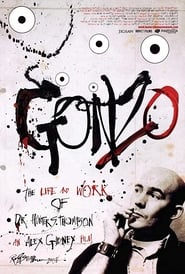
Gonzo: The Life and Work of Dr. Hunter S. Thompson
دانلود زیرنویس English
هماهنگ با نسخههای زیر
برچسبها
پیشنمایش زیرنویس English
نخستین 200 خط.
...First down, Hunter's out at the 20-yard line and a big...
He'd known for a long time
That he was no longer a really good writer.
He had spurts.
He lost that Gonzo edge.
I wonder what's happening to old Hunter.
He's kind of losing it.
Creatively, he had written all his great stuff.
He hadn't been really productive for five or six years.
I think he just had run out of juice.
In Hunter's last years--
In order to really get the juices stirred up in him--
In what we call quintessential Hunter--
It took something like--
It had to almost a feel like a kick in the groin.
"It was just after dawn in Woody Creek, Colorado,
When the first plane hit the world trade center
In New York City on tuesday morning.
And as usual I was writing about sports,
But not for long.
Football suddenly seemed irrelevant
Compared to the scenes of destruction and utter devastation
Coming out of New York on TV."
"The towers are gone now, reduced to bloody rubble,
Along with all hopes for peace in our time--
In the United States or any other country."
"Make no mistake about it We are at war now."
"It will be a religious war-- a sort of christian jihad
Fueled by religious hatred
And led by merciless fanatics on both sides--
Guerrilla warfare on a global scale
With no front lines and no identifiable enemy."
"We're gonna punish somebody for this attack,
But just who or what will be blown to smithereens is hard to say--
Maybe Afghanistan, maybe Pakistan or Iraq."
"This is going to be a very expensive war,
And victory is not guaranteed for anyone--
And certainly not for anyone as baffled as George W Bush.
He will declare a national security emergency
And clamp down hard on everybody, no matter where they live or why.
Winston Churchill once said,
'The first casualty of war is always the truth.'
The lid is on. Loose lips sink ships.
Don't say anything that might give aid to the enemy."
A giant of the written word has died.
Hunter Thompson was a lot of things--
A journalist, an author, a patriot,
A professional troublemaker,
A complex walking monument to misbehavior
Who apparently took his own life with a gun last night.
"It was always at night, like a werewolf,
That I would take the thing out
For an honest run down the coast.
I would start in golden gate park,
Thinking only to run a few long curves to clear my head."
"The momentary freedom of the park was like the one unlucky drink
That shoves a wavering alcoholic off the wagon.
But in a matter of minutes, I'd be out at the beach
With the sound of the engine in my ears,
The surf booming up on the sea wall
And a fine empty road stretching all the way down to Santa Cruz.
There was no helmet on those nights,
No speed limit and no cooling it down around the curves.
Then into second gear, forgetting the cars
And letting the beast wind out-- 35, 45.
Then into third, not worried about green or red signals
But only some other werewolf loony.
Now there is no sound except wind.
The needle leans down on 100,
And wind-burned eyeballs strain to see down the centerline
No room at all for mistakes.
That's when the strange music starts."
"The edge-- there is no honest way to explain it
Because the only people who really know where it is
Are the ones who have gone over.
The others-- the living--
Are those who pushed their control as far as they felt they could handle it,
And then pulled back, or slowed down.
But the edge... is still out there."
What is your name, please?
My name is Hunter Thompson.
My name is Hunter Thompson.
My name is Hunter Thompson. -
I met Hunter in the '60s
A short time before he wrote the book on us.
And he went on to become
Probably one of the greatest writers
That America will ever have.
Doesn't mean he isn't a jerk in my eyes,
But he's a very good writer.
Hunter reminds me so much of Mark Twain.
He was a reporter-- Twain started out as a reporter--
With a wild imagination
And he's not trying to fool you.
You know immediately that he is filtering reality
Through what Hunter called Gonzo.
Will the real Hunter Thompson please stand up?
Will the real Hunter Thompson stand up?
That was before I understood what all that was going to mean.
Oops, are we marking?
Oh, no! god! help us, Jesus!
I know it. it's in my interest--
Maybe in the interest of greatest good--
For me to smoke a joint and calm down.
He was not afraid to rock the boat,
To challenge the establishment
And express himself in unique and radical, sometimes shocking, ways.
He described me as a half-crazed Davy Crockett
Running around the parapets of Nixon's Alamo.
We were all amused by him.
He was an interesting guy to be around.
He asked you unexpected questions.
Most people were surprised that I walk on two legs.
I think people think I'm... very much--
Maybe a violent version of that comic strip.
This is the last drawing I did of him so far.
"My god! I musta missed-- it's hell down here!!"
Ralph Steadhe's pushing the boundaries as much as he could.
Life to him was the challenge.
He was gonna be dead at 30, anyway,
So now he was living on borrowed time.
"Dear Hunter, it is over a year
Since you set the scene for your strangely planned suicide.
The messages that I have received from you
Up to the Bush/Kerry election of 2004
Were infected by a dismal undertone.
'If Bush wins,' you said, 'the planet is doomed.'
When you pulled the trigger on your magnum .44,
My first reaction was to say, 'about bloody time.
He's been threatening to do that for years.'
You were never reasonable, and you knew,
In spite of your wayward spirit,
You were not invincible.
Those who grew to be a threat to your America
Continue to burgeon.
For you, it was victory or game over.
I just wanted you to hang around and nail the beauty
Of that image of absolute evil.
But you leave us with a blueprint, old sport.
Take it up with the gods.
Send word. Ralph."
I think he was important
In a literary way
And also in a political way.
And I think that his story is tragic.
He was loving.
He was generous.
On the other end of the spectrum,
The boy in the man
Was absolutely vicious.
God damn, you dumbass! reach under there
- And get some goddamned medicine! - over here?
To the right.
Hunter had two extremes in him
That he lived with constantly--
The generous, beautiful Hunter
And the scary, mean, cruel Hunter.
And he was aware of both.
I don't know if he was in control of both all the time,
But he was certainly aware of both.
And they became present in his life
When he was very young-- both sides.
You've gotta go back to Louisville, Kentucky,
To understand him. his father died when he was young.
So you had a mother raising three boys
On a librarian salary.
He lived-- it wasn't even middle class,
It was a lower- middle-class existence.
His friends were the rich kids of Louisville,
The ones that had all the privilege.
So he was on the other side of the railroad tracks.
Yet, Hunter was very smart, naturally intelligent,
And he always felt a bit like the outsider.
He was a real hellion on vandalism.
The seminal experience was when he and a group of buddies
Were partying and smoking cigarettes
And drinking beer. they were all arrested.
The rich kids who knew the judges got out.
Hunter never got to walk for graduation.
He was in jail.
"I could see the moon hung high in the sky
With a mocking grin on his face.
I seized the bars, and shrieked and wailed
Like a soul who's lost in hell."
Essentially, inside...
Hunter was an agonized human being.
But he also felt
Like he had the potential
Of being a really great writer.
"The great Gatsby" is how Hunter learned to write.
He would type "The Great Gatsby" over and over again
Just to learn the music of Fitzgerald.
"The Great Gatsby" was filled with anger
That the whole deal in American life was rigged.
Hunter identified with Fitzgerald I'd say more than any other writer.
The difference is Fitzgerald would look in on the candy store window,
Look in on the storefronts of the rich.
Hunter wanted to smash the windows.
Hunter was extremely seductive.
I was very attracted to Hunter.
Gonzo: The Life and Work of Dr. Hunter S. Thompson subtitles in other languages
More English subtitles for Gonzo: The Life and Work of Dr. Hunter S. Thompson
- Gonzo The Life and Work of Dr Hunter S Thompson LIMITED DOCU DVDSCR XviD-SAPHiRE · 75 downloads · 2009-06-28
نظرات
No comments yet. Be the first to leave one.