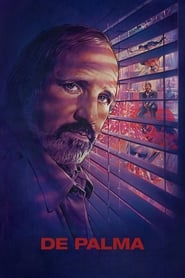
De Palma
دانلود زیرنویس English
پیشنمایش زیرنویس English
نخستین 200 خط.
I saw Vertigo in 1958.
I saw it at Radio City Music Hall. I will never forget it.
Give me your hand.
That left an incredible impression upon me.
What's so compelling about Vertigo?
It is the...
He's making a movie about what a director does,
which is basically create these romantic illusions.
It makes you fall in love with it and then kills it. Twice.
And it's what we do as directors.
We create these beautiful women, these exciting virile men.
We get audiences involved in their stories
and emotionally attached to them.
And Hitchcock made a movie which is, you know, it's so Brechtian.
It's showing what we're doing as we're doing it.
And it is something that has fascinated me, you know,
since I saw Vertigo.
I was the youngest.
I was born in North New Jersey.
When I was about five,
we moved into suburbian Philadelphia, right off the Main Line,
in a kind of fairly nice suburban house.
My father was a very successful orthopedic surgeon,
and then my mother was very close to the three of us.
She was over at school a lot.
You know, going to our football practices and soccer practices.
My father basically drove into the city, and operated very early and was teaching
and then writing his books when he got home at night.
So, we didn't see a lot of him.
And we didn't have much of a relationship with him.
I went to a Quaker school, Friends' Central.
And I went to that school for 12 years.
Well, I'd say the thing that left the most impression on me
was, you know, meeting at this Quaker school.
Sitting in silence and thinking about the moral aspects of your life,
and if you had anything you wanted to share with the community
you stood up and talked.
There was a lot of turmoil in my family.
My parents were not happy together,
and at one point I got up and talked about...
the difficulties going on within my family.
I was very chummy with the girls.
I got along with the girls very well.
I would do sort of crazy things occasionally,
like taping the girls sex education class.
Debbie Deming, as I recall her name,
she dared me to do it, and then of course I did it,
and then of course I told her and then she turned me in.
I went to Columbia to study physics, and math and Russian.
I was basically a science nerd.
I mean I wasn't really interested in movies,
not until I went to Columbia.
There was a lot of excitement because, of course, we had the war,
had to worry about getting drafted.
And we had all this French new wave stuff coming in,
all these foreign movies,
So, it was a pretty exciting time.
It was like, that's what you talked about.
That was like, the new thing.
There was no place you could take film at Columbia.
I signed up for a cinema society called Cinema 16,
run by Amos Vogel.
And they would show all these very avant-garde shorts.
That was... That's what you signed up for.
I submitted my shorts every year,
until the third year I won it with Woton's Wake.
# What you hear it is fruitless #
# You see it must be #
# So here is the saga of Wretchichevsky #
Bill Finley was a classmate of mine at Columbia.
So, I began to craft pieces
for his particular kind of characters he could portray.
And that was the genesis of Woton's Wake,
where he played everything
from the Phantom of the Opera to King Kong.
I'd seen a casting notice
for a graduate project at Sarah Lawrence
and I said, "Oh, this looks like a good idea."
So, I went up to Sarah Lawrence and I got into a graduate play.
And that's when I met Wilford Leach, who was very influential.
And he was like my mentor. He was a brilliant director.
That's what really started me going,
in the sense of learning all the things I had to learn
in order to, you know, be a director.
My first feature came out of Sarah Lawrence.
We brought Will on to sort of oversee the whole thing.
And a lot of the people in it came right out of the Sarah Lawrence workshop.
Bobby was in the Sarah Lawrence workshop.
Jill was in the Sarah Lawrence workshop.
Jennifer Salt was in the Sarah Lawrence workshop.
Well, that sounds like free love. What about purity?
The Wedding Party was De Niro's first movie.
Bobby came into a casting session
and Will and I were in the loft on Broadway.
He's, like, the last guy in the room.
And he's very quiet, shy.
And then he said he had something he'd prepared in class.
Then he went out, and Will and I were sort of looking at each other,
and, like, 20 minutes from... We thought he'd left, it was at night.
And then he burst through the door
and does a scene from Clifford Odets' play.
"Strike, I think about the cab strike."
And it was like...
You were, like, watching Lee J. Cobb rant in front of the union guys.
It was like, "holy mackerel!"
The one place where there's life, the beach.
The dock, where there's something...
a connection to the mainland.
And you walk... Start walking around the beach.
The great irony was that we co-directed The Wedding Party.
That's when I saw and knew more about motion picture directing than Wilford did.
We had the scene with Bill Finley, Bob De Niro and Charlie Pfluger,
where the two boys are trying to convince him not to get married.
We were shooting it and I could see
that we were never able to do the shot.
Plus, it was not a good shot.
Because basically we're shooting three guys against the hedge.
You know, you weren't getting any value out of the motion of the camera.
And Will kept on insisting that we do it this way.
And then Will kind of got frustrated,
and I said, "Will, let me block this act,
because this is not the way. This should work."
So, I blocked it out a whole different way.
Broke the whole thing up into a whole bunch of shots.
And... And I made the shot work.
And he was wrong.
I shot a lot of documentaries in that period in order to support myself
while I was in graduate school.
I shot a documentary about the OP Art opening at the Museum of Modern Art,
which was pretty successful.
I was a very good cameraman.
You know, and I had a really good sense
how to follow a scene and see what was happening.
Well, the advantage of doing everything yourself is that I did everything.
I figured I'd really hit the big time
when I didn't have to pack up the equipment at the end of the day
and take it back to the rental house.
You see a lot of the sort of Hitchcockian things in Murder a la Mod.
A lot of stylistic madness going on.
You have the scene of Jennifer, you know,
me trying to talk her into taking her clothes off for the camera.
Is this supposed to be sexy?
Well, yeah, you're supposed to be,
you know, doing sort of strip tease for us.
Which is very much like the same scene
that I did in The Black Dahlia
where I'm interviewing an actress.
- How long have you lived here? - Two years.
- You lost your accent? - Yeah.
So, some of that stuff I,
you know, started to play with in Murder a la Mod.
We had to release it ourselves
over on 12th Street and Second Avenue.
I was literally pulling people off the street to go see it.
When I was a graduate student at Sarah Lawrence,
Universal Pictures paid my tuition.
When I got out of Sarah Lawrence
I got into a new talents program at Universal,
and again I was writing stuff but nobody ever read anything.
And we became so frustrated Chuck Hirsch and I,
that we decided to make a movie ourselves.
# Greetings, greetings, greetings #
Greetings was the more Godardian influenced movie.
Of course, we were seeing all the Godard movies at the New York Film Festival.
They were all a revelation one after another.
I especially remember Weekend, going, "Holy mackerel."
And very much influenced by what was going on politically.
What you... What are you finding space for?
Well, you know, I'm trying to get in my pre-induction physical side.
I mean, if you wanted to stay out of the war,
and you were a middle-class kid,
you could figure out a way to do it.
I finally had to go in and I had a letter from a doctor.
I took everything to make me allergic, so I could hardly breathe.
I was up all night and I was running around, wheezing.
We kept him awake for two days. We can't keep him going like that.
They took me right to the psychiatrist.
Hey, Lloyd. You be the psychiatrist.
I had to dead stare right at his forehead
and talked about my homosexual feelings.
Just walk right up to the sergeant.
You gaze. Just walked right up to him.
Get as close as you can. Look him straight in the eye.
Seduce him with your eyeballs and say, "Hi."
I was a communist. I was a homosexual.
I was crazy.
And I think with my letter from my doctor, that got me out.
Greetings opened in December,
and was crucified in The Times.
Fortunately what happened was, the review was so bad,
a guy wrote a reply in The Sunday Times,
which was huge,
saying "Was that a way to greet Greetings?"
And then, at that same week,
Pauline Kael's review came out in The New Yorker
and suddenly the movie became a hit.
I feel very strongly about these political movies
when I get into that area.
This... This clearly shows that Officer...
was in the front and firing from the front
De Palma subtitles in other languages
More English subtitles for De Palma
- De Palma 2015 BDRip x264-VoMiT · 114 downloads · 2019-12-03
نظرات
No comments yet. Be the first to leave one.