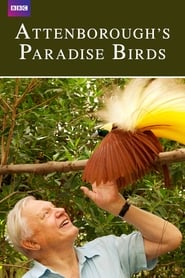
Attenborough's Paradise Birds
دانلود زیرنویس English
هماهنگ با نسخههای زیر
برچسبها
پیشنمایش زیرنویس English
نخستین 200 خط.
SQUAWKING
For 500 years, these birds have been
surrounded by myth and glamour.
And I've got to confess that I've been fascinated by them
for most of my life.
This is just one member of a hugely varied family
that, to my mind, includes the most spectacular
and beautiful birds on Earth.
The birds of paradise.
And what's more,
they throw light on some of the great mysteries of evolution.
Why have the birds of paradise become the most diverse, bizarre
and beautiful of all bird families?
Why have they developed the most extravagant plumes
and adornments of any group of living things on Earth,
so that sometimes, they almost cease to look like birds at all?
And why is it that this extraordinary family
is largely restricted
to one jungle-covered island in the Pacific?
TRILLING
Explorers and scientists
have been puzzling over these questions for 500 years.
Even today, by using the latest filming techniques,
we are making new discoveries about their behaviour.
This surely is one of the most spectacular sights
anyone could see in the natural world.
The mystery of the birds of paradise
began back in the 16th century.
In 1522, a ship returning to Europe
from exploring the mysterious islands of the Far East
brought with it, amongst other marvels,
three extraordinary skins.
They were very like this one.
You can see it's a bird - there's its beak, and its head.
And here are these long, feathery plumes.
But it has no wings...
and no feet.
The explorers had been told that
that was because these birds lived in paradise.
The ship concerned was one of five
that had set out in 1519
to sail around the world for the very first time,
under the command of the Portuguese explorer Ferdinand Magellan.
They endured catastrophic tropical storms and shipwrecks.
Magellan himself was killed in a tribal war in the Philippines.
But after three gruelling years,
the Victoria, the sole surviving ship, arrived back in Spain.
It was loaded with wonders and treasures,
including those first specimens of birds of paradise.
Magellan had been presented with these skins by a king
in the Spice Islands - the Moluccas, as we call them today -
in eastern Indonesia.
When Magellan's men asked why they had no wings or no feet,
the people had a problem,
because they themselves had never seen the birds alive.
They had been traded to the islands
from islands even farther to the east.
So they made up an answer.
They said, "Well, it's because the birds float high in the sky,
"among the clouds, feeding on dew,
"and human beings only see them when they die and fall to the earth."
So the first descriptions of these "birds of the gods"
were far from first-hand.
Yet they were accepted as fact by Europeans.
This was one of the very first paintings of a bird of paradise,
and it appears in the margin of a book of prayers
written in 1540,
to show the devout the sort of creatures
they might expect to see when they got to paradise.
But it wasn't only the pious who were interested in the discovery.
So were naturalists.
But their understanding of the birds was similarly clouded by mythology.
This is the first volume in a great encyclopaedia of natural history
published in 1599 by an Italian called Aldrovandus.
And it's full of remarkably accurate pictures and descriptions.
There's a toucan, for example.
And here is a hornbill.
But turn another couple of pages...
..and a bird of paradise, without legs,
floating in the skies. No wings.
And here it is drinking dew from the clouds.
Aldrovandus was so respected that this view of the habits
of birds of paradise persisted well into the 17th century.
It's hardly surprising that these pictures are wildly inaccurate,
bearing in mind that they were drawn from those flattened skins.
After all, no-one in Europe had ever seen wings or legs
attached to these astonishing plumes.
So it was not unreasonable for Europeans,
who still believed in dragons and mermaids,
to accept that these birds lived in paradise.
But still no-one knew where the skins actually came from.
In fact, the birds come from New Guinea.
It's 1,000 miles long and lies just north of Australia.
And there, of course, the people knew perfectly well
the truth about the birds.
They hunted them for the sake of their plumes,
which they used as currency and in many of their important ceremonials.
My first opportunity to see these wonderful birds
came when I went to New Guinea back in 1957.
We saw a wide, fertile valley ringed with mountains.
This was our destination - the valley of the Wahgi River.
Within a few minutes of landing, I saw coming towards me
through the tall grass a party of tribesmen
wearing magnificent feather headdresses.
We filmed a celebration called a Sing-sing,
during which tribal people,
wearing spectacular headdresses of birds-of-paradise plumes,
gather together to dance and chant.
And I took these photographs.
They displayed them during their dances,
showing how wealthy each of the men were
by having these enormous headdresses.
That's Princess Stephanie's black tail feathers.
These are King of Saxony's feathers from the top of the head.
These are the red plumes of Count Raggi's bird of paradise,
and these the yellow ones of the Lesser.
When they came to have marriages,
a party going to collect a bride would have to take a gift
to the bride's parents of birds-of-paradise plumes.
And they arrange them on these great banners.
There's a front view of that with nearly two dozen sets
of bird-of-paradise plumes all around the side of the banner.
And down the middle there, gold-lipped pearl shells.
For thousands of years, the plumes have been traded
from this part of New Guinea right across Indonesia,
up into South-East Asia and beyond.
In Europe 400 years ago, many aristocratic families
possessed cabinets of curiosities
in which they displayed their collections of natural wonders,
and specimens of birds of paradise were amongst the most precious.
Their splendour even caught the eye of British royalty.
The young Scottish prince who was going to become Charles I of England
had his portrait painted with his furry hat on the table beside him,
and in it, his most treasured possession -
the plumes of birds of paradise.
Naturalists, seeking to curry favour with the aristocracy
and get financial backing for their expeditions,
promised to name any new species they discovered after their patrons,
and indeed they did so.
This is Queen Carola's bird of paradise,
with plumes on the top of his head.
This one was named after an Italian count,
Count Raggi's bird of paradise.
This one was named after Queen Victoria.
And this one is Prince Rudolf's bird of paradise,
though it's more often known these days as the blue bird of paradise.
And here is Princess Stephanie's bird of paradise,
with a great, long, glossy black plume.
Not all were named after royalty.
Napoleon Bonaparte's nephew, fired with republican zeal,
named this one Diphyllodes Respublica,
the Republican or People's bird of paradise.
But the popular version of the name didn't catch on,
and these days we call it Wilson's Bird.
Unlike the showy males,
the female birds-of-paradise are drab and brown in colour.
All look very similar, so you can well believe that they are related.
It's just the males with their extravagant decorations
that make the individual species look so different.
But even as late as the 19th century, no European
had seen anything of these birds except their dried skins.
And people wondered what the living birds must look like.
Errol Fuller, a collector who owns specimens
of 37 of the 39 known species of birds of paradise,
also paints them, and understands the difficulties involved.
The early painters of birds couldn't go and see these things in the wild,
and they couldn't see them in captivity,
so they were presented with something like this.
A dried, flattened skin that had been brought back from New Guinea,
and this was all they had to go on to make their painting.
This is a Black Sicklebill bird of paradise.
And the problem they had were things like this.
What on earth are these?
They look at first sight like wings. But they're not wings.
The wings are down here. They're just ornamental plumes,
and there are more ornamental plumes down here.
So, what did the bird do with these in life?
This is a mid-19th-century artist's answer,
and it's wildly inaccurate.
The Sicklebill actually displays like this.
It takes him a little time to work up to his full display posture.
There!
He lifts up those feathery tufts on his shoulders,
and holds them around his head so that he hardly looks like a bird.
And he repeats the performance on the same display post
up to five times every morning.
It wasn't until 300 years after Europeans saw the first skins
that anyone actually saw a bird of paradise displaying in the wild.
And the person who did so was the British explorer
Alfred Russel Wallace who, along with Darwin,
first proposed the theory of evolution by natural selection.
Alfred Russel Wallace was a great naturalist and scientist,
but he was not a wealthy man.
He earned his living by going to the tropics and collecting insects
and birds, and sending them back for sale to wealthy collectors
and to museums.
And he was obsessed with birds of paradise.
In 1854, he set off for New Guinea.
He became the first European ever to see birds of paradise display.
Here is his description of that sight.
Attenborough's Paradise Birds subtitles in other languages
More English subtitles for Attenborough's Paradise Birds
- Attenborough's Paradise Birds 2015 1080p AMZN WEB-DL DD+2 0 x264-Cinefeel Eng · 46 downloads · 2020-04-04
نظرات
No comments yet. Be the first to leave one.