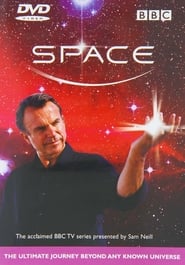
Space
Lataa English -tekstitys
Julkaisutiedot
Tunnisteet
English tekstityksen esikatselu
142 ensimmäistä riviä.
We humans have come a long way.
Travelling our world in search of new lands.
Spreading to every corner of the globe.
But the time has come to look to new destinations.
To go, once more, into the unknown.
This is the story of our journey in space.
We will fly to the stars on a ship that sails on sunlight.
We'll explore the most distant edges of the cosmos
by taking a roller-coaster ride through the fabric of our universe.
We'll discover the machine that has charted the heavens as never before.
It's the voyage of a lifetime, a voyage to our future in space.
We've always had the urge to explore.
Our ancestors journeyed into the unknown to discover new lands.
And now it's time to do it again.
And this time,
it's not a voyage between continents.
This time, it's a voyage to the stars.
As our telescopes get ever more powerful,
they've shown us a universe of unimaginable beauty and power.
Vast clouds where new stars are born.
Strange galaxies.
Even tantalising hints of new worlds.
But they have also shown dangers.
Disasters so huge, they could destroy the Earth in seconds.
Space is full of terrors... and wonders.
But will we ever see them for ourselves?
We have lift off!
It's less than 50 years since we took our first steps into space.
Since then, thousands of rockets carrying hundreds of people have made
the ten-minute flight into orbit.
Astronaut Story Musgrave is one of a new breed of space adventurers.
When you see a launch from the outside,
it's a rather glorious thing.
Inside, it's the absolute opposite of that.
It's 137 decibels. It's shaking. Everything is shaking.
You have a solid block of boosters that are really pounding the vehicle.
You have atmospheric turbulence
that adds another shake, rattle and roll.
You're basically in a small closet
with belts and straps and helmets and gloves and parachutes, survival gear.
That's all over you and, at the same time, you're being shook.
And it can't help but pass through your mind
that you just want the whole stack to hold together.
You're along for the ride and you want to survive.
So, it's not a joyride for me.
It's what I need to go through to get into the serenity
and the celestial dance of zero gravity.
Hello, Houston, we are inspired.
We are ready. Let's go and fix something.
We are becoming space farers.
It's a strange and unfamiliar world.
But for the privileged few who go there, it is an experience
they can never forget.
Space walking is more like dance than anything.
You choreograph every move.
You choreograph every finger, every toe, every body position
and how you will do all of that.
It's just as precise as a ballet.
Going into space is opening night at the ballet.
During a space walk,
I live to look at my feet.
You see your boots going 25,000 feet per second.
You see them going down the road.
If you ever want to play Superman, that's where to do it.
We stand on the edge of space.
Our most ambitious project is testament to what we have achieved:
the international space station Freedom.
But it's surprisingly close to home.
It is floating less than 400 kilometres above our heads.
The furthest we have travelled into space is this.
In 1969, we set foot on the moon.
That's one small step for man, one giant leap for mankind.
For the first time ever, we looked back at our home
from the surface of another world.
It's amazing to think that people have actually walked up there.
The trouble is, it may have been a giant leap for us,
but in the vastness of space, it really was one small step.
Although we humans haven't reached any further than the moon,
our robot ambassadors are already reaching for the stars.
Where we cannot go, we have sent machines.
This is the Voyager probe.
Nothing we've created has travelled so far.
It's left our solar system on its way to the stars.
Look at how far it has gone.
Voyager left Earth in 1976.
It passed Jupiter, then Saturn.
Now it has left all the planets far behind.
After decades in space, it's 14 billion kilometres from Earth.
It's an impressive journey until you consider this.
On this scale, the nearest star to our solar system is way over there.
In fact, it's over 100 kilometres away.
To reach it would take Voyager another 25,000 years.
At Voyager's speed, even reaching the nearest star
is an impossible journey.
But perhaps there is hope.
It's easy to forget that in one lifetime we've gone from this...
..to this.
And in our quest to reach the stars,
some scientists believe the answer could be to go from this...
..to this.
Deep Space One.
Its secret is a new kind of engine - the ion drive.
And it is the passion of NASA scientist Marc Rayman.
The idea for ion propulsion was around from before I was born,
but I first heard of it on Star Trek.
They were using ion propulsion, and Spock said,
''Configuration unidentified.
''Ion propulsion. High velocity. Unique technology.''
And I thought, ''Well, this is really amazing,
''but I'll never see anything like that in my lifetime.''
But in 1998, Marc's dream became reality.
Deep Space One.
But what is it that makes the ion drive so different?
Compare it with a conventional rocket.
The rocket fuel burns with tremendous force.
And, as it thrusts down, it pushes the rocket up.
In the lab, Marc Rayman watches a prototype ion drive in action.
Instead of tonnes of rocket fuel,
the engine uses a few grammes of a gas.
It gives the gas an electric charge and spits it out atom by atom
at incredible speeds, creating a seemingly gentle blue haze.
The ion drive doesn't have the raw power of a rocket.
It has something better - staying power.
It's a bit like the hare...
..and the tortoise.
Conventional rocket engines create huge thrust and awesome acceleration.
But they burn through their entire fuel supply in just a few minutes.
After that...
it's all over.
The ion drive is nowhere near as powerful.
In fact, it would take Deep Space One four days to get from nought to 60.
But the reason Deep Space One is the fastest spacecraft ever
is because it has been accelerating for almost two years.
When we communicate with that craft out so far in the solar system,
to think that our baby is out there, this little spacecraft that we built.
I just...I think it's really amazing.
Ion drive spacecraft will be fast enough to chase down comets
or travel round the planets in our solar system in a few months.
But even ion drives don't last forever.
Eventually, they too will run out of fuel.
To travel further, to reach the stars, we'll need something new.
And it may be based on one of the oldest technologies we know -
Space subtitles in other languages
More English subtitles for Space
- Documentary BBC Space · 34 downloads · 2010-10-04
- Documentary BBC Space · 30 downloads · 2010-10-04
- 5of6 New Worlds DivX5-AC3 www mvgroup org ENG · 16 downloads · 2007-08-26
- 4of6 Are We Alone DivX5-AC3 www mvgroup org ENG · 18 downloads · 2007-08-26
- Space 3of6 Black Holes DivX5-AC3 www mvgroup org ENG · 12 downloads · 2007-08-26
- 2of6 Staying Alive DivX5-AC3 www mvgroup org ENG · 16 downloads · 2007-08-26
- 1of6 Star Stuff DivX5-AC3 www mvgroup org ENG · 13 downloads · 2007-08-26
- -=COMPLETE=- DivX5-AC3 www mvgroup org ENG · 18 downloads · 2007-08-26
Kommentit
No comments yet. Be the first to leave one.