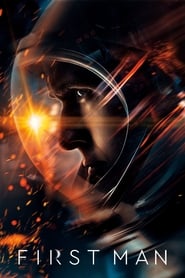
First Man
Lataa English -tekstitys
Julkaisutiedot
Tunnisteet
English tekstityksen esikatselu
173 ensimmäistä riviä.
(OVER RADIO) Twenty seconds to drop.
(OVER RADIO) Arm switch lite check.
-Brakes out, check. -(AIR HISSING)
What's your mixing chambers?
Real rough up here, fluctuating a half degree on each side.
I see that.
Ten seconds.
Good on track, 15 seconds. -Huh?
Give us a visual estimate of your location.
Okay. 140,000 feet. On your way down.
Approaching 115,000 feet.
Should be regaining aerodynamic control.
Right turn.
We show you ballooning, not turning.
Altitude rising. A lot more right.
Neil, you're bouncing off the atmosphere.
(DISTORTED) The altitude's still rising, Neil.
You're gonna have to stretch out your glide.
You seem to be a tad short.
Stow your flaps down, Neil.
I'm down.
Roger.
You okay?
Yeah.
Okay, Neil.
Kid's a good engineer.
But he's distracted.
He got home, Chuck.
He bounced off the atmosphere and still figured out how to get home.
Third mishap this month.
Bikle should ground him before he hurts himself.
-(SOFTLY) There you go. -(RETCHES)
It's okay.
-It's okay, sweetheart. -(CRYING)
What's that?
Look. Who's that?
Is that a kite?
Does that fly in the sky?
Yeah.
How?
I see the moon
The moon sees me
Down through the leaves of the old oak tree
Please let the light that shines on me
Shine on the one I love
Maybe I should talk to Dr. Johns about it.
Who?
Dr. Harold Johns.
He developed a procedure in Saskatchewan.
So you'd go to Canada?
I guess I would take some time off.
Why don't you talk to the hospital?
See if the tumor might...
I spoke to them already.
I'm sorry, Neil. I wish I had more to offer.
That's okay, Jack. Appreciate it.
Of course.
-Give my love to June. -You got it.
-Okay, bye now. -Bye.
Now, who made that? You or Grace?
Grace did.
I'll take it, then.
-Thank you. -Thank you.
Dick Day called from Houston.
He was asking after you.
That about Gemini?
They're looking for pilots with a solid background in engineering.
Well, maybe once Karen starts feeling better.
Just, you know, I wouldn't wanna move her until then.
Well, it would be nice to keep you around.
Enjoy the casserole. Thank you.
You're welcome.
-Joe. -Hey, Jan.
You, uh, hanging in?
Oh, you know.
It's nice of you to come by.
Of course.
Night, now.
Dad, wanna come play?
I should, uh...
I have to help your mother.
I thought I might go to work.
Okay.
They're gonna use VTOL technology.
They don't even have it figured out how to get there yet.
I'm not gonna waste my time on...
Morning.
Neil.
You can take a few days off, you know.
I know.
I'm just getting up to speed on the new delta wing in the UK.
Bikle canceled the trip.
He wants you focused on writing up the pilot report from your last flight.
Am I grounded, Joe?
Write up the report on the bounce, okay?
Civilian?
-Yeah. -Yeah. Me, too.
-Elliot. -Neil.
Tough morning, huh?
I barely lasted two minutes in that ice bath.
Of course, I suppose NASA's more interested
in the psychological reaction.
Well, I think I made it pretty clear that I thought it was cold.
Armstrong.
Good luck.
And to you, too.
Another egghead.
Neil, we've been chatting with candidates about the program.
As you know, our decision to forego direct ascent
in favor of a lunar orbit rendezvous approach
to the eventual Moon mission
has had a major impact on Gemini.
Do you have any thoughts on that decision?
Well, even considering von Braun's initial criticism,
it seems that the payload saved by parking the primary vehicle in orbit
and sending a smaller ship down to the lunar surface
is well worth the resulting challenges.
What do you see as the challenges?
Cislunar navigation, for one.
And rendezvous and docking.
Why do you think spaceflight's important?
I had a few, uh, opportunities in the X-15 to observe the atmosphere.
It was so thin, such a small part of the Earth
you could barely see it at all.
And when you're down here in the crowd and you look up, it...
It looks pretty big and you don't think about it too much, but...
When you get a different vantage point, it changes your perspective.
I don't know what space exploration will uncover,
but I don't think it'll be exploration just for the sake of exploration.
I think it'll be more the fact that it allows us to see things
that maybe we should've seen a long time ago.
But just haven't been able to until now.
-Does anyone have anything else? Yeah.
Neil, I was sorry to hear about your daughter.
I'm sorry, is there a question?
Um...
What I mean is, uh, do you think it will have an effect?
I think it would be
unreasonable to assume that it wouldn't have some effect.
All right, Neil.
Thank you. That's fine.
Thank you. Thank you for your time.
Hello?
Yeah, sure. Neil.
-Hello? -Can I go play outside?
Yeah.
Yes, sir.
Thank you, sir.
I got it.
It's a fresh start.
Are you sure?
Yeah.
Hey.
It'll be an adventure.
Since the time of Jules Verne,
man has imagined traveling to the Moon.
The old idea of how to get to the Moon
was to send one spacecraft all the way there and back.
However, NASA engineers have developed a modern approach.
Where one rocket contains several ships that will make the journey together.
Just as Columbus took a rowboat
from the Santa MarĂa to the shore of the New World.
The astronauts will take a smaller spacecraft
from the mothership down to the lunar surface.
When it's time to return, the smaller craft
will lift off from the surface
and dock with the mothership,
which will then power the crew back to Earth.
Thus, thanks to the brilliant minds of NASA,
the age-old dream of going to the Moon
will soon be achieved.
Sputnik, Sputnik 2...
Vostok...
First Man subtitles in other languages
More English subtitles for First Man
- First Man 2018 720p BluRay x264-[YTS AM] · 314 downloads · 2023-11-19
- First Man 2018 WEBRip iTunes · 177 downloads · 2021-08-18
- First Man 2018 WEBRip Amazon · 204 downloads · 2021-05-23
- First Man 2018 WEBRip Netflix · 266 downloads · 2021-05-22
- First Man (2018)23 976 fps - 140 59 min mp4 version-edited-resync-colorized-Hi · 168 downloads · 2020-11-21
- First Man 2018 PROPER BDRip x264-DRONES · 222 downloads · 2020-09-29
- First Man Aufbruch zum Mond 2018 IMAX German DTS DL 1080p BluRay x264 - MULTiPLEX · 306 downloads · 2020-09-13
- FirstMan(2018) COMMENTARY · 158 downloads · 2020-09-13
Kommentit
No comments yet. Be the first to leave one.