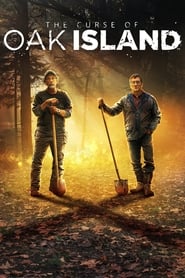
The Curse of Oak Island
Lataa English -tekstitys
Julkaisutiedot
Tunnisteet
English tekstityksen esikatselu
200 ensimmäistä riviä.
Tonight on The Curse of Oak Island...
Here we go.
There's wood. We got it.
There it is, guys.
-Wow. -We must be close to some type of a structure.
There could be some treasure just below us.
-Hey, Laird. -Yeah?
This is definitely the largest artifact we've found here.
-What? -Come on. Be something.
Look at that. It's old.
Emma, what have we learned?
So, right now, I am finding
something that I was not expecting.
There is an island in the North Atlantic
where people have been looking for
an incredible treasure for more than 200 years.
So far, they have found a stone slab
with strange symbols carved into it...
...man-made workings that date to medieval times,
and a lead cross whose origin may be connected
to the Knights Templar.
To date, six men have died
trying to solve the mystery.
And according to legend, one more will have to die
before the treasure can be found.
Here we go!
Core is up. All right.
-Here we go. -60.
Thank you.
-That's pretty firm stuff there. -Yep.
There is a lot of room yet
-for something to show itself. Yep.
It is the start of a new day on Oak Island
for brothers Rick and Marty Lagina and their team.
One that begins with renewed optimism
that they are finally on the verge
of solving a 228-year-old mystery.
I think it has the possibility to intersect
the Garden Shaft tunnel,
-leading to or seeking -Yeah.
-the treasure chamber. -Yeah.
It may put some answers to that tunnel down there.
We don't have enough information in the area.
We don't have a start point,
-we don't have an end point. -No. That's right.
We as a group have not explored much up here.
-This is a plausible location. -Yes.
Currently, the team is drilling
a borehole on their strategic grid known as D.5N-26.5.
Located several feet east
of the mid-18th century structure
known as "the Garden Shaft,"
it is their hope that this new borehole
will encounter a mysterious tunnel
that they previously discovered
at a depth of 95 feet.
A tunnel which is believed to run directly west
beneath the Garden Shaft and into an area
that has been dubbed "the Baby Blob,"
where water tests conducted one year ago
revealed high-trace evidence
of silver, gold and other metals
between 80 and 120 feet below ground.
Last year we were able to concentrate
and be very confident in the Baby Blob area.
That's right.
However, when the team met
with geoscientist Dr. Ian Spooner
and his colleague,
hydrogeologist Dr. Fred Michel last week,
the two presented their updated testing analysis,
which suggested that the fabled treasure
could actually lie buried anywhere
within a 20-foot radius of the feature.
Nothing is dissuading us from our opinion
that there's an area around the Garden Shaft
where something's been deposited.
Well, that I consider very good news.
Yeah.
Now, while the team awaits a new permit
to deepen the Garden Shaft by approximately 20 feet,
which will also allow them to construct lateral tunnels
in order to reach potential targets,
Rick, Marty and the team
are looking for any evidence of valuables
more than 100 feet underground
that might be located to the east of the shaft.
The tunnel that goes under the Garden Shaft
doesn't appear in the literature anywhere,
doesn't appear in the records,
so that's the one I'm most interested in.
So, we need to keep going.
That, perhaps, could go off to a chamber.
Meaning, there could be some actual treasure just below us.
And we're gonna find that out this year.
Hey, Mike. What do we got?
-78. -78.
78.
Anyone got a knife?
I love this hole.
We are in the middle of all
of the very, very soft material.
And this to my eye is relatively soft.
What do you think, Scott?
There is a lot going on in this area,
I mean, that we really don't know about.
-There's a lot of possibilities. -Absolutely.
Yeah, we've seen that whenever we're near a structure.
-Yeah. -We could be coming down on the intersection
-of the tunnel here. -For sure.
Time is going to tell.
We are going to do the work that's gonna find that out.
While the drilling operation continues
in the Money Pit area, on Lot 5,
located on the western side of the island...
Here he comes. Oh, yeah.
...Marty Lagina joins Jack Begley,
archaeologist Laird Niven,
Jamie Kouba
and their assistant Fiona Steele
as they continue investigating
a strange, circular feature.
Okay, Laird. What's the mission?
All right.
We're going to do the big rocks in the interior.
Show me.
-Oh, yeah. There are some big rocks in there. -Yeah.
You want all that out, right? Yeah.
I-I don't know why it's filled with rocks.
But underneath all those,
we think there's that intact layer
that we want to get to.
-That will help tell us exactly what this feature is. -Yeah. Yeah.
Interesting.
Just keeps getting more interesting.
-Yeah. Okay. -Okay, I can do that.
Since the Laginas' and their partners' purchase
of Lot 5 one year ago,
Laird and his colleagues have been mystified
by the unique construction
of this stone-lined, circular depression,
especially when it was determined
to have a 13-foot diameter,
which matched the description
of the original Money Pit
when it was first discovered in 1795.
However, one week ago,
the team discovered a piece of pottery
that could date back to as early as the 17th century,
along with an iron latch.
A latch that when analyzed
by archaeometallurgist Emma Culligan,
was determined to have the exact same composition
as other artifacts directly connected
to Sir William Phips,
the 17th century English politician and privateer
who is believed by some
to have buried treasure in the Money Pit
around 1687.
We have a big rock here, right in the wall.
Maybe if you can tickle it out a bit.
Oh, I'm sure I can.
Yes. Nice.
We've got a very mysterious,
very old round rock structure
which is still being excavated,
but it's full of artifacts,
with no record of human habitation.
Then Laird lets me know that
I can do something I am fond of,
which is to pull the big rocks, at least, off
with the backhoe.
Well, that really helps.
And that is going to get
the ball rolling really fast
and so I'm eager to do it.
Yeah, that's it, right?
Yep. That's good. -Okay.
We're starting to see a wall. Maybe?
There should be another 90-degree corner
-somewhere over there? -That's the hope.
So, ideally, we'd find the base of a nice structure here.
It's pretty kind of hard to believe.
I mean, this is massive and yet not...
not any reference to it.
-Yeah. -It, yeah, it's very odd.
It was quite an occupation for the time. Isn't it?
Yeah, it was a substantial structure.
People weren't here for just a month, were they?
No. -No.
I mean, we really don't know what
this structure was used for at all.
Not at the moment, no.
Because there could have been some feature here
-that was older. -Yeah.
That's why we need to get rid of this stuff
and come down on the good stuff.
I think, Jamie, the first thing you work on
is to the right where the rock came out of.
Yeah, absolutely.
The Curse of Oak Island subtitles in other languages
More English subtitles for The Curse of Oak Island
- The Curse of Oak Island S11E25 1080p WEB h264-EDITH · 121 downloads · 2024-05-01
- The Curse of Oak Island S11E24 1080p WEB h264-EDITH · 129 downloads · 2024-04-24
- The Curse of Oak Island S11E23 1080p HEVC x265-MeGusta[EZTVx to] · 128 downloads · 2024-04-18
- The Curse of Oak Island S11E22 1080p WEB h264-EDITH · 98 downloads · 2024-04-10
- The Curse of Oak Island S11E22 720p HEVC x265-MeGusta[EZTVx to] · 100 downloads · 2024-04-10
- The Curse of Oak Island S11E21 1080p WEB h264-EDITH · 112 downloads · 2024-04-03
- The Curse of Oak Island S11E20 1080p WEB h264-EDITH · 103 downloads · 2024-03-27
- The Curse of Oak Island S11E19 1080p HEVC x265-MeGusta[EZTVx to] · 137 downloads · 2024-03-21
Kommentit
No comments yet. Be the first to leave one.