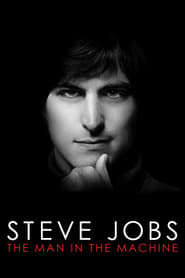
Steve Jobs: The Man in the Machine
I-download ang English Subtitle
Impormasyon ng release
Mga Tag
Preview ng subtitle na English
Ang unang 200 linya.
After hours of getting this thing right...
God, look at that. Look, I'm on television.
- Hey! Isn't that amazing? - Yeah, it is.
- You're on TV in New York, too. - What's that?
- You're on TV in New York, too. - No, no.
- Yes, you are. - Am I really? Are you serious?
- Yeah, they got you in New York. - God.
I'm gonna let you put it in your own ear.
- Really? - It's a talk back.
- They're going to talk to you. - This is not the real thing, right?
You just want a picture of me now?
- They're going to sit you here first. - God.
You need to tell me where the restroom is, too,
cos I'm deathly ill, actually,
and ready to throw up at any moment, so...
- It's right across the hall. - Great. I'm not joking.
We're ready to go, gentlemen. New York's waiting for a shot of him.
If you see in my eyes, I've been crying just a little bit.
And it seems really ridiculous because I've never met the man.
I know life is ephemeral, but I just, you know,
I expected him to be around a little longer.
Pretty sure everybody did, but, you know...
The thing I'm using right now, an iMac, he made.
He made the iMac. He made the Macbook.
He made the Macbook Pro. He made the Macbook Air.
He made the iPhone. He made the iPod.
Yeah, he's made the iPod Touch. He's made everything.
It's not often that the whole planet seems to feel a loss together,
but after the death of Steve Jobs,
co-founder of Apple and singular dreamer,
all day, we watched as there was a kind of global wake.
On Facebook, millions changing their profiles to the Apple logo.
A kind of black armband, a gesture of gratitude.
We've been monitoring the hashtag "thankyousteve."
My favorite tweet last night
was four simple letters simply saying, "iSad."
Hi.
When Steve Jobs died, I was mystified.
What accounted for the grief of millions of people who didn't know him?
I'd seen it with John Lennon and Martin Luther king,
but Steve Jobs wasn't a singer or a civil-rights leader.
Many commentators were surprised
by the intensity and the power of this wave of emotion.
What was it? And I think it was truly love.
Jobs has proven to be the one and only person in the world
who can create technology products that people love.
Wall-E.
I love "Wall-E," a film Jobs's Pixar produced,
and I love my iPhone,
but the grief for Jobs seemed to go beyond the products he left behind.
We mourned the man himself, but why?
Behind the scenes, Jobs could be ruthless, deceitful and cruel.
Yet he won our hearts by convincing us that Apple represented a higher ideal.
It was not like other companies. It was different.
Good morning and welcome to Apple's 1984 annual shareholders' meeting.
I'd like to open the meeting with part of an old poem,
about a 20-year-old poem, by Dylan. That's Bob Dylan.
"Come writers and critics who prophesize with your pens
and keep your eyes wide, the chance won't come again."
"And don't speak too soon for the wheel's still in spin
and there's no telling who that it's naming."
"For the loser now will be later to win, for the times, they are a-changing."
Jobs loved Dylan maybe because he wasn't just one thing.
He was a storyteller who could be whatever we wanted him to be.
I don't even what know what All Along The Watchtower means.
I think it is one of the most beautiful, haunting,
brilliant pieces of poetry ever. And to me, it's like Steve.
"There must be some way out of here, said the..."
What is it?
Said the Joker to the Thief.
He's both.
There's something going on here in life
beyond just a job and a family and career.
There's another side of the coin.
It's the same thing
that causes people to want to be poets instead of bankers.
And I think that that same spirit can be put into products.
And those products can be manufactured and given to people,
and they can sense that spirit.
A computer is a straightforward, everyday machine.
A simple way of studying the principle of how it works
is that a computer is quite dead.
It can do nothing without someone to give instructions.
When I was growing up, computers weren't something to love.
They were something to fear.
They were huge, impersonal, made by faceless corporations.
But for Jobs, it was different.
I saw my first computer when I was 12 at NASA.
We had a local NASA center nearby. It was a terminal,
which was connected to a big computer somewhere.
This is one of the consoles they might be using in the future.
It looks very much like just a regular typewriter.
Too often the equipment of the past
has sort of been designed for other machines.
They're really not for people.
I saw my second computer a few years later, the Hewlett-Packard 9100.
The 9100 computing calculator.
It was very large. Had a very small cathode ray tube on it for display.
And I got a chance to play with one of those maybe in 1968.
I started going up
to Hewlett-Packard's Palo Alto research lab every Tuesday night,
and I spent every spare moment I had trying to write programs for it.
I was so fascinated by this.
We have a pointing device called a mouse.
I don't know why we call it a mouse.
By 1968, Stanford's Doug Engelbart, inventor of the mouse,
was asking new questions
about the essential nature of our changing relationship with computers.
If in your office, you as an intellectual worker
were supplied with a computer display
backed up by a computer that was alive for you all day
and was instantly responsible, responsive,
instantly responsive to every action you had,
how much value could you derive from that?
We needed a guide to help us navigate this new relationship.
My whole adult life has been spent building personal computers.
So, the history of my vocation and my avocations
and, you know, my growing up are all the same,
and it's very hard to separate one from the other.
I come from a place called Silicon Valley, California,
and you'll find there are a lot of electronics kits around.
My electronics teacher realized that I had a lot of computer ability
that went beyond anything he could possibly teach me in school.
He knew that as long as I was in class, I was just going to sit around,
playing pranks on the other students
like wrapping little hair wires around certain circuits
so when they plugged in their radio, it would blow up.
As hard as I think about it,
I don't think I ever had one friend who was not one of the tech kids.
I met Woz when I was maybe 12 years old, 13 years old.
He was the first person I met that knew more electronics than I did.
And one of the things that Woz and I did was we built blue boxes.
One day I picked up a magazine,
and I started reading a story about phone phreaks and blue boxes.
When phone phreaks have a convention,
as they did in the ballroom of a seedy New York hotel lately,
masks are given out at the door. People don't give their right names.
The blue box was a little device that put special tones into anybody's phone
and those tones would connect you anywhere you wanted.
Halfway through reading this, I called Steve Jobs over
and started reading it to him over the phone.
There's a way to fool the entire telephone system
into thinking you were a telephone computer
and to open up itself and let you call anywhere in the world for free.
You could call from a pay phone, go to White Plains, New York,
take a satellite to Europe.
And you'd go around the world and call the pay phone next door.
Shout in the phone, be about 30 seconds,
it'd come out the other end of the other phone.
And he's like, "Hello," There's a lag and, "Hello, how are you?"
"I'm fine." You know?
Why, one might wonder, would someone want to do that?
To rip off the phone company.
And these were illegal, I have to add.
In college, I had a blue box of my own. It was important
because long-distance phone calls were really expensive back then.
It was also a way of sticking it to the man.
This would become an important selling point for Jobs, too,
even as he left the technical work to others.
Well, I had this blue box design.
I did a trick in there that I've never done that good a trick
in any other design in my life.
And Steve Jobs said, "Hey, why don't we sell them?"
You know, you rapidly run out of people you want to call,
but it was the magic that two teenagers
could build this box for $100 worth of parts
and control hundreds of billions of dollars of infrastructure
in the entire telephone network in the whole world.
We could sort of influence the world, you know?
Control it, in the case of blue boxes,
but something much more powerful than controlling.
Influencing, in the case of Apple. And they're very closely related.
I really do, to this day,
feel that if we hadn't had had those blue box experiences,
there never would have been an Apple computer.
I think Jobs was always a storyteller.
There was always this sense that he was constructing a persona.
The first time I sat down with him to work on a story,
he immediately asked me if I had read.
Thomas Kuhn's "The Structure of Scientific Revolutions."
I think he was assimilating into this personality,
this notion that he had found in Kuhn.
The random result that eventually creates
a paradigm shift where everybody one morning wakes up,
and they think the new way.
And I believe that he thought that he was a paradigm shifter.
That was part of his story. He wanted to have a foot in both worlds.
He wanted to be the renegade, but he also wanted to be legit.
This is the video deposition of Steven P Jobs.
We are on the record at 9:22am.
Can we just sort of briefly go over your employment history after 1973?
I was employed by Atari, a maker of video games.
- What time frame? - I don't know. Early '70s.
Creativity is a lot about anarchy.
I had been in the video-game business two years
and our corporate culture was really "work hard, play hard."
The true original sin of Apple
literally takes place before the company is founded.
Jobs had left Reed College and now he was back in Silicon Valley.
Woz was working at HP.
Steve Jobs: The Man in the Machine subtitles in other languages
More English subtitles for Steve Jobs: The Man in the Machine
- Steve Jobs The Man in the Mane 2015 LIMITED 720p BluRay x264-USURY · 90 downloads · 2015-11-17
- Steve Jobs The Man in the Machine 2015 LIMITED 720p BluRay x264-USURY · 78 downloads · 2015-11-17
- Steve Jobs The Man in the Machine 2015 LIMITED 720p BluRay x264-USURY · 158 downloads · 2015-11-16
- Steve Jobs The Man in the Machine 2015 LIMITED 720p BluRay x264-USURY · 101 downloads · 2015-11-16
- Steve Jobs The Man in the Machine 2015 LIMITED 720p BluRay x264-USURY · 89 downloads · 2015-11-16
- Steve Jobs The Man in the Mane 2015 1080p BluRay H264 AAC-RARBG · 108 downloads · 2015-11-11
- Steve Jobs The Man in the Mane 2015 LIMITED 1080p BluRay x264-USURY · 95 downloads · 2015-11-11
- Steve Jobs The Man in the Mane 2015 LIMITED 1080p BluRay x264-USURY · 95 downloads · 2015-11-11
Mga Komento
No comments yet. Be the first to leave one.