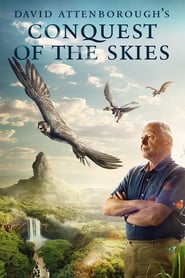
David Attenborough's Conquest of the Skies
I-download ang English Subtitle
Impormasyon ng release
Mga Tag
Download English Subtitle Files for Mobile (4)
Preview ng subtitle na English
Ang unang 200 linya.
The ability to move through the air in any direction you wish,
to cross continents and oceans,
to range over forests and deserts and mountains,
all this birds have been able to do for 150 million years.
But they weren't the first or indeed the last, in the skies.
We are setting out to explore one of the most astonishing stories in the natural world.
The way in which animals manage to rise up from the surface of the Earth,
and colonise the air.
From the dazzling aerobatics of the insects...
to the majesty of ancient winged reptiles.
The splendour and agility of birds...
and the sonar guided precision of night flying bats.
Flight has been the key to the success
of some of our planet's most remarkable inhabitants.
To analyse their spectacular skills, we will use the latest technology.
And we will travel around the world.
From the jungles of Borneo, to the fossil-filled rocks of China,
and the Cloud Forests of Ecuador.
We will take you into the air...
and travel with animals as they fly.
Evidence for the very beginnings of this astonishing story
can be found close to home in The Fens of Cambridgeshire.
Here live creatures that have an ancestry stretching back millions of years.
Nobody knows exactly how the first flying animals in the world evolved,
but there are creatures alive today, that can take us back
to those far-distant, remarkable times,
and they live - surprisingly - under water.
Looking down through the surface to the riverbed,
is like traveling back in time, over 320 million years.
It was then, in an age long before even the dinosaurs evolved,
that creatures like this, first appeared in the waters of the Earth.
It's an insect.
A ferocious predator with jaws like a mechanical grab.
It seems unlikely that this animal's ancestors
were among the first creatures ever to fly.
But this one is not yet adult, it's a larva,
and it doesn't spend all its life in the water.
It has another life, and another body above the surface.
Early one morning, it climbs up a reed.
A split appears in its skin, and a very different-looking creature begins to emerge.
It has four lumps on its back, that might perhaps ancestrally
have become either gills, or protective armour plates.
But now they develop into something very different.
Wings.
It has two pairs of them.
Liquid from its body is pumped-down along veins, to stretch them tight.
As they dry in the sun, they harden.
The water-living dragon has become the dragonfly.
And the four-winged apparatus that he uses to get into the air,
is the earliest that we know.
Imprints of such wings have been found in rocks that were laid down
on the bottom of ancient lakes and streams.
This specimen is about 150 million years old.
And this wing is double that age at nearly 300 million years old.
Ancient and modern wings share a structure that is strikingly similar.
So today's dragonflies are amazingly, living fossils that can show us
how the very first flyers overcame the pull of gravity, and took to the skies.
Their wings are marvels of natural engineering.
But to see how they lift the dragonfly into the air,
we need to slow the action down.
In principle, it looks fairly simple, each wing beats down,
pushing on the air below, so lifting the dragonfly up.
But each beat also creates another air current
that lifts the dragonfly in a very different way.
And I can demonstrate it, using this strip of paper to represent a wing.
If I blow across the top of it, it'll rise. Watch.
That is because the faster air moves, the lower its pressure.
So I created a lower pressure above the wing,
and in consequence it was sucked upwards.
The problem for a flying animal, is to recreate that difference in air-speed.
The way the dragonfly does this is remarkable.
As it moves through the air, we can see that it twists its wings at different angles.
On the powerful down-beat, it holds them at a slight upwards angle to the air flow,
and this produces an extraordinary effect above the wing.
It creates a swirl behind the leading edge, which spins the air round,
increasing the speed of the air current over the top of the wing,
and just a tiny increasing speed generates a significant upwards force,
lifting up the wing, and the dragonfly.
The dragonfly can then change the direction of its wing beats,
to propel it forwards, as well as upwards.
Remarkably, a dragonfly can beat each of its four wings independently.
And that enables it to perform an astonishing variety of man oeuvres.
It can hover.
It can glide.
It can even fly backwards.
For maximum power, it beats both pairs together,
and can make really sharp turns.
So the very first dragonflies were able
to extend their territories far and wide.
And as more insects joined them in the skies,
the dragonflies had the skills to be deadly aerial hunters.
The ability to fly brought great advantages to those early insects.
It enabled them to find food, to escape from predators,
and particularly important, to travel to new territories in search of a mate.
Damselflies like their close relations dragonflies,
have remained virtually unchanged for millions of years.
Mating can be quite complicated when both partners can fly,
and these were among the first kind of animals that had to deal with that problem.
The blue colour of this one, shows that it's a male.
To attract a female, a male must have something to offer her. A territory.
He chooses a stretch of water, that is likely to contain plenty of food for his offspring.
Then he guards this territory against any rivals.
Until a female flies in and joins him.
He must now grab her before she changes her mind, in mid-air if necessary.
He uses claspers at the tip of his abdomen, to grip her behind her neck.
Amazingly, the pair are able to coordinate the beats of their eight wings.
They may mate in the air, or choose a secluded perch where they'll be safe from predators.
They then fly around the territory, laying their fertilized eggs.
Flight enabled insects to invade part of the planet
that until then, had been uninhabited: The air.
And they flourished.
So, 320 million years ago, the skies thronged with flying insects.
But those early four-wing forms were destined to produce
a whole range of spectacular, highly specialized flyers.
The need to lay eggs in water, tied the first dragonflies
to streams and ponds like these.
But then, around 20 million years after their arrival,
a new kind of flying insect appeared with no such ties to water.
Proof of their success can be found almost wherever you look,
and few places more abundantly than in Borneo.
The very first flyers had two pairs of wings,
now we're looking for their successors.
One group of creatures adapted that original
four-wing design with such success,
that they diversified into the most numerous
and widespread group of animals on the entire planet,
and you can find some of the most spectacular examples, down there in the rainforest.
Not all insects are hunters, some are strict vegetarians like this one.
This it is the land living equivalent to that underwater monster,
the dragonfly larva.
But this larva instead of catching little fish and water fleas, munches wood pulp.
The trouble is, that wood pulp is not very nutritious,
and this creature has to eat it for at least a year,
before it's this size, which is full grown.
But then this larva will turn into an adult, which is equally monstrous.
Emerging from beneath the ground, where it is lived and fed as a larva, is a beetle.
One of the biggest in the world. The Atlas beetle.
Males like this one are armed with long horns,
powerful weapons with which to compete with rivals for a mate.
It now spends most of its time above the ground,
barging its way through the undergrowth, where it feeds on tree-sap and fallen fruit.
This hefty, powerful creature may not look as if it could fly.
But it can.
At key moments in its life it takes to the air
to look for new sources of food, and of course, a female.
All this burrowing and munching around, could injure delicate flight wings.
So beetles have hardened the front pair
to form this pair of protective covers,
and the delicate flight pair, are stowed away in safety, underneath.
To see how the wings are folded away beneath their covers, we need to wait for take-off.
As it flaps, sprung hinges click-open and the wings are stretched to their full size.
The working wings create lift in just the same way that the dragonfly wings do,
and the front wings, which have now become covers, are held out to the side.
And their shape does give a little extra lift.
But it's clear that this is really, rather a clumsy flyer.
Landings can be clumsy too.
And now those fragile wings must be carefully packed away, beneath their covers.
They're guided by a line of tiny hairs at the base of the abdomen.
These grip the wings and help push them into position.
The beetle does it with all the care and precision
that a skydiver uses when packing away his parachute.
Once in a new territory, it will stake out a fresh source of food,
and then defend it until a female arrives.
The beetle way of life proved astonishingly successful.
There are over 370,000 different species of beetle, so far discovered.
Unbelievable figure.
So early on, the beetles managed to fly as much as they need to,
with just one pair of wings.
And then, around 57 million years ago,
came another key development in the history of flight.
A new type of insect appeared, with two pairs of wings
that became in effect, huge billboards.
Wings that are perhaps the most dazzlingly beautiful of all.
Butterflies.
To create these extraordinary wings, the butterflies evolved a complex life cycle.
They hatch from eggs, as little worms with legs - caterpillars.
But, unlike many beetle grubs, caterpillars find their food above ground,
where they're very vulnerable to predators.
So they have evolved several strategies
to accumulate all the body mass they will need, to become flying adults.
The first is to eat as much as they can, as quickly as they can.
Many are able to reach full size, in just a matter of weeks.
Of course, a little thin-skinned, fat-filled sausage
is a tempting morsel for any bird or reptile.
So caterpillars have to have ways of defending themselves.
This one, which is the caterpillar of a lovely swallowtail butterfly
has disguised itself, as a bird dropping.
And if that doesn't deceive a bird, and a bird goes for it,
it has another form of defence.
It's emitted a rather unpleasant smell as well.
In the struggle to survive long enough to become winged adults,
other caterpillars have developed other equally ingenious forms of defence.
Concealed within these fluffy strands are short stinging spikes.
And this one is armed with long spines which have really painful stings.
Not only that, it has these bright warning colours
to tell any potential predator that they'll be in trouble if they attack.
This caterpillar may appear to be dangerous, but it is in fact a fraud.
The spines don't sting at all.
It's relying on its disguise to make a potential predator think twice,
and leave it alone.
David Attenborough's Conquest of the Skies subtitles in other languages
More English subtitles for David Attenborough's Conquest of the Skies
- David Attenboroughs Conquest Of The Skies S01 INTERNAL 720p BluRay x264-SHORTBREHD · 35 downloads · 2022-10-10
- David Attenborough's Conquest of the Skies Making Of 720p 10bit BluRay x265-budgetbits · 76 downloads · 2022-07-23
- David Attenborough's Conquest of the Skies (2015) - S01E03 - Triumph (1080p BluRay x265 afm72) · 47 downloads · 2022-05-25
- David Attenborough's Conquest of the Skies (2015) - S01E02 - Rivals (1080p BluRay x265 afm72) · 58 downloads · 2022-05-25
- David Attenborough's Conquest of the Skies (2015) - S01E01 - The First to Fly (1080p BluRay x265 afm72) · 53 downloads · 2022-05-25
- Conquest Of The Skies E03 Triumph 1080p bluray x264-eng · 54 downloads · 2019-10-14
- Conquest Of The Skies E02 Rivals 1080p bluray x264-eng · 66 downloads · 2019-10-14
- Conquest Of The Skies E01 First To Fly 1080 bluray x264-eng · 57 downloads · 2019-10-14
Mga Komento
No comments yet. Be the first to leave one.