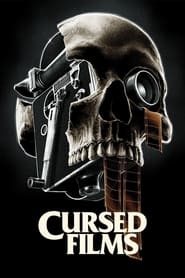
Cursed Films
I-download ang English Subtitle
Impormasyon ng release
Mga Tag
Preview ng subtitle na English
Ang unang 200 linya.
If I'm asked which TARKOVSKY film
I regard most highly,
I will usually answer the one that I've seen most recently
or the one that I'm watching right now.
Sometimes I go back and watch "Ivan's Childhood,"
his very first film, 1962.
With "Andrei Rublev,"
"Solaris,"
"Mirror,"
"Stalker," those films are indisputable.
"Stalker" is a haunting Soviet-era
science fiction movie
in which stalkers are figures who, for a price,
will escort people into this very dangerous area
called "The Zone."
This zone is considered to be the site,
possibly, of a UFO landing.
- Or some sort of extraterrestrial event.
And it has been cordoned off by the military,
because inside of The Zone,
there exists a place called "The Room."
And The Room is a place where you will be granted
your deepest, most cherished desires.
- Tarkovsky's got a particular way of making films.
I mean, "Stalker," it created a kind of mystery
and a suspense without any action.
He can hold a shot
so that you start thinking,
what's happening now?
But then the shot becomes something else.
The shot sort of evolves,
just because of the time you're actually observing it.
Denis Villeneuve has a similar sensibility.
Like Carl Dreyer's "The Passion of Joan of Arc,"
Tarkovsky's camera is really just concentrating
on the faces of the three principal actors,
Aleksandr Kaydanovskiy, who plays the stalker,
Nikolay GRINKO, who plays the scientist,
and Anatoliy Solonitsyn, who plays the writer.
Stalker" does have this reputation
being a prophetic film.
It clearly wasn't Tarkovsky's intention to make a film
about nuclear power or ecological disaster,
but that's kind of there in the film.
Of course TARKOVSKY did encourage these
sorts of wild interpretations,
whether it be ecological disaster,
or as a prediction of Chernobyl.
The myth that surrounds the movie
becomes almost part of the movie
in some really strange way.
The film is about belief,
and there's been more myth built up about the film
than actually is in the actual story.
It really was, you know, one of cinema's
most difficult shoots.
Problems with the lab ruining the stock,
people being fired, the earthquakes.
Since the film has been completed,
a number of stories have grown up around "Stalker"
to suggest that a lot of the crew
actually became seriously ill
during the shooting of "Stalker."
I don't think those people
that were working on "Stalker"
realized the danger that they might be in.
Several people that I've met
experienced a central event in their lives
while working on "Stalker."
When I moved to Chicago,
I started going up to a used bookstore
that had old Soviet books that I was interested in,
and I got talking to the proprietor,
Grigory Verkhovsky.
And only after some time did I learn
that he had actually worked on "Stalker,"
and had all these photographs,
had all these stories to tell.
Over the years, I think "Stalker" has become
the central film in Tarkovsky's oeuvre for many,
the film that had the greatest mystique about it.
One of the things that heightens the mystery,
and the extraordinary qualities of the movie
is that it was made in the Soviet era,
in a society that at that time
was officially atheistic,
was ardently materialistic,
and here is a film
with extraordinary metaphysical themes.
TARKOVSKY came across "Stalker" in 1973,
when he first read the novel, "Roadside Picnic,"
by the STRUGATSKY brothers.
It was Tarkovsky's second foray into science fiction.
He'd made "Solaris,"
based on a novel by Stanislaw Lem in 1972.
And science fiction was seen by the Soviet authorities
as a safe genre.
- "Stalker" was beset with problems from the get-go.
The film was due to start shooting
towards the end of 1976
in the Soviet Republic of Tajikistan,
in an area called Isfara.
The first of the film's problems
happened at this point,
there was an earthquake in that area,
rendering all of the locations they'd selected
completely unusable.
- So TARKOVSKY got his location scouts to start looking around
in other parts of the Soviet Union,
and they eventually settled on Estonia.
When I was a student in Moscow Film School in 1974,
I was terribly lucky,
because I met my favorite filmmaker Andrei TARKOVSKY.
When they came to prepare the production
of the "Stalker" in Tallinn,
I asked permission from TARKOVSKY
to come to shooting ground of "Stalker."
And actually I helped him also
to find some locations.
You see these letters.
"U.N." United Nations.
They were painted for "Stalker" film.
And right here was entrance
into The Zone.
Get closer.
"These letters were painted on the chimney in 1978,
while shooting Andrei Tarkovsky's cult movie,
"Stalker."
In the scene with the busy United Nations soldiers
at the gate of the mysterious Zone,
the letters can barely be seen through the smoke and steam.
The plaque was opened on May 7th, 2008,
to commemorate the 30th anniversary of this...
very good film."
Let's play the scene from the "Stalker."
I am on Land Rover,
and the train,
with the two wagons, passed.
So now I... oh! Go.
On the tracks,
now the soldiers notice,
and there was the projector, very heavy,
like fog and mist.
Land Rover turns around the corner,
and disappears.
On the shooting ground,
it was strictly not allowed anybody to take photographs.
So I hid in the bushes during the rehearsals,
and my first shots were made through the branches.
I printed the images,
and showed to Andrei.
He was surprised, and said, "yeah!"
For example, I shot in Mosfilm Studios,
daydreaming TARKOVSKY.
And here, my favorite cinematographer this time,
Georgy Rerberg, also on the "Stalker."
I felt like it was second time going to film school.
I saw how these masters are doing everything
by their hands.
It was... muah!
Wonderful.
Andrei was very passionate about cinematic image,
and mise en scène.
But in this case, first time,
he was arranging all the moments of camera,
and cinematographer has nothing to do.
- TARKOVSKY is, if you like, the quintessential auteur.
He liked to quote Tolstoy:
"Never trouble others with what you can do yourself."
The problem with that was it made TARKOVSKY
look a bit like an egomaniac.
Andrei is behind the camera.
Actors are working before the camera.
But cinematographer standing aside,
and scratching his head.
Nothing to do.
So Rerberg started drinking,
fucking around with the young ladies,
and um,
it made Andrei TARKOVSKY mad.
The relations grew worse.
- On top of that, TARKOVSKY apparently had a feeling
that there was something wrong with the stock.
And he kept asking the lab to "please check."
They were shooting already six weeks,
not seeing any rushes.
- For some reason, and I don't have a good answer why,
um, they did not check the rushes.
They weren't checking the rushes.
Really?
Well, that's...
That seems pretty crazy, doesn't it?
- TARKOVSKY was using a new batch of Kodak
that had been given to him by a producer in West Berlin.
The first time they shot "Stalker" it was on 5247,
which at the time was a new Kodak stock.
They did the whole shooting
and then returned to Moscow to check the rushes.
Finally they were able to watch the rushes,
and somebody described it as um,
Cursed Films subtitles in other languages
More English subtitles for Cursed Films
- Cursed Films S01 BDRip x265-ION265 · 16 downloads · 2023-03-17
- Cursed Films S02E05 1080p SHDR WEB-DL AAC2 0 H 264-PMP · 43 downloads · 2022-05-30
- Cursed Films S02E04 Cursed Films The Serpent And The Rainbow 1080p AMZN WEBRip · 40 downloads · 2022-05-30
- Cursed Films S02E02 Rosemarys Baby 720p AMZN WEB-DL DDP2 0 H 264-NTb · 42 downloads · 2022-05-30
- Cursed Films S02E01 The Wizard of Oz 720p AMZN WEB-DL DDP2 0 H 264-NTb · 42 downloads · 2022-05-30
- Cursed Films Season01 WEBRip x264-ION10 · 25 downloads · 2020-05-01
- Cursed Films S01E05 WEBRip x264-ION10 · 16 downloads · 2020-04-16
- Cursed Films S01E05 WEBRip x264-ION10 · 13 downloads · 2020-04-16
Mga Komento
No comments yet. Be the first to leave one.