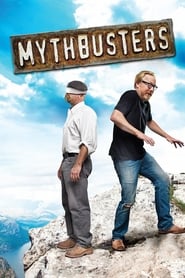
MythBusters
I-download ang English Subtitle
Download English Subtitle Files for Mobile (6)
Preview ng subtitle na English
Ang unang 200 linya.
It may not look like it, but we're professionals.
Do us a favor.
Don't try this at home! Whoa!
Narrator: On this episode of "Mythbusters"...
Jamie, don't jump. You have so much to live for.
...Adam and Jamie take out the trash...
Those things will get ya.
Ow!
...as they test the movie myth
of a dumpster-diving escape...
A perfect 10!
...and find out if legging it
after a "trash" landing is legit.
- Nice job. - Thank you.
Meanwhile, Kari, Tory, and Grant go off the deep end...
...with a "ye olde" diving myth.
Time to go divin'.
Narrator: Could an air-supply failure up top...
You're kidding me. This is working?
...spell a spectacular squeeze and certain death down below?
Oh! Look at what's happening to his head!
Kari: Yeah!
Narrator: Who are the Mythbusters?
Adam savage...
I feel perfectly normal
...and Jamie Hyneman.
Pain is your friend.
Between them, more than 30 years of special-effects experience.
Joining them...
...Grant Imahara...
Burn!
...Kari Byron...
And I'm starting to get the idea
that this shouldn't be done inside.
...Tory Belleci...
...and featuring Jessi Combs.
That was awesome!
They don't just tell the myths.
They put them to the test.
First up, Adam and Jamie dive into a film fable.
So I hear you have a movie myth for us.
I do, old bean.
It seems that within the logic of an action movie,
any building can be escaped from
by handily jumping into a dumpster parked next to it.
Hop out, dust yourself off and walk away unharmed.
Well, that sounds like rubbish.
It's an action-movie cliché.
After a roof runaround with nowhere else to go,
a dive into a dumpster equals a guaranteed getaway.
But can you really get up and go every time
after a "trash" landing?
So, how is this gonna go down?
Well, I figure that any line of investigation we pursue
is ultimately hopefully gonna end
with one of us leaping into a dumpster.
So first things first.
I think we need to be trained how to fall safely.
I think we need to call
one of the stuntmen we know to teach us.
Well, I guess it's time to jump right in, huh?
All right.
Yep, this myth can only end one way...
with an actual dumpster dive.
And to make sure our Mythbusters will live to bust another day,
it's off to Treasure Island for Stunt-Falling 101.
Adam: So in our ongoing training to be action-movie heroes,
we are about to learn how to take a high fall safely.
And this is the building we're gonna start with.
This is the air bag that's gonna break our fall.
And this...
...is the guy that's gonna train us.
That's Randy Lamb, stunt coordinator and fall guy.
Oh, this is cool in here!
As Jamie said,
they're not starting on the dumpsters just yet.
First there's this.
How does this air bag work, you ask?
Well, it's called a two-stage air bag, and it works thusly.
The first stage, this top part, slows you down by popping,
by opening through this very portal that I climbed out of.
The second stage, that bottom layer, stops you.
It does not deflate.
Narrator: And that's key,
because the name of this game is deceleration.
Like they say, it's not the fall that kills you,
it's the sudden stop.
A jump from a height onto a hard surface
will bring you to a stop very quickly.
And it's this sudden impact that is potentially fatal.
But landing on a soft surface maximizes deceleration,
dissipating impact over a longer time,
reducing the risk of injury.
Randy, Falling 101. What do we have to know?
When you jump,
you want to make sure that you land flat on your back
and use up as much volume as possible.
Awesome! Can we get started?
Sure. Who wants to go first?
Me! I want to go first.
Is that okay if I go first? Can I go first? Is that cool?
- Yay. - All right. Follow me.
Narrator: Unsurprisingly,
Adam is falling over himself to get started.
Lamb: Less is more.
Yeah, it's a lot higher now, isn't it?
All right. Here we go.
But at a height of 13 feet,
getting the technique right is vital.
- Place your left foot right here. - All right.
Now, you're gonna take one giant step out
and lay back just like you were laying into a recliner.
Perfect.
Wow!
That's cool!
And if at first you succeed, why not go again?
And again.
And again.
It looked like you did it perfectly.
With that out of his system...
That was awesome!
Adam: Don't look now, but there's a Hyneman
on the roof of that building, and I think he's gonna jump.
Jamie, don't jump. You have so much to live for.
Jamie: You know, it's a little bit of a jolt, but it works.
Lamb: Much better. Excellent.
I think you guys have both got this height down.
Awesome! 'Cause I want to go higher.
- Can we go higher? - Let's go.
Narrator: Yep, it's as easy as moving the air bag
to a new location.
Or is it?
Well, we're about to bump it up a notch.
And make no mistake...
when you're looking down at that bag,
there's a pretty big difference between 13 feet...
...and 20 feet.
The stakes just went up, and so did my adrenaline level.
Narrator: And this time,
Jamie's drawn the short straw to jump first.
Lamb: Perfect!
How you feeling?
That was no worse than the smaller one.
- - Cool.
My turn!
Perfect.
Perfect!
- Nice job. - How'd that feel?
Felt great.
Narrator: And now that both the guys
have mastered the art of falling from a great height,
they can get their hands dirty.
I think I'm getting this down.
I think you are.
What's next?
You're gonna love this.
Now from high diving to deep-sea diving.
Before the days of scuba diving,
divers would go down in those old suits
with those brass helmets, just like this, right? - Sure.
They would pressurize their suit using a compressor
on a boat at the surface.
To counteract the external water pressure.
Exactly.
That sounds like an accident waiting to happen.
And that's what this myth is about.
If that compressor were to stop or the air hose would get cut,
that diver would come to a grisly end.
Yeah, without the high-pressure air
helping to keep the suit inflated,
it would simply crush under the weight of all the water.
That's right.
And the pressure would change so suddenly,
it would be so dramatic,
that it would literally squish the diver into the helmet.
Sick.
I love it.
Narrator: Yep, according to this macabre maritime myth,
early deep-sea-diving suits had a flaw,
whereby a failure in the air supply
could cause a drastic depressurization.
But could the pressure differential
really put the squeeze on an entire human body,
or is this a load of "Pulp Fiction"?
So, how do we test this?
Ultimately, I think we need to build one of these suits,
put a human analogue in it,
drop it to the bottom of the ocean,
cut the line, and see what happens.
See if we get instant sausages.
Or whatever.
Okay, before we do all of that,
I think we need to do two things.
We need to go talk to an expert,
and we need to do a few proof-of-concept tests.
Narrator: And at San Francisco Maritime
National Historical Park,
ex-Navy diver Mike Ward is just the expert Kari needs.
What kind of diving were these suits used for?
They were used for salvage diving,
MythBusters subtitles in other languages
More English subtitles for MythBusters
- Season 2003/Smyth S2003E01 Jet Assisted Chev eng · 6645 downloads · 2025-02-22
- Mythbuster S01E03 · 146 downloads · 2020-03-22
- Mythbusters S01E02 · 140 downloads · 2020-03-22
- Mythbusters S01E01 · 234 downloads · 2020-03-22
- MythBusters S12E04 iNTERNAL HDTV x264-WNN · 130 downloads · 2015-04-02
- Mythbusters S12 Zombie Special REPACK HDTV x264-KILLERS · 147 downloads · 2015-04-02
- Mythbusters S14E03 Commercial Myths HDTV x264-W4F · 85 downloads · 2015-02-07
- Mythbusters S14E02 Household Disasters HDTV x264-W4F · 81 downloads · 2015-02-07
Mga Komento
No comments yet. Be the first to leave one.