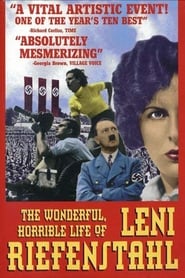
The Wonderful, Horrible Life of Leni Riefenstahl
Die Macht der Bilder: Leni Riefenstahl
I-download ang English Subtitle
Impormasyon ng release
Mga Tag
Preview ng subtitle na English
Ang unang 200 linya.
We are in the presence of a legend with many faces
loathed by many, admired deeply by others.
Her name is still taboo in Germany.
Leni Riefenstahl, the most influential filmmaker of the Third Reich,
the last great surviving image maker of the Nazis.
A film about Leni Riefenstahl, can content itself
with updating the old prejudices.
Or it can attempt to deconstruct her myth, and to look at it afresh
A feminist pioneer or a woman of evil.
One thing is certain, she is still
the most famous female film director in the world.
This film will approach her without preconceptions.
What do you feel, looking at those pictures?
Well, really as if the person in this picture is not me...
...but just some actress
This innocence, enthusiasm...
...then the fall from fame, the great disappointment...
...how do you see all that today?
It's all so long ago now, I've long since got over it
I don't think about it anymore
At my age...
...I'll be 90 this year...
...many decades have now gone by.
They were bad times
It's like another world but no longer live in that past
Guest Dance Performance
An Evening of Dance
I really only wanted to go on stage as an experiment
To see whether I would make a good dancer
But I had such a huge success, I was immediately engaged by Max Reinhardt
Then Prague wanted me, and Zurich. It was incredible, intoxicating
It was incredible
This station here at Nollendorfplatz totally changed my life
I was standing here waiting for a train
I had to go to the doctor. I had hurt my knee badly and couldn't dance
I was impatient because the train was late
But, as it drew in, I suddenly saw a poster for a film...
...'Mountain of Destiny'
It showed a mountaineer stepping across a chasm
I was so fascinated I missed the train
I stood rooted to the spot
I read: 'Mountain of Destiny' Mozartsaal Cinema, Nollendorfplatz
It was right here. I forgot the doctor and everything else...
...and went to the cinema
'Mountain of Destiny' directed by Arnold Fanck
was the first feature film in the history of cinema
to set its drama high in the mountains.
When she saw it, the film was to change Riefenstahl's life.
Frank had invented an evocative new genre
the mountain film.
It was a totally new kind of film
The first mountaineering film
The first with sequences so filled with movement
The clouds were alive with movement. We'd never seen that before
Fanck was breaking new ground
His use of slow motion, lighting, the composition of his shots...
It was all artistic and way ahead of its time
I didn't know much about film but realised I was looking...
...at a very special art-form on the screen for the first time
Riefenstahl immediately set off in search of Fanck,
and quite by chance met his leading actor
Luis Trenker in a hotel in the Dolomites
She came up and said she wanted to star opposite me in my next film
She's crazy, I thought. Then she gave me a lovely photo of herself
I sent it to Fanck and wrote:
Dear Fanck, this woman is beautiful
She's determined to be in your next film, starring opposite me
It's all a fantasy...
...but I enclose her photo. Do what you like with it
Fanck was smitten, and was so fascinated by her
that he asked her to play the starring role in his next film
I'd hurt my knee seriously while dancing
So I sent Fanck my photos and the rave reviews
Presumably because of the pictures and reviews...
..he visited me in hospital
To my amazement he handed me a script on which was written:
"'The Sacred Mountain' written in 3 days and nights for Leni Riefenstahl"
Then Fanck wrote to me:
You're the one who's crazy. She'll be Germany's greatest star
She's going to be your leading lady so see you get on with her
The script said I had to be buried by an avalanche
We were quite mad to do it
I can show you the spot or as near as makes no difference
Up there
We stood on a rock-face like that
Maybe even steeper
I had to cling...
...onto a rock with my hands...
...until the avalanche came down
Not just once but two or three times
People today say it was madness, but Fanck demanded our all
This is where I did my first directing
Since the last time we filmed here...
...sixty-six years have gone by
I will never forget this scene
It wasn't only my first time as director...
...it was the first time I had to wind a camera
In those days there were no electric cameras
It would all have gone wonderfully but there was an accident
The moment I began turning the handle to shoot...
...there was a terrible bang as a torch exploded
The boy holding it was behind me. There was a sheet of flame
My face was burnt
...but I went on filming
I could feel the pain...
...but I finished the shot
And when I'd finished I looked in the mirror
My face was black
Then I heard a little boy had also nearly been burnt...
...but they rescued him
In the Berlin of the early 1920s,
war profiteers and black market millionaires
flaunted their wealth
But, for most of the people, life was wretched
Many was starving
Soup kitchens and food queues were a common sight on the streets
Social unrest was rife.
Berlin, 60 years later
For this film, Leni Riefenstahl and her companion of many years, Horst Kettner
visit the legendary UFA Filmstudios in Babelsberg
This is where all the classic German silent film were made
The camera follows you...
...and you tell us how you first came to the studios
- As I'm walking along? - Yes, is that a problem?
- I can't speak when I'm walking - Couldn't you walk a bit?
No, I've never done that in my life
I've never talked while I'm walking I'm not a ghost
Just try it
I'm just saying I can't talk while I'm walking
Even when I dream, I lie down or sit. I can't talk and walk
No one told me...
You won't listen, will you?
I did listen
I'll ask you a question roughly like this
You'll answer while we pull back slowly
But you can't walk backwards. I'd have to speak like this
But I'm here
How did the studio atmosphere strike you?
It was very impressive
Three big films were being made here
Fritz Lang's 'Metropolis', with Brigitte Helm
Murnau's 'Faust' with Camilla Horn and our film 'The Sacred Mountain'
Admittedly, we were in a small studio
But here in this studio, where I later shot scenes for 'Tiefland'...
they'd built some fantastic sets
They were hundreds of extras
Did you meet any famous directors?
I never met Lang...
...but Fanck wanted me to go for the part of Gretchen in Murnau's 'Faust'
I got hold of a long blonde wig
Fanck was convinced Murnau would hire me
Muranu was interested
I was on the short-list but Camilla was his final choice
Leni Riefenstahl never became star tied to the studio
From her first film, she was drawn over and over again
away from Berlin, into the mountains
This was my favorite area
There's hardly a rock-face or peak I haven't climbed
See how steep it is?
To the left of that ridge, there's a sheer drop of over 2,000 ft
Wonderful!
For these mountain films, the actress from Berlin
had to learn to ski and rock climb
and quickly became a skilled mountaineer
She even climbed without ropes and in bare feet for the cameras
In those days, mountain climbing was strenuous activity practiced exclusively by men
But Riefenstahl never had any difficulty asserting herself
Later on, she would become the only woman
to play a significant role in the rise of National Socialism
You can only get a general shot of the mountains behind me
The camera must be on me...
...or it won't work
If you want me to talk about climbing, I must face the rocks...
But we're too far away...
No, while I'm talking, you can film the rock-face with the telephoto
You can edit that in
- The mountains will be too small - But we need a general shot
Yes, but not like that
You must find a cinematic solution
The mountains make no impression
You can only do it in the cutting, never with a camera-angle
Don't tell me you want a Hitler-salute
Over there is the famous east face
We had to bivouac a rope's length below the summit
Way down, I could see lights in the huts below
I suppose I didn't realise...
It was fascinating because you forgot everything
All your worries and problems... you just concentrated on not falling
It's a sport...
...which involves the whole body
It gives you a feeling of freedom, being so close...
...to the rocks, to nature, and the mountains
When you reach the top...
...there's such a feeling of bliss...
...you just want to experience it as often as possible
For the best of Arnold Fanck's mountain films,
Riefenstahl persuaded the director to hire the famous stunt-flier Udet
And to bring in his co-director, one of the great names in German Cinema, W.G. Pabst
Yes, Fanck was so wonderful outdoor director for filming nature
Pabst was a fabulous feature-film director
Mga Komento
No comments yet. Be the first to leave one.