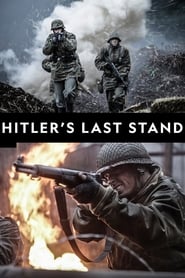
Hitler's Last Stand
I-download ang English Subtitle
Impormasyon ng release
Mga Tag
Download English Subtitle Files for Mobile (4)
Preview ng subtitle na English
Ang unang 200 linya.
May 1945.
During the final days of war in Europe,
an American tank commander
leads an unlikely band of U.S. and German soldiers...
to rescue French VIPs held in an Austrian castle.
As he organizes their defenses...
Lee's strategy is to keep the SS guessing
about the disposition of forces inside the castle.
They don't know he's only got 25 men and three officers.
But when Waffen SS forces attack,
he cannot be sure where their loyalty will stand.
On June 6, 1944,
Allied forces finally land troops in Normandy
to open the Western Front.
But Nazi fanatics and diehards
continue to fight ruthlessly for survival.
D-Day was a battle.
The Allies still need to win the war.
May 4, 1945.
Tyrol, Austria.
German Army major Josef Gangl and his driver
near the town of Kufstein,
occupied just the day before by American troops.
German resistance has more or less collapsed.
But it has not yet surrendered.
German troops are withdrawing to the Alpine region,
where there is this myth of this Alpine Fortress,
the last stand of the Nazis.
As they turn a corner,
they come face to face with four U.S. Sherman tanks.
Out of the car.
Alright. What do you want?
On the surface,
it may look like Gangl is one of thousands of German soldiers
surrendering to Western Allies.
Whoa, whoa, whoa!
But Gangl has come to Kufstein on a mission.
It may be risky.
Days prior,
the U.S. Army began to liberate
the nearby Dachau prison camp system.
After witnessing the atrocities,
many of the soldiers were of the opinion
that they simply weren't in the business of taking prisoners anymore.
But Gangl has joined the Austrian Resistance
to help defeat the Nazis from within the Third Reich.
Gangl is taken to Lieutenant Jack Lee,
commander of Company B, 23rd Tank Battalion,
U.S. 12th Armored Division.
Months of hard fighting gives Lee confidence,
on the edge of bravado.
In a couple of days prior,
a German colonel wanted to surrender a large number of his men
but wouldn't do so to a lowly first lieutenant.
So, Lieutenant Lee, making use of the fact
that the insignia for a first lieutenant is a single silver bar
and for a captain is two silver bars,
simply took a spare bar, put it on his collar,
and was a captain for a few minutes to accept surrender.
In English, Gangl delivers his message.
The German officer explains
that he has knowledge of important French prisoners
held by the Nazis not far away.
JOHN McMANUS: From the perspective of a U.S. Army commander,
you're wise if you decide, I'm only going to trust my own guys.
But you also have to be open-minded enough
to realize that there may be a lot of people
who need your help
and that you're probably going to do yourself
more harm than good
if you're shooting first and asking questions later.
Gangl presents a letter
written by one of the VIPs.
In it, they plead for rescue.
Rumors had circulated
about an Alpine fortress holding such prisoners.
The story could be true,
or it could be a trap.
McMANUS: It's a tough sell for someone like Gangl
to make the Americans understand
that he is going to join them in common cause
and that he's really not a supporter of Nazism.
Lee climbs into his tank
to radio his commanding officer.
HQ, this is Lee.
He shares the intel about the French hostages.
Lee receives permission to proceed
as he judges appropriate.
Alright, we'll see it through. Over.
It's indicative of how fluid the situation is,
there's not always going to be time to check in.
The battalion commander is telling Lee
that he needs to exercise his judgment.
Lee decides to check out the story himself.
He will reconnoiter to where Gangl claims
the VIP prisoners are being held.
Only one of Lee's gunners
and the two Germans accompany him.
Lee decides to travel with Gangl
to determine the German major's reliability...
and to verify his connections with the Austrian Resistance.
McMANUS: This situation
that you have there on the ground in Austria
is extraordinarily complex.
German Chancellor Adolf Hitler
committed suicide five days prior,
on April 30, 1945.
The German military is disintegrating.
Some surrender to the Allies.
Others retreat, or even desert.
In my opinion,
Gangl represents the state of the German armed forces
in May 1945.
He understands the war is lost, probably has also understood
that he had served the wrong cause.
And now is time to try to avoid even more damage
to our home country,
even if this means to cooperate with a former enemy.
But many still support the cause of Nazism,
particularly those in the Waffen-SS--
The military arm of the Nazi party.
There are a number of Waffen-SS troops
in northern Austria by this time.
Most of them are still determined to fight on.
They are fanatical.
When we hear "fanatic" or "fanatical" today,
we think of crazy people who fight on stupid-like.
But fanatic is actually considered a positive term
by the Nazis.
If they say you are a fanatic Nazi,
it's meant as a compliment.
The Waffen-SS will fight to the bitter end.
A couple of days before the war was over,
the thinking then was we are losing,
but when we are losing, our enemies shall not survive.
Their fatalism creates great risk for the Allies.
Whether in the next village
they will be met with open arms,
or whether they will be met with a hail of bullets.
The four men travel to their objective--
Castle Itter.
Their route will be dictated by roadblocks.
McMANUS: The Nazis controlled most every aspect of German life,
including the road net.
We have a roadblock at the entry points of a town.
This was a way to maintain control over populations,
to cow them into submission.
It was a way to maintain some semblance of political control.
With Gangl and his driver's knowledge of the area,
they bypass some roadblocks.
Other times, en route to the town of Worgl,
Lee and Gangl encounter Wehrmacht German Army troops,
who prove loyal to the German major.
As Gangl navigates each turn,
Lee must still wonder whether it's an elaborate ruse.
During a stop in Worgl, Gangl offers Lee formal surrender
of the garrison based in the town.
They then continue to Itter village,
situated just below the castle itself.
So, for Lee,
the next introduction must have been jarring.
Though he's dressed in civilian clothes,
the man is introduced as a Waffen-SS captain.
SS officers did not swear loyalty to Germany
and its constitution and its laws.
They swore a personal loyalty to Adolf Hitler himself.
These were the fanatics.
These were the people who ran the concentration camps.
Lee may have trusted the Wehrmacht officer,
only to fall into the clutches of the SS instead.
May 4, 1945.
In the final days of World War II,
an American tank commander believes a German officer's story
about French VIP prisoners in a nearby castle
needing rescue.
But while on reconnaissance,
Lieutenant Jack Lee fears he has fallen into the hands
of Waffen-SS Captain Kurt-Siegfried Schrader.
Why should I believe you?
But German Army Major Josef Gangl
vouches for the SS captain.
This creates a tense moment.
Gangl recognizes him.
They'd worked together before on Battle Group Giehl.
Schrader informs Lee and Gangl
that he has assumed responsibility
for the French VIPs' protection.
We can only speculate what motivates Schrader's change in mind.
Was it a true change of mind, or was it just opportunism,
seeing the war is lost for Germany.
They also learn from Schrader
that the SS unit that had guarded the prisoners
has fled overnight.
The VIPs are safe for now,
but everyone fears what's coming next.
Lee finds himself in a remarkable situation.
Two German officers-- one from the SS--
Have turned their backs on the Nazi cause
to assist American forces to protect the French prisoners.
I'm going to check this guy's story out.
Hitler's Last Stand subtitles in other languages
More English subtitles for Hitler's Last Stand
- Hitlers Last Stand S04 NORDiC 720p WEB-DL H 264 DDP5 1-CiNEMiX · 46 downloads · 2025-02-21
- Hitlers Last Stand S03 NORDiC 720p WEB-DL H 264 DDP5 1-CiNEMiX · 32 downloads · 2025-02-21
- Hitlers Last Stand S02 NORDiC 720p WEB-DL H 264 DDP5 1-CiNEMiX · 25 downloads · 2025-02-21
- Hitlers Last Stand Series S01 720p HDTV x264-1 · 33 downloads · 2022-03-03
- Hitlers Last Stand S02 WEBRip x265-ION265 · 63 downloads · 2022-03-02
- Hitlers Last Stand S01 WEBRip x265-ION265 · 44 downloads · 2022-02-28
Mga Komento
No comments yet. Be the first to leave one.