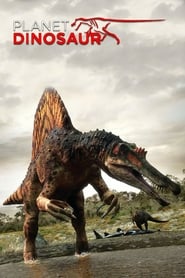
Planet Dinosaur
Télécharger le sous-titre en Farsi Persian
Informations sur la version
Tags
Download Farsi Persian Subtitle Files for Mobile (2)
Aperçu des sous-titres Farsi Persian
Les 112 premières lignes.
We're living through THE golden age of dinosaur discoveries.
From all over the world,
a whole new generation of dinosaurs has been revealed.
From the biggest giants and the deadliest killers...
to the weird and the wonderful.
from the Arctic...to Africa. From South America to Asia.
Using the latest evidence, for the first time...
we have a truly global view of these incredible animals.
In this episode,
we explore the last generation of killer dinosaurs...
..carnivores that took killing to a new level.
At the end of the Cretaceous period, 75 million years ago,
these hunter-killers had spread throughout the globe.
In the southern continents,
it was the powerful and muscular Abelisaurids that reigned supreme.
Whereas in the north, it was the famous Tyrannosaurs that dominated.
75 million years ago, the Dinosaur Park formation in Canada
was home to two of the largest Tyrannosaurs.
The biggest and heaviest was Daspletosaurus.
In 2009, medical scanners were used
to look inside the brain cases of these killers.
Of all the dinosaur groups, Tyrannosaurs were discovered
to have one of the largest areas devoted to smell...
something that would give them a clear hunting advantage.
Back then, Cretaceous Alberta
was a vast coastal river plain covered in forests...
..the perfect hunting grounds for Daspletosaurus.
At nine metres and three tonnes,
it's the dominant predator in these forests.
Here, it relies on its acute sense of smell and hearing,
as much as its sight, to hunt its prey.
Chasmosaurus,
a rhino-sized behemoth, bristling with defensive horns...
..and an opponent befitting a killer like Daspletosaurus.
Of all the tyrannosaurs, T Rex might be the most famous,
but the evolutionary blueprint for these predators
was laid down 10 million years earlier, with Daspletosaurus.
Tyrannosaurs' effectiveness as killers is clear from their anatomy.
They're massive, with huge, strong skulls, and powerful muscular necks.
Forward-facing eyes make tracking moving prey easy.
They've famously short arms,
but with these giant Tyrannosaurs, it's all about the bite.
They had the most powerful bite of any dinosaur with teeth that,
unlike the thin, flesh-tearing blades of Carnosaurs,
are thick and strong, easily able to crush bone and kill.
However, this Daspletosaurus has lost the element of surprise.
The odds are now stacked in the Chasmosaur's favour.
Even the most deadly predators fail more often than they succeed.
Tyrannosaurus appeared locked in a deadly evolutionary arms race
with the horned dinosaurs.
As one got bigger, so did the other.
It's a predator-prey relationship that endured
for more than 65 million years.
Most striking are the head frills of the horned dinosaurs.
The imposing frill of Chasmosaurus is actually made of thin bone
and wouldn't stop the bite of a Tyrannosaur.
But by making it look much bigger, it had the desired effect.
The horns and frills of these dinosaurs acted as visual deterrents,
even if they offered little physical protection.
It meant that a fully grown Chasmosaurus
would usually be safe from most predators.
This Daspletosaurus is just a youngster.
Even two Daspletosaurs pose little threat.
But in 2005, a remarkable discovery was announced.
In the Two Medicine Formation of Montana,
a new dig revealed had unearthed something quite extraordinary...
a collection of Daspletosaurus fossils,
all buried at the same place at the same time.
The implication is that Daspletosaurus hunt in gangs.
Tyrannosaurs, like Daspletosaurus, were so successful that,
by the late cretaceous, they were the apex predator across virtually
all of North America and Asia.
In Asia, there was Alectrosaurus, Alioramus and Tarbosaurus.
In America, Albertosaurus, Gorgosaurus,
Daspletosaurus and T Rex.
But moving further north, evidence of Tyrannosaurs
becomes increasingly rare.
In Alaska, fossils have been excavated close to the Arctic Ocean.
It's the richest source of dinosaurs that lived in the polar regions...
and it seems here, a different type of killer dominated.
The most common plant-eater in this region
is the highly social Edmontosaurus.
They're the largest duck-billed dinosaur in North America...
..and they are the perfect prey for a very different type of predator.
Troodon may not look as lethal as a Tyrannosaur,
but fossil evidence suggests that these too were deadly hunters
surviving entirely on a diet of meat.
At first sight, it appears the adult Edmontosaurus have little to fear.
12m in length and weighing 3.5 tonnes,
they physically dwarf this diminutive predator.
Troodon were usually small, two-metre dinosaurs...
but the teeth from the Alaskan Troodon showed something remarkable.
These Arctic predators were almost twice as big as normal.
Troodon not only survived here, they positively thrived.
And that's because their hunting prowess
comes into its own after sunset.
This is a land where, after late summer,
there are more hours of darkness than light.
Troodon famously have the largest brains
relative to their body size of any dinosaur...
..although what appears more important are their eyes.
Not only are they forward facing, making them active hunters,
but they are exceptionally large.
These are predators that can hunt equally well after dark.
Although the group offers protection,
predators always choose the easiest prey,
so it's the juvenile Edmontosaurs that are at risk.
Separated from the group,
this youngster has made a dangerous mistake.
The Alaskan dinosaur bone beds are dominated
by juvenile Edmontosaurus remains.
Some show clear evidence of Troodon bite marks.
Planet Dinosaur subtitles in other languages
More Farsi Persian subtitles for Planet Dinosaur
- زیرنویس 6 قسمت مستند BBC Planet Dinosaur - کاری از میهن دانلود · 18 downloads · 2013-07-30
- Planet Dinosaur S01E06 720p HDTV x264 SFM persian by m norouzian · 23 downloads · 2011-11-18
- Planet Dinosaur S01E04 720p HDTV x264 persian by m norouzian · 25 downloads · 2011-11-18
- Planet Dinosaur01x05New GiantsPDTV XviDPersian By felora60 · 25 downloads · 2011-11-12
- Planet DinosaurS01E02Feathered Dragons720p hdtv x264 persian by m norouzian · 31 downloads · 2011-11-05
- Planet Dinosaur01x01Lost WorldPDTV XviDPersian By felora60 · 26 downloads · 2011-11-04
Commentaires
No comments yet. Be the first to leave one.