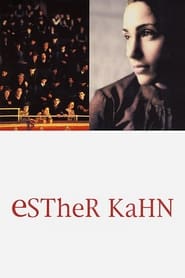
Esther Kahn
English felirat letöltése
Kiadási információk
Címkék
English felirat előnézete
Az első 200 sor.
So, I am Arnaud Despleuchins, the director of the film.
I am Emmanuel Pourdieu, the co-writer of the film.
Aurémy Stein, production director.
And Sébastien Lemercier, assistant and intern.
English writer from the beginning of the century, who is a not very well-known writer.
I came across a collection of
news called “Spiritual adventure”.
I loved this title because it sounded abstract and at the same time adventurous.
I liked the idea of there being a Stevenson side like that.
And it's a collection of short stories that is absolutely
wonderful, which I read a really long time ago.
And I always thought it would make a great movie.
So, I suggested it to some director friends.
I remember proposing to Lwowski, etc.
Everyone was like, “Yeah, that’s really good, but go ahead and do it.”
And so, after a while, it's up to you,
Emmanuel, whom I had read the news.
The short story is called “Esther Khan”, like the movie.
And this is the portrait of this young girl.
And so, afterwards, we met on the previous film, Emmanuel and I.
And after finishing the previous film, “How I
am arguing,” I brought the news back to your desk.
And there you have it.
And I made him read it asking me “ Is this a good idea for a film?
".
And there you have it.
But I had very...
It's true that I was quite scared when I read it
first time because the material is not cheap...
Finally, the dialogue material, we have the impression that there is no...
There is no story that is completely fabricated.
Yes, but you say that the dialogues are not given, but there, already, we see...
It's true that the dialogues are not given, but perhaps what had me
What struck me in the news is that there are a lot of images.
For example, from the beginning, it's the beginning of the film
where there are all these shots that go quite quickly, etc.
It's just images that come from his home.
Images of nailed shutters, images of the East
End, the description that begins the story.
And everywhere in the film, I find that there
has images like that, very, very striking.
And there is this movement which is interesting.
This is what struck me in the writing, that we start from very
off this street, the street where this little girl lives.
And we will then look for it by tightening it like this,
passing through these rather enigmatic nailed shutters.
I admit that for a long time, I did not understand the precise meaning of these components.
I felt it was an essential element, but I
didn't really know what that could mean.
The news, It begins with this, that the
girl was scared just by shutters.
So it seemed an enigmatic image.
It was the image that was violent like that.
It's funny because on the sets after that, when we do the location scouting,
all the preparation, the whole period of preparation for historical research,
this is where we come to understand, but not in intellectual terms,
but sometimes simply understanding where the images come from.
It's true that the girl lives in the East End, which is
therefore the popular district, the equivalent of the Marais.
In London.
And which is the Jewish quarter in the 19th and early 20th centuries.
And which before, initially, was the Protestant district where the
French had arrived when they had been put to sea.
The Huguenots, in fact.
The Huguenots, there you go.
And in fact, in this neighborhood, it was the only district where, by
permission from the mayor, they were allowed to have shutters.
Since in the rest of London, the shutters were taxed.
There was a tax.
That's old stuff.
And so, the little girl, She lives in a
neighborhood that is different from other neighborhoods.
And in fact, that's it, it's these shutters that are quite strange.
And the picture is...
And as the whole film is the portrait of 'a very withdrawn girl, who we see there,
like that, who is a pretty stubborn girl from the moment she is a child.
The little girl is Philadelphia.
Me, what I would like to say about the little girl, if I
can I allow myself to say that we found it before the adult.
According to a logic which has always amazed me and which I find entirely effective,
which is that the child must resemble the character and not the actress.
That’s an idea that it’s Pascal Ferrand
who taught me that, who taught me that.
That you should always choose actors because they look like
to the character and not because they resemble the adult.
And I find that it works.
Finally, I was surprised, once we discovered the adult, that the little one,
that she was doing well with the little one, in fact.
But it's true, the little one, She has a pretty amazing story all the same.
When she started the film, She didn't speak very well yet.
English since his father does not speak English.
Then it was an Albanian.
And her name is Philadelphia.
First of all, it's a character name.
We imagine the Albanian parents who say one day, you will be in America.
And she was a very girl... That's interesting to know.
I didn't know that about this little girl.
Because precisely, it starts with this problem.
It's starting, why?
By a language problem.
Why are there these words on the Metsouza that cannot be translated?
Is it because we can't understand them?
Is it because it's in another language?
Already, she doesn't know how to read well.
Additionally, She cannot read Hebrew characters.
And that's what interests him.
This is the description of the factory.
The small cane factory.
For me, it’s true that it’s one of the ideas that 'we had from the start.
It was to completely escape the picturesqueness of the costume film.
And it's true that I really recognize the screenplay work on the fact that it
we had to have the impression that we were in the factory and
not in a cute little workshop with woodwork etc.
And that there was nothing charming about it, that everything
was quite hard, like the scissors we saw.
It was blue and hard.
I think it also comes down to work a lot.
If I remember, all the preparation work was always to find
contemporary correspondences to what
was true at the time, that is to say modern.
For example, there, it was said that the little one, She is Albanian, She is an immigrant,
She doesn't really know how to speak English,
well not really when She arrived.
So each time, we were in the current correspondence of the scenario and
what was happening in Esther's life era.
We were doing it again today.
But in the script, that was already it.
In fact, in the script, we didn't say...
Finally, if we started to say to ourselves that we were making a period film, we would say everything
time we had to make a film for people.
Now, what, we can't do...
We make films for spectators 'today.
SO...
And besides, on this subject, all the shutters that we have seen, all the plans that we have
seen from the start, they are only natural settings.
This is London today, London and its surroundings.
But there are no studio plans.
Nothing was...
But that was the other, finally the big choice, but
which was already in the script, but who was after the...
It was that I wanted to make the film, obviously, in dec...
in natural decor, because it is the aesthetic school in
which I recognize myself, and that there is nothing studio.
And that the film is, in its own way, a portrait of London today.
And that’s true, suddenly, of...
Like filming in London, it's quite complicated for practical reasons.
It's not a movie town like Paris or New York can be.
But from the start, the idea was to make a film that always had a
relationship with the real streets, with the real settings, with the...
But I remember, there, we saw the iron curtains, too, of a discussion where
you said, but I assure you that the people did not have hats and that the
curtains were made of iron, which seemed absurd, but I had seen the
collections of photographs, there, that you have...
which had been established in the research.
Wavy rates, not only existed, but as, obviously,
it was an inexpensive material and was considered very modern, up-to-date,
and all that, people loved putting stuff
with wavy rates at the beginning of the 20th century.
Obviously, because for them, it was the height of modernity.
And when I realized that in the photos, I said to myself, that's weird,
you never see stuff like that in movies, whereas in photos of
time, that’s what we see all the time.
That, I like disappearances, the apparitions.
There, for example, we were filming in a working-class neighborhood in the north of
London, a little bit not in the East End, a little off the East End.
And...
I remember that the toilets for The film crew were in a pub in
side, so it was interesting, we are in a working-class environment.
and the whole film crew to go to the
toilet comes back in the pub absolutely gloomy and...
with everyone dead drunk at 11 a.m. and
which immediately sets the mood...
But that's 60% acting direction,
This is where we are shooting, in fact.
And besides, I remember that indeed
there were no toilets for the actors.
There were no small...
special treatments.
But it was in the same atmosphere.
This is the moment that really got me hooked on the news.
This is the moment when Esther Kahn's mother tells her that She looks like a monkey.
And it's funny, it's there...
If it's to tell the way I I really got hooked on this project...
of a mother who tells her daughter that she is a monkey and who tells her nicely I think
that this is what She is saying and in a certain way for
help him in the situation where She is what She feels.
who fixes his family identity like that.
All because She imitates.
She can't help but imitate.
That's not wise.
It's a very beautiful...
I really like the idea which doesn't come from the news anyway.
But It comes from another short story in the same collection.
It is that in the same collection, he says in his self-portrait and
it's funny how much Simon looks like Esther he says that when he is
arrived in London, he embraced life as he had seen
once a dog biting bubbles in a stream.
A dog in Ireland.
It says a lot about Simon's character and the man he was.
Someone who defines themselves by comparing themselves to a dog.
Esther Kahn subtitles in other languages
More English subtitles for Esther Kahn
- Esther Kahn 2000 1080p BluRay DD5 1 x264-SbR Subtitles01 machine ENG · 8 downloads · 2026-06-22
Hozzászólások
No comments yet. Be the first to leave one.