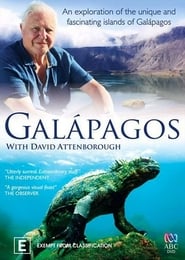
Galapagos with David Attenborough
Unduh Subtitle English
Informasi rilis
Tag
Pratinjau subtitle English
200 baris pertama.
subtitles added and redone by sixsnobs
Hidden away in the vastness of the Pacific, and undiscovered by men
until only a few centuries ago, lies a group of strange volcanic islands.
Each is a crucible where evolution proceeds at extraordinary speed.
Galapagos.
Each island contains its own unique community.
The discovery of these creatures inspired an idea
that changed our understanding of life on Earth...
Evolution.
And today, scientists on Galapagos are continuing to make
discoveries that shed light on that crucial process
and have revealed that human beings can be just as powerful
a driving force for change as any other factor.
Something here was the catalyst that produced the most spectacular
explosion of biological diversity in the world.
It's not just the number of species that appeared,
but the rate at which they did so, and the result is so extraordinary,
it inspired the most important of all biological theories...
Charles Darwin's evolution by natural selection.
And now, 200 years later, we're beginning to understand
the deep-lying forces that produced this biological wonderland.
One of those factors is isolation.
A part of Isabela Island, the largest of the 16 in the
archipelago, is so difficult to get to, it's hardly ever visited.
Wolf Volcano.
Its giant crater lies exactly on the Equator,
and is encircled internally by steep cliffs.
And on its flanks,
evidence was discovered of a catastrophe that might,
paradoxically, eventually lead to the creation of a new species.
This flow of recently solidified lava
has created an impassable barrier 100 metres wide,
right through the vegetation.
The fresh lava is razor-sharp, and almost impossible to cross.
On it lie bones.
Bleached white by the baking sun, they're those of giant tortoises.
Some animals that got stuck here are still clinging to life.
Tortoises are tough.
They can survive for months without any food or water.
And that worsened their fate...
it will take them months to die.
Why so many tortoises tried to cross the lava barrier, nobody knows.
What drove them to keep attempting this impossible journey?
Perhaps they were desperately trying to rejoin
other members of their group.
Their deaths, however, are significant.
They illustrate a principle that applies to the whole of nature.
It's not unique to the Galapagos, but it's because of the Galapagos
that we first came to understand it.
This tragic scene, filmed for the first time,
may provide a clue as to how a new species may start to evolve.
The lava flow created an impassable physical barrier
across the tortoises' territory, dividing it into two.
So two tortoise populations that were once one must now live apart.
If there is any significant difference,
now or in the future, between their two territories,
the tortoises may eventually become two different species.
Animals and plants are evolving throughout the natural world.
But it was the strange creatures of Galapagos that first revealed
how that happens.
Nearly 200 years ago, the islands were visited by a young naturalist.
On September 16th 1835,
HMS Beagle arrived in the Galapagos Islands,
and the 26-year-old Charles Darwin stepped ashore to explore.
At the time,
very little was known about the natural history of the islands.
Darwin, initially, was fascinated by its geology.
But it was the animals that gave him his historic insight.
Darwin was only on these islands for five weeks.
But in that short time, there were things he saw
and conversations he had which stuck in his mind.
For example, the British vice-governor of Floreana Island
said that he could tell which island a giant tortoise came from
simply by the shape of its shell.
He pondered on the vice-governor's casual remark.
Why were populations of tortoises on separate islands
all slightly different from one another?
He set about making a collection of animals and plants
from all the islands he visited.
Although it was the tortoises that first alerted Darwin
to the differences between animals on different islands,
it was his collection of these undramatic little birds,
the finches, which provided him
with the most substantial evidence for his great theory.
We now know that the ancestral Galapagos finches
arrived in these islands about 2 million years ago.
Since then, they have diversified into a number of different species.
Today, there are 13 of them,
distributed throughout the archipelago.
Each has its own special talents.
The woodpecker finch has discovered how to use a tool
to winkle grubs out of their burrows in the branches of trees.
The vampire finch has learned how to extract blood from sitting birds.
Darwin, when he returned to England, brought back with him
a wide variety of specimens of all kinds,
and he spent years studying his collections.
He had a range of finches from several of the islands,
and he noticed one particular way in which they differed.
They had beaks of different sizes.
Why?
An idea grew in his mind.
It would also apply to tortoises - maybe to all animals and plants,
wherever they occurred.
Painstakingly, meticulously, he started to accumulate
evidence from all over the world to support his idea,
and he called the process that produced new species
"evolution by natural selection."
And nowhere is its workings more vivadly evident,
than here when it first occured to him, in the Galapogos.
He realised why it was
that there were several species of giant tortoises.
That original species probably had a high-domed shell, like this one,
and that's very useful on well watered islands like this,
where you have to barge your way through the vegetation.
But on other islands, there are other problems.
In the southeast corner of the archipelago lies Espanola Island.
Here, there is virtually no edible vegetation at all.
Except, that is, for this prickly pear cactus, opuntia.
But this species of opuntia is very tall.
And it has a tough, woody trunk.
The only parts worth eating
are the fleshy leaves and flowers at the top.
Any giant tortoise that could reach them could get a meal.
Tortoises with low, round fronts to their shells couldn't do that.
But those with a peak at the front of their shell,
and long necks, could just manage it.
So they were the ones that survived and produced young.
Over many thousands of generations and millions of years,
the shell shape of the Espanola tortoise
became more and more exaggerated.
Now, the peak at the front of the shell is shaped like a saddle.
Such a change didn't happen just on Espanola...
different islands had their own versions.
Eventually, there were 15 different species on the islands,
all descended from a single founder.
But why should the environments of the islands be so different?
Well, a hint of that reason may come from looking at films
I shot right here, back in 1978.
In these programmes, we're going to survey
the immeasurable number of animals that have been produced
by natural selection, and look at them not as isolated oddities...
That image of me, shot 30 years ago, indicates something extraordinary.
In that time, the rock on which I was sitting has moved its position
by about a metre from where I was then to where I am now.
In fact, the whole of this island
is drifting across the surface of the globe
at a rate of about three centimetres a year,
roughly the rate at which my fingernails grow.
That may not sound much, but in the 3 million odd years
since this island emerged above the surface of the ocean,
it has drifted in a south-easterly direction by about 60 miles.
Movements in the Earth's crust are the key to understanding
the archipelago's extraordinary evolutionary history.
A giant hotspot, rising from the Earth's molten core,
began to build the Galapagos 4 million years ago.
But, as the island drifted away from it,
other volcanoes replaced it, one after the other.
Each was built from an accumulation of ash and lava.
But then, as each moved away, eruptions ceased.
So a group of islands appeared, one after the other.
The islands were separated from one another by water,
so their populations can't, for the most part, mix.
But they're just close enough for an occasional animal
to float across and so seed a newly emerging island.
Because the islands are of different ages,
they contain between them a great variety of environments.
And each has moulded its inhabitants in its own way.
That is why their animals are so diverse.
Each is a separate evolutionary community.
Darwin had noticed some of the clearest differences.
But there are many others that are less obvious.
An isolated population of animals can change
not only in their anatomy, but in their behaviour.
Little lizards like this are found throughout the archipelago.
Each island has its own distinct species.
And they differ not so much in the way they look
as the way they behave.
This is a lava lizard.
There are lots of them on the rocks around here.
And in the breeding season, which is now,
the males are competing with one another,
both for territory and for females.
And the way they do so is with press-ups.
Watch.
Actually, this is a model that is used by scientists
to investigate the way in which these lizards communicate
with one another.
Let's see how he gets on.
And there's a response.
These press-ups vary, both in the number and the intensity,
the speed at which they do it...
..and how high they bob their heads.
The interesting thing is that the responses vary
from species to species.
In other words, each species has its own language of gestures.
There are slight physical differences
between the species of lava lizard on different islands.
But now, because they have developed different gestures,
they can't interbreed, even if they meet.
They're separated by a language barrier.
Galapagos with David Attenborough subtitles in other languages
More English subtitles for Galapagos with David Attenborough
- David Attenborough’s Galapagos (2013) Complete Bluray 720p x264 Pahe · 104 downloads · 2017-11-25
- BSkyB Galapagos with David Attenborough 4of4 The Making Of HDTV x264 AAC MVGroup org · 44 downloads · 2014-05-09
- david attenboroughs galapagos s01e03 internal 720p bluray x264-shortbrehd · 41 downloads · 2014-03-08
- BSkyB Galapagos with David Attenborough 2of4 Adaptation HDTV x264 AAC MVGroup · 35 downloads · 2013-09-21
- BSkyB Galapagos with David Attenborough 3of4 Evolution HDTV x264 AAC MVGroup org eng · 39 downloads · 2013-01-20
- BSkyB Galapagos with David Attenborough 1of4 Origin HDTV x264 AAC MVGroup org eng(1) · 38 downloads · 2013-01-20
Komentar
No comments yet. Be the first to leave one.