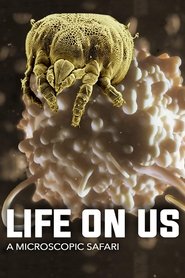
Life on Us: A Microscopic Safari
Unduh Subtitle English
Informasi rilis
Tag
Download English Subtitle Files for Mobile (3)
Pratinjau subtitle English
191 baris pertama.
Hidden on you is a world you have never seen
overrun with bizarre creatures that live on and in
every part of your body.
It's an animal.
It's on your face and we don't know very much about it.
Yet they are affecting us
in ways we never imagined
but now for the first time
we can explore this unknown world.
- They're an absolutely essential component of what we are.
This is a struggle of life and death.
- If we got rid of all of the microbes on us
and inside us we would die.
- So doctors are even reintroducing bugs into our bodies.
Larvae are alive.
They're going through the skin.
It's Judy plus hookworm.
You are more than human.
Each and everyone of us is a collection
of different life forms that call us home.
This is Life on Us.
You are mostly not you.
Come on.
You are home to an astounding array
of life forms.
Some creatures hide inside your bowels.
Others prefer the view from your eye brows.
There are gardens of fungi on your feet.
Alien tribes inhabit the jungle of your hair.
Tiny mites borrow into your face
and you host more bacteria
than there are stars in the milky way.
You and your bugs form a web of life.
In fact bugs are us.
Everyday this typical family is home
to 100 trillion hitchhikers
on their skin and inside their body.
These invisible colonizers keep them healthy.
Sometimes make them ill.
Hey!
- Mine! - You played yesterday.
No it's breakfast.
And even influence their behavior.
Wait!
Stop fighting!
Yet until recently we understood very little
about our microscopic residents.
Germs have a bad reputation.
We think of them as the cause of disease
but paradoxically we couldn't survive without them.
We have our tunnel vision.
Bacteria are bad.
The archaeans are bad.
All this stuff growing on me is bad.
Let's just nuke it.
And the majority of those organisms
are actually good for us.
They're assisting us.
They're not our enemies.
Our obsession with bad bugs
left us blind to the good,
but now genetic tools allow us to see
what we've been missing.
Molecular tools, sequencing DNA,
have allowed us to get a true picture
of what organisms are there
and there's a far richer picture than we had previously
appreciated for our culturing microorganisms.
By decoding the genes
of these microscopic creatures
we can reveal a new microbial world.
- The genetic tools are kind of like the new telescope.
- Think of it as a geographer that might have
just been studying the fields
around Norway their whole career
and then somebody says, "Oh by the way
"we just discovered the Americas and Australia,"
and nobody had ever heard of it before.
For the first time we can see the microbes
that live on us and inside us.
- It's a bit like a gold rush at the moment.
It really is a very thrilling thing.
Scientists have embarked on a journey
into the unexplored world of our own body.
They are discovering how we are all shaped and kept alive
by the bugs that live on us.
As the crust covers planet Earth
the skin covers the body,
an impermeable barrier between us and invading germs.
But we only realize just how important it is
when it's compromised.
I see people's lives changed
in an instant on a daily basis.
But that tissue on the corner right
is not gonna stay.
Fiona Wood is a world leading burn specialist.
Her struggle to save lives is all about beating pathogens.
The microbes that cause infections.
We have bacteria and pathogens
all over us all the time.
When you have a breach in your skin there's a way in
and that way in is going to be there
until we seal the wound.
So the longer the wound is open
the greater the risk of getting infected.
So what we want to do is close that surface.
Seal the surface of the wound as quickly as possible
while the waves of infection keep coming over.
If you waterproof you will survive.
And central to that survival
is the layer of microbes that live on our skin.
Like the atmosphere that protects our planet
our microbes form a shield against alien invaders.
If some pathogen arrives on your skin
it's not your immune system that rises up to greet it.
The first thing that greets it is this microbial layer.
This hairy invisible cloak.
But where do these bugs come from?
The answer lies in the miracle of birth.
For the baby the womb is a solitary world,
but outside an army of microbes awaits its arrival.
The moment you're born you're colonized
with your mother's microbes.
Until then you can be called 100% human
but after that moment you're really
just 10% human and 90% microbes.
- Which as a scientist is very very exciting,
but as a parent is terrifying.
Towards the end of pregnancy
the bacteria that live in the mother's gut
migrate to the vagina
ready for the baby to pick them up
as it slides through the birth canal.
Being covered in vagina microbes
may not seem much of a trait,
but it's a gift that lasts a lifetime.
These bugs not only protect us from infections
they're essential for our overall health.
They also have an important role
in regulating the immune system.
The immune system never rests.
Its cells constantly patrol our bodies
to eliminate pathogens,
but this power can also be dangerous.
- It can potentially damage your own tissues
and therefore it must be controlled.
It must be turned down.
It must be regulated.
The immune system has an internal police force
keeping it under constant surveillance.
- If you don't have a properly regulated immune system
it becomes trigger happy.
It's attacking people's brains.
It's attacking people's joints and giving them arthritis
or it's attacking the contents of the gut
and then you have inflammatory bowel disease,
or it's attacking trivial quantities of pollen
or dog dandruff or whatever in the air
and that gives you allergic airway disorders.
And what keeps our immune system in check
is our microbes.
- So that if you have that organism in the gut
you have more, more policemen.
More regulation.
More control of the immune system
so it doesn't get trigger happy and do crazy things.
The supply of these microbial regulators
doesn't stop at birth.
The mother continues to deliver hundreds
of species of bacteria in her breast milk.
- And it's only very recently that it's become clear
that breast milk comes with a whole suite of microbes
that have moved up through the mother's body,
through the lymph, into the milk,
and come as part of what goes
into the baby with the breast milk.
Breast milk also contains sugars
that the infant can't digest.
These are like fertilizer for the baby's
rapidly developing gut flora.
- And the breast milk becomes this really amazing example
of the way in which our bodies actually evolved
to help these microbes to the next generation.
By the time a child is two and a half
it will have developed a fully mature microscopic community.
Collectively they're known as our microbiome.
They're as much apart of us as any of our own organs.
We shouldn't think of them as a scary
part of our machinery.
They're an absolutely essential component of what we are.
Every one of us is a finely tuned society
Komentar
No comments yet. Be the first to leave one.