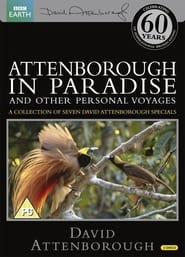
Attenborough in Paradise
Scarica il sottotitolo English
Informazioni sulla release
Tag
Anteprima dei sottotitoli in English
Le prime 200 righe.
These arrows and this bow
belong to a man who has never seen a European face.
So does this house.
I'm in the middle of Central New Guinea
and these wonderful mountains all around
are one of the few places left on the surface of the earth
that are truly unexplored.
Until only a few months ago
it was thought that this area of Central New Guinea
was completely uninhabited.
And then Laurie Bragg, the Assistant District Commissioner for this area
was looking at some aerial photographs to try and map this area,
to make sense out of this tangle of mountain ranges and rivers.
And on the photographs he saw one or two tiny pinpoints,
which indicated to him that there there were gardens like this one
and houses and people.
People who had not been contacted ever by the outside world.
And so it was decided to send an expedition to try and find them.
Aeroplanes first arrived in this country back in the '20s.
The island of New Guinea is immense 1,500 miles long,
lying between Australia and the equator,
and 50 years ago its interior was virtually blank on the map.
The aeroplane has ever since been a key tool in filling in that blank.
Sometimes by dropping supplies to explorers who had marched for weeks,
sometimes by dumping men on a sand bank by an unknown river,
sometimes, as now by giving a man like Laurie Bragg
a view of what lies ahead of him before he sets off into new country.
And the view is hardly welcoming.
An unbroken carpet of green corduroy,
jungle as thick and as sticky as you can find anywhere.
Does it look OK for the canoes?
Yes, there aren't many snags. It's hard to tell the current from here
but it looks pretty good.
How many times have you been here?
I haven't. Has anybody?
Not beyond here.
There's a village!
It's the last known one.
You can start to see some snags in the river now.
It's a bit marginal for canoes now.
There's some bad rapids. Will we get this high?
We won't get canoes here.
Could we go down and have a look at that junction? At the foot of that ridge?
There's the junction. That could well be it.
- I'm looking for that garden area. - (Man) Eh?
I'm trying to pick out that garden area I saw.
There's a big garden complex under the top of this mountain here.
Is that everything you want to see?
Yeah. Except for clouds.
Back at his base at Ambunti on the Sepik River,
Laurie Bragg develops his plans
for a major patrol into those unknown mountains
to discoverjust what was there.
We'll move from Ambunti here downstream along the Sepik
in two work boats the Opal and the Sapphire,
and come into the Karawari River here.
Follow the Karawari upstream into the Korosameri.
The work boat should get to about here
and then the river'll be too shallow for the work boats.
We'll be towing canoes with the boats... the work boats
and the canoes will shuttle us and the rations and patrol gear
up to approximately here,
where I think we'll run out of sufficient depth of water to take canoes,
and from there we'll have to walk.
What's the walking gonna be like?
- Very difficult. - Is it?
- Yes, if we look at the... - Yeah.
Um, aerial photographs of the area, I don't want to shock you but...
That's the Salamei River.
Er, we won't get that far with the canoes, we'll have to walk from here.
We'll be moving up to that junction there,
which I don't know what it's called
and then we'll be going to this ridge
and follow that to the crest of the Salamei-April divide.
You can see garden areas there. See them?
They're scattered across that face,
2,500-3,000 feet above sea level
and we'll establish ourselves on that ridge
somewhere where we find people and let the people come to us.
Patrols are the means of administering this country.
Every few months government officers like Laurie Bragg
take a handful of armed native police, leave their stations
and travel for weeks visiting the people in their territory.
In the settled areas they see that schools are started and roads built
and that the people get some sort of medical help.
In the wilder parts the job's more dramatic.
Tribal feuds must be stopped and elementary law established.
This patrol would be different only because in addition to doing all that,
it was going to walk slap across
one of the last of those empty blank patches on the map
to try and sort out its geography on the ground
and, if possible, contact the inhabitants, who so far had never seen Europeans.
40 years ago the Sepik river was notorious for its head-hunters.
Indeed, it was news of a spectacular head-hunting raid
that made the government decide to establish the station at Ambunti
240 miles up the river, in what was then the dark interior.
The men of one village had raided their neighbours, lopped off 28 heads,
boiled them and scraped them, moulded them with clay
and stuck them up for display.
Even today it's not unusual to hear of a ritual murder in the remoter parts,
away from the main river and the eye of the government.
90 miles downstream from Ambunti we left the Sepik
and turned into a tributary that came in from the south.
This river was shallower and hemmed in by rafts of floating reeds
so we had to leave the two big boats
and carry on in three canoes with outboard motors.
On the Sepik we'd seen quite a lot of people travelling in canoes
but here there was no one, just flocks of ducks and eagles and herons.
After three days of travel we came in to land
at the last known village on this river - Inaru.
This was the end of the easy bit.
From now on we should be walking.
Patrols only come up as far as Inaru about once a year
and none had ever been beyond it.
For the villagers, our arrival was an important event,
and since there were only 50 of them
we represented an almost overwhelming invasion.
The people of Inaru live very simply.
They plant a few vegetables
but rely heavily on the forest to supply them with fruit and meat.
The river provides them with fish, mostly black, bony catfish,
and once a year it presents them with an enormous bonanza - mayflies.
For three days, millions of them hatch and rise
to swirl in blizzards over the surface of the water.
No one knows what particular chemistry in the river or change in the climate
causes all of them to emerge at the same time in this fashion.
But the Inaru people know well enough that this limitless gift of food
will only be here for a day or so.
All the women and children go down to the river to harvest it.
The newly-hatched insects are soft and juicy
and eaten still wriggling, just like oysters.
Our porters relished them just as the villagers did.
Life in the jungle may look blissful and untroubled
Adam and Eve in a primitive paradise.
But in fact only too often it's scourged by disease.
The headman had a tropical ulcer on his foot the size of a golf ball.
There were cases of yaws and malaria and skin fungus,
all diseases easily treated by the medicines we had with us.
The villagers knew that perfectly well and were delighted to see us.
Communication, however, was not easy.
Astonishingly, there are over a thousand mutually incomprehensible languages
in New Guinea. The Inaru language is only spoken by these people
and two other villages, about 200 people in all.
If we were to meet any new people on the journey ahead
interpreters would obviously be invaluable
but plans to get them had already run into snags.
We were expecting to get a... Bisorio bloke to interpret for us...
but we haven't got him yet.
and the Bisorio people live in these hills over here.
And they're nomadic.
And, er, the local people here have agreed to go and look for them
but they're not sure they're gonna find them.
When did they last see them?
Two blokes from this group, a month ago.
When they came in from the hills over there to trade for tobacco.
Er, since then they've had a party of their own go to look for the Bisorio
and they've found their last camp and the houses have been burnt down.
Probably an accident. I don't know. But...
they appear to have gone further north.
But they're a nomadic group and they're gonna go and look for them
but it might take four or five days.
How do you look? It's a hell of a big country and there are very few people.
They'll go to a house that's been burnt down and try to find a track from there.
Do the Bisorios speak to the people we're interested in, directly?
There's nobody who can speak directly to the Bikaru,
which we think are the groups we're looking for.
The only people who can speak to the Bikaru
are the Bisorios, who are bilingual.
Or some of them are.
And one of our blokes round here somewhere
speaks the Bisorio language,
and we'll speak pidgin to our interpreter who'll speak Bisorio,
and the Bisorio'll speak to the Bikaru.
So Constable Caius and two Inaru men
set off in a canoe to try and find us an interpreter,
a nomad, who might be anywhere in several hundred square miles of forest,
and who might not be too keen on being discovered anyway.
It seemed a fairly tough assignment.
The next day we would set off on foot,
following the river into the mountains.
Since from here on we should be in uncontrolled country
we might have to defend ourselves.
So Laurie issued bullets to the police,
and at the same time as the regulations insist,
gave instructions in pidgin on when and how a man was permitted to fire.
Or you in supreme court long killing man.
And so the march began.
There was no track so two men at the head of the column
had to cut a path wide enough for people burdened by bulky loads.
Because we had no idea when or where we might find villagers
from whom we could get food and shelter
everything we needed had to be carried with us on men's shoulders.
Tent, medicines, lamps, surveying equipment, radio gear,
personal baggage, trade goods such as beads and salt and knives
photographic equipment, axes, buckets and, above all, food.
Food for us food for the carriers of equipment
and more food for those carrying food.
We marched up the east bank of the river
but most of the unknown country lay to the west,
and so eventually we had to cross it.
Attenborough in Paradise subtitles in other languages
More English subtitles for Attenborough in Paradise
- 7of7 Amber Time Machine xvid ac3 www mvgroup org ENG · 16 downloads · 2007-10-04
- 6of7 Life On Air xvid ac3 www mvgroup org ENG · 18 downloads · 2007-10-04
- 5of7 The Song Of The Earth xvid ac3 www mvgroup org ENG · 12 downloads · 2007-10-04
- 4of7 Bowerbirds The Art Of Seduction xvid ac3 www mvgroup org ENG · 12 downloads · 2007-10-04
- 3of7 Lost Gods Of Easter Island xvid ac3 www mvgroup org ENG · 16 downloads · 2007-10-04
- 1of7 In Paradise xvid ac3 www mvgroup org ENG · 13 downloads · 2007-10-04
- -=COMPLETE=- xvid ac3 www mvgroup org ENG · 35 downloads · 2007-10-04
Commenti
No comments yet. Be the first to leave one.