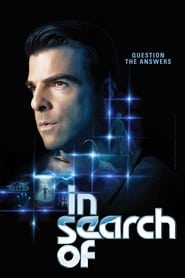
In Search Of
Scarica il sottotitolo English
Informazioni sulla release
Tag
Anteprima dei sottotitoli in English
Le prime 200 righe.
One of the most mysterious parts of our human existance
is the nature of time.
What exactly is time?
How does it work?
Moving from past to present and into the future.
Does time only move forward?
Or can we manipulate it and go back?
The potential for time travel has been entertained
in our wildest imaginations, and in ancient texts.
But some believe it's more than fantasy.
I know that time travel is possible because I've done it.
When I traveled, I jumped through an elliptical boom
between a shimmering curtain of radiant energy.
A bluish-white tunnel opened up.
Moving forward in time at a great rate of speed.
It was both awe-inspiring and terrifying.
Contemporary physicists don't realize
that time travel was achieved 50 years ago,
because the file were kept back from science.
And I aim to change that.
Is time flexible, can it be manipulated,
and is it actually possible to travel through it?
My search begins now.
My Name is Zachary Quinto.
As an actor, I've played many supernatural characters
that blurred the line between science and fiction.
I'm drawn to the unknown, the otherworldly,
and those experiences so beyond belief,
they call everything into question.
I'm exploring some of the most enduring mysteries
that continue to haunt mankind in search of the truth...
wherever it leads me.
[metronome clicking rhythmically]
Ever since humans first began tracking time,
we've been obsessed with understanding and trying to control it.
With early Egyptian devices like sundials and shadow clocks
to later advancements like the hourglass,
pendulum clocks, and now the modern smartwatch,
time has always been a central topic in religion,
philosophy, and science.
But what exactly is time?
Is it a purely human construct?
Or is it an independent dimension
that can be explored and even traveled?
Movies and literature have only have only stoked our curiosity.
But what if you could move freely between past, present, and future?
Where would you go? What would you see?
And if you could travel back in time,
would you be able to alter our present reality?
I'm meeting with a man who claims to have answers for many of these questions,
because he says he's actually traveled through time.
I understand that you not only believe time is movable
and that you can travel through it, but you've actually done this.
Yes. By the mid-1960s,
my father was the nation's leading expert in teleportation
when he was a special projects engineer
at the Thomas A. Edison Research Laboratory
in West Orange New Jersey.
And I was primarily active in the program
from the fall of 1969
until the end of the summer of 1972,
with DARPA serving as the umbrella agency.
It's a government agency. Right? Right.
DARPA is the Defense Advanced Research Projects Agency.
Mm-hmm. The primary
technical development laboratory for the US military.
So how do you explain the disparity
between the scientific point of view, right,
which is that we understand time only exists in a forward-moving pattern--
that there's no other dimension of it--
and your experience, being able to travel through time?
Because that information was kept as official state secrets.
And so, for example, an important discovery
was Nikola Tesla's discovery of radiant energy--
an energy he found that is latent and pervasive
in the entire universe
and has, among its capabilities,
the capability to bend the fabric of time space.
Let me show it to you.
Okay. Sure.
There was two elliptical booms,
about ten feet high
and about ten feet apart.
The device is a Tesla invention?
Between these two booms
was a shimmering field of radiant energy--
energy that can bend the fabric of timespace.
My father explained that we were gonna jump through this field of energy.
We would go through a blueish-white tunnel of light.
It sounds like science fiction.
On one hand, I feel like this is
an incredibly compelling, fascinating, dramatic story.
I would love to believe. That would be amazing.
But it's like, I'm interested in the tangible.
I'm interested in the thing that we can look at and say
that that's what this is irrefutably.
I mean, there's so many questions that I have.
Tesla was a well-documented scientist,
and his experiments were chronicled catalogued.
So, if there was a scientific advancement that he discovered,
wouldn't that have been inrmation and knowledge
that would've been shared with the scientific community at the time?
There was a Tesla cover-up.
It was perpetuated by Tesla himself to protect the technology.
Contemporary physicists do not understand
how and why we achieved time travel
because the information was kept back from them.
They deserve to be told what everybody deserves to be told,
and that's the truth.
Andrew presents it like, "This is what I did,
and it was a secret government program.
You know, there are obviously other people that you can talk to
about things in our government's history
that are top secret and are classified.
But there's not that many people like Andrew
who are asserting that they've actually traveled through space and time.
So, I-I don't know.
I feel really conflicted about this one.
What he's talking about would be revolutionary
and change the world and how we move through this universe.
And that, to me, is really worth exploring.
Andrew is not the only one who claims
to have experience with time travel.
There are many other incredible stories
about people supposedly going back in time.
Some even have evidence.
Like this 1928 film
of a woman who appears to be holding a cell phone
decades before that technology existed.
Or this modern-looking man in a photograph from the 1940s.
But if people have learned how to time travel,
why don't we all know about it?
For years, there have been rumors of time travel research
being conducted in secret, like the Montauk Project,
an alleged U.S. government program
experimenting with time travel to use in warfare.
Putting all this evidence together, is it possible
that Andrew's story might have some truth?
To find out, I need to understand more about how time works.
Hi, Zach. Good morning.How are you?
Mathematician Tom Van Baak
believes that time is not an absolute,
and that while clocks appear to tick at the exact same speed,
day by day, not all time is created equal.
It was only in the last hundred years, with the theories of Einstein,
that he proposed this radical idea that time wasn't fixed.
It's mind-blowing.How? How is that possible?
I mean--Well, it seems that gravity and time are somehow related.
If we have two clocks,
and one clock is here, at sea level,
where gravity is the strongest,
and one clock is raised far up into a mountain,
where there's less gravity, the clock closer to Earth
is actually running slower than the clock that's further away from Earth.
If you have excess gravity, time slows down.
It's incredible. So, someone who lives in New Orleans, for example,
and someone who lives in Denver--
these two clocks would, theoretically, be running at slightly different speeds?
Not just theoretical, but that's an example
of something you can actually verify.
Would you like to see how?I would love to.
These are all clocks.Uh-huh.
And that demonstrate the tremendous evolution of timekeeping.
There are all different types.
We have the classic sand timer. That old chestnut.
This is a chronometer
from the 1950s.
This is a military quartz crystal. Mm.
But still not as accurate as we would need for a relativity experiment.
Right. For that, we need an atomic clock.
So here's the inside of an atomic cesium clock.
It allows to measure down to one nanosecond in a day--Wow.
...for the relativity experiment. Great.
There's our man.
And he would agree.He would agree.
Our experiment will test
Einstein's theory of relativity
by placing two atomic clocks at vastly different elevations.
One clock will stay at sea level--
We need to synchronize the clocks-- Okay.
...so they're all equal. ...while the other
will be placed on a mountain
6,000 feet above sea level.
Very simple experiment conceptually.
If the theory of relativity is true,
the clocks that are on the mountain
should come back a tiny bit ahead of the clocks left behind,
and that's because the clocks at higher elevation
run a little bit faster than clocks at sea level.
Theoretically, the greater the distance
the bigger the gap in time.
So if time runs at different speeds in these two locations,
does that mean that time is not fixed?
We're about to see, with our own eyes,
just how flexible time can be.
Coming up, I investigateve .
Uh-huh.Time's not fixed.
There's slight variations possible. It's mind-blowing.
I'm diving in to the true nature of time
to see how it works.
In Search Of subtitles in other languages
More English subtitles for In Search Of
- History Channel Revival E03 In Search Of Monsters of the Deep 720p HDTV x264 AAC · 14 downloads · 2019-02-02
- History Channel Revival E02 In Search Of Super Human 720p HDTV x264 AAC · 10 downloads · 2019-02-02
- History Channel Revival E01 In Search Of Aliens 720p HDTV x264 AAC · 13 downloads · 2019-02-02
- History Channel Revival E06 In Search Of Sinkholes 720p HDTV x264 AAC · 11 downloads · 2019-01-01
- History Channel Revival E04 In Search Of Artificial Intelligence 720p HDTV x264 AAC · 14 downloads · 2019-01-01
- In Search Of Artificial Intelligence 720p HDTV x264 AAC MVGroup org · 11 downloads · 2018-12-20
Commenti
No comments yet. Be the first to leave one.