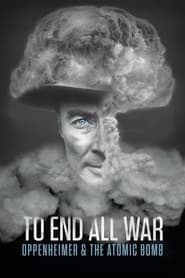
To End All War: Oppenheimer & the Atomic Bomb
Scarica il sottotitolo English
Informazioni sulla release
Tag
Anteprima dei sottotitoli in English
Le prime 200 righe.
I have
been asked whether, in the years to come,
it will be possible to kill 40 million American people
by the use of atomic bombs in a single night.
I am afraid that the answer to that question is yes.
Robert Oppenheimer was the father of the atomic bomb.
He was this complex ball of contradictions.
They are weapons of aggression, of surprise and of terror.
Oppenheimer wanted the bomb to be used.
How else would the world know what it
was? Dr. Oppenheimer,
are we creating something we may not be able to control?
In a world of atomic weapons, wars will cease.
It is D-minus one for the
test of the world's first atomic device.
This cultured, nonviolent man was responsible for birthing
the most violent weapon in human history.
He devoted the rest of his life to trying
to control the monster he had unleashed.
If there is another world war…
this civilization may go under.
He became a political pariah. Is it
true that humans have already discovered
a method of destroying humanity?
And it finally ruined him. "Now I am become Death,
the destroyer of worlds."
We have made a thing that, by all the standards of the world we grew up in,
is an evil thing.
[Bradbury Reid] When I was 15,
I had a chance to speak to Oppenheimer alone.
He was at a cocktail party.
I was serving hors d'oeuvres…
...and found Oppenheimer standing alone.
I said, "I think you're some sort of a saint." And he was very taken aback.
And he said, "W-Why would you say that to me?"
And I said, "Because you had second thoughts."
And he turned around and picked his hat up and walked out the door.
It obviously struck him in a way that I had never imagined.
Oppenheimer for Cronkite, take
one. Dr. Oppenheimer,
with all the inevitability of the decision that history demonstrates to us,
you still seem to suffer, may I say, from a bad conscience about it.
Is that true, sir? Uh, I think when you play a meaningful part
in bringing about the death of over a
hundred thousand people… uh, you naturally,
uh, don't think of that with ease.
When you look at the history of Oppenheimer,
it's very difficult to find any person in
history sitting in such a complex situation
with all kinds of impossible questions and very few answers.
Everybody has their own idea of what Robert Oppenheimer is.
I mean, the fact is that he invented a weapon
that can destroy human life on Earth.
I mean, don't forget that this weapon,
which has the capacity to end civilization,
was developed as a means to save Western civilization.
In the 1930s, millions of Americans
were following the news coming out of Europe
in their local theaters, watching newsreels.
And Oppenheimer was horrified by the rise of Hitler.
His sense of his own Jewishness made him immediately and massively aware
of the danger of fascism.
When the war started in 1939, he was a professor at Berkeley.
And that same year, one of his students comes rushing into his office
to convey the news that fission has been discovered.
Word has just come through from Germany
that the uranium atom under neutron
bombardment actually splits into two parts.
Initially, Oppenheimer can't believe it.
He runs to the blackboard and does some mathematics,
and he comes to the understanding that
you could use fission to generate energy.
Einstein showed explicitly that if you can convert matter into pure energy,
the amount of energy is extraordinary.
It's the speed of light squared, for crying out loud.
They realize that from a very small amount of matter,
you could make power to drive ships and planes
and trains, whatever, make electricity, of course.
And they also realize very quickly
that it might be possible to make a weapon of untold destruction.
- -
We were deeply worried.
After all, the discovery of fission was in
Nazi Germany. [airplane passing overhead]
Nazi Germany could potentially build a nuclear bomb.
This was the worry, and it was very tangible, it was very real.
December 7th, 1941, a date which will live in infamy.
Pearl Harbor happens.
I assert that this form of treachery
shall never again endanger us.
Now the United States is an active combatant in the war.
The idea at this point is,
we basically need to get this done as quickly as possible,
because we could wake up tomorrow,
and Hitler could have that nuclear monopoly that we all want to avoid.
So, we need a place where we can design, build, test
and help deliver nuclear weapons. But even before we pick the place though,
we need to find somebody who can lead that installation.
And virtually nobody expected Oppenheimer to be named
the director of the weapons design laboratory.
He was kind of this ethereal personality.
He had no record of having big achievements.
One of the scientists who knew Oppenheimer said,
"This is a man who couldn't run a hot dog
stand." Oppenheimer's friends felt
that he was a divided man not quite sure of his identity.
He said at one point, "From my earliest days, I never did anything
or thought anything or knew anyone
where I didn't feel about myself the deepest loathing."
Oppenheimer was born in 1904
and into an age of great scientific possibility.
The first two decades of the 20th century
were periods of incredible intellectual daring.
Electricity, automobiles, flight were all transforming daily life.
And then you had incredible advances in science,
and it looks like almost anything could be achieved.
The story of Oppenheimer
is really the story of immigrant America.
His father comes over from Germany, gets a job in the garment industry
and makes a tremendous amount of money,
winds up on the Upper West Side on Riverside Drive.
And he's got a Picasso, and he's got three van Goghs.
His mother was a Paris-trained artist
who exhibited her work at various galleries in Manhattan.
She was a nervous person.
She really didn't let this little boy go outside.
And he was very sheltered and extremely socially awkward.
When he finally went to camp one summer,
he was so nasty to the other kids that they roughed him up.
He said later they put him in the icehouse
all night, naked, and painted him green,
including his genitals. Oddly enough, Oppenheimer didn't protest.
He just took his punishment stoically.
It was a very odd reaction for a young boy at that age.
Imagine this sensitive boy, this very smart boy,
but one who has no idea how to deal with other people.
Certainly not with children his own age. He's had no experience.
The real core psychological moment for Oppenheimer
appears to have been when he was in college.
And he goes to study physics at Cambridge, and he doesn't do very well.
He ends up in a laboratory that's really about experimental physics,
and he is not good at that.
He doesn't really know how to do an experiment with his hands.
And he has this sort of crisis of confidence.
This came to a head when he had a--
what I think can only be described as a nervous breakdown.
One of his friends stumbled upon him in an empty classroom
where Oppenheimer was standing at the blackboard.
Muttering to himself over and over again,
"The point is… the point is… the point is…"
And he could never finish the sentence.
And then another one of his friends
went to his dorm room and heard this moaning inside and opened the door,
and there was Oppenheimer in a fetal position,
-rolling back and forth, groaning. -
He literally came close to committing suicide at that point.
He saw a psychiatrist as a result of this,
and the psychiatrist said that he's kind of living in his own world.
He was having an identity crisis,
something we're clearer about these days than we were then.
His parents took him to Paris, where he saw yet another psychologist,
and in a very French way prescribed a professional woman and red wine.
So… Uh, we don't know if that happened.
He had always been the top of the class, the smartest person,
admired for his intellectual capability by all his classmates.
And suddenly, he was an incompetent.
And he just couldn't deal with that at that
point. And what snapped him out of that
was his discovery of theoretical physics, of quantum physics.
At the time, it was sort of the golden age of physics.
It was a very exciting time to be a theorist. And if you are young and quick
and willing to think weird ideas that nobody else has ever thought,
you can potentially make a huge amount of progress and a name for yourself.
So, when Oppenheimer decided to move to Gottingen in Germany
to study with Max Born, a theoretical physicist, he blossomed.
He meets some of the leading physicists in Germany at the time.
Heisenberg, who, ironically enough,
would lead the German atomic bomb project.
And while he's over there,
he sort of invents this Oppie personality.
This is where he gets the name. They
call him Opje, and this turns into Oppie.
And Oppie is not an insecure young American
who doesn't really know what he wants to do. Oppie is the brilliant guy
who is always five steps ahead of everybody
else and can keep everything in his head.
Oppie is a genius who's very eccentric and interesting
and strikes a really dashing figure and is chain-smoking.
And you see these pictures of him from the '20s. It's very Bob Dylan.
He had the eyes of an Old Testament prophet inside this frail body,
and he sort of cocked himself with his funny little porkpie hat on top.
So, Oppie is this sort of construction
of everything that he would want to be. And
that re-creation is immensely successful.
When the cancerous Nazi growth spread farther still,
the people of Europe, and the world, entered a new era.
Certainly the first motivation for the scientists
was to beat the Germans to the bomb.
There's nothing like the prospect of a hanging to concentrate the mind.
And the threat of death of civilization as they knew it was so great
To End All War: Oppenheimer & the Atomic Bomb subtitles in other languages
More English subtitles for To End All War: Oppenheimer & the Atomic Bomb
- To End All War Oppenheimer and the Atomic Bomb 2023 NORDiC 1080p WEB-DL DDP5 1 H 264-GRANiTEN · 156 downloads · 2024-03-26
- To End All War Oppenheimer The Atomic Bomb 2023 1080p WEBRip x264 AAC5 1-[YTS MX] · 205 downloads · 2023-09-16
- To End All War Oppenheimer The Atomic Bomb 2023 720p WEBRip x264 AAC-[HQCINEMAS COM] · 104 downloads · 2023-07-24
- To End All War Oppenheimer & the Atomic Bomb 2023 1080p WEBRip x264 AAC5 1-[YTS MX] · 127 downloads · 2023-07-15
- To End All War Oppenheimer The Atomic Bomb 2023 720p WEBRip x264 AAC-[YTS MX] · 180 downloads · 2023-07-13
Commenti
No comments yet. Be the first to leave one.