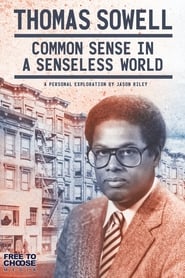
Thomas Sowell: Common Sense in a Senseless World
Scarica il sottotitolo English
Informazioni sulla release
Tag
Anteprima dei sottotitoli in English
Le prime 200 righe.
has always been disintegrating, that is nonsense.
His studies go up to 1925.
The great bulk of black families were intact
two-parent families up through 1925
and going all the way back through the era of slavery.
So it is now only within our own time
that we suddenly see this inevitable tragedy
which the welfare system says it's going to rush in to solve.
It's been 40 years since the show aired,
and Thomas Sowell's writings continue to illuminate.
Whether the topic is race, crime, immigration,
or so many other subjects, his scholarship
remains as relevant as ever.
Racists may prefer one race to another,
but they prefer themselves to everybody else.
Thomas Sowell is a trained economist.
He's a sociologist who has written books
about virtually every culture that's ever existed.
He is a photographer.
He is America's greatest contemporary living philosopher.
I'm Jason Riley.
I'm a journalist and author.
For more than two decades,
I have closely studied the life and work of Thomas Sowell.
His story is both fascinating and illuminating.
Tom makes a very, very good point that general principles
affect everybody, whether they're black, brown, or purple.
Tom is fearless not just in advancing unpopular opinions,
but in venturing into areas of scholarship
that had been untrodden.
Tom Sowell is known for his views
on economics, history, race, and politics.
But I've also discovered some lesser-known
aspects of his life --
his research and his writings about late-talking children,
and the fact that he is a highly regarded
world-traveling photographer.
Over the next hour, we'll examine the life and career
of Dr. Thomas Sowell,
how he rose from humble beginnings
to attend and teach at some of the nation's
leading institutions
and became one of our foremost social commentators.
You were a Marxist at one time in your life.
What was your wake-up to what was wrong
with that line of thinking?
Uh, facts.
You're about to meet one of the greatest minds
of the past half-century.
Funding for this program
has been provided by...
Because I was a Marxist at the time,
and they were appalled, and I thought --
you know, they have very high intellectual standards,
and I'm not going to find ideological soul mates.
I was still a Marxist.
I took a summer job in the government,
got an intern in economics.
And it was seeing the government from the inside
that turned me around.
The vision of the left,
and I think many conservatives underestimate this,
is really a more attractive vision in itself.
The only reason for not believing in it
is that it doesn't work.
But you don't see that at the outset
if all you're looking at is just a theory.
If the world were the way the left conceives it to be,
it would be a better world
than the way the right conceives it to be.
It just happens that the world is not that way.
For me, Thomas Sowell
is that rarest of species --
and honest intellectual.
He's spent a career
putting truth above popularity.
He's explored the answers to questions
others were afraid to even ask.
He's followed the facts where they lead
and accepted the findings,
however unpopular or politically incorrect.
Thomas Sowell fervently stands
by his well-researched beliefs,
and he does not hesitate to let someone know
if he thinks they're wrong.
I've spent dozens of hours interviewing Tom
and hundreds more selecting stories
he's told over the years to others
to help us understand what makes Thomas Sowell unique.
Sowell's body of work is quite vast.
It's covered everything from economics and history
to culture, migration, and racial inequality.
The main thing that he's done, in my opinion,
is to cause people to rethink their assumptions
about all sorts of things.
Not just economics,
but about race, about politics,
about how we get along.
Tom is absolutely fearless.
I mean, he's forceful in his opinions.
He will not compromise any of his opinions
for the sake of social politeness.
How do you take the measure of a man,
especially if he's someone who's impacted our thinking
about politics and economics for more than half a century?
Do you do it through his deeds or influence?
Or by what he says or writes?
Perhaps Dr. Martin Luther King Jr.
said it best --
"The ultimate measure of a man
is not where he stands
in moments of comfort and convenience,
but where he stands at times of challenge and controversy."
The media -- the television and the print media,
they've wised up.
You can't argue with Tom,
so you might as well hide what he's doing.
And that's what they're doing.
They're just ignoring what he's written
because there's no way that they can argue with Tom Sowell.
What distinguishes Thomas Sowell's scholarship?
First, intellectual honesty -- asking the right questions,
gathering the relevant data,
and following the facts to their logical conclusion,
even if that conclusion turns out to be unpopular.
Second, the importance of incentives
and the reality of trade-offs
in addressing our social problems.
Third, the belief that a group's upward mobility
derives primarily from its development of human capital.
And finally, Sowell has an abiding respect
for social processes and existing institutions
and the role they play in decision-making.
So where do Tom Sowell's ideas come from?
What formed the foundation of a man who would go on
to become one of the country's foremost public intellectuals?
That story began
600 miles to the south of Midtown Manhattan
more than eight decades ago.
Thomas Sowell was born in Gastonia, North Carolina,
on June 30, 1930.
The Great Depression was just getting underway,
and like many blacks in the South at the time,
his family had no electricity,
no central heating,
and no hot running water.
Sowell's father died before Tom was born
and his mother, a maid, died in childbirth
just a few years later.
He was adopted by his great aunt
and raised by her and her two daughters.
So he was raised by three women.
My whole career would not have been possible
without the particular family in which I was raised,
which was not composed of educated people.
I mean, nobody in that family had ever graduated
from high school,
and most had not graduated from grade school.
But they were interested in education
and they were interested in me.
Tom was raised by a great aunt and her adult children.
The family moved to New York City's
Harlem neighborhood,
a migration that exposed him to better schools
and more opportunities than were available to blacks
in the segregated South.
"My great fear is that a black child
growing up in Harlem today will not have as good a chance
to rise as people of my generation did,
simply because they will not receive
as solid an education, in an era
when such an education is even more important."
When Thomas Sowell was 8 years old,
his family moved from North Carolina
to New York City, and settled here,
at 720 St. Nicholas Avenue
in the neighborhood of Harlem.
The building looks pretty much the same
as it did more than 80 years ago
when the Sowells moved in.
Young Tommy, as he was called,
ventured out into a big city
for the very first time.
He rode double-decker buses
and learned to cross busy streets all by himself.
We were much poorer than the people in Harlem
or most anywhere else today.
It was my last year or two at home
that we finally had a telephone.
We had a radio. We never had a television.
But in another sense,
in the sense of the things you need to get ahead,
I was enormously more fortunate than most black kids today.
While coming of age in Harlem,
Sowell discovered the magic of education,
thanks to family friend named Eddie Mapp.
In Harlem, there was a kid named Eddie
that members of the family had run into
before I ever arrived from North Carolina.
He came from a highly educated family,
More English subtitles for Thomas Sowell: Common Sense in a Senseless World
- Thomas Sowell Common Sense in a Senseless World 2021 1080p WEBRip x264-RARBG · 17 downloads · 2021-03-18
- Thomas Sowell Common Sense In A Senseless World A Personal Exploration By Jason Riley 2021 1080p WEBRip x264 AAC-[YTS MX] · 17 downloads · 2021-03-16
Commenti
No comments yet. Be the first to leave one.