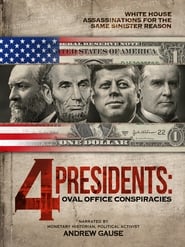
4 Presidents
Scarica il sottotitolo English
Informazioni sulla release
Tag
Anteprima dei sottotitoli in English
Le prime 200 righe.
Four United States presidents
have been assassinated,
and all four had something in common.
Abraham Lincoln, James Garfield, William McKinley,
and John F. Kennedy were the victimized
Commanders-in-Chief.
Conventional wisdom is that Honest Abe
angered many Southerners whose economy, in large part,
revolved around the legalization of slavery.
And what could Abraham Lincoln's murder
have to do with the assassination of James Garfield
17 years later in 1881,
or the shooting death of President William McKinley in 1901?
And what could possibly be the common thread
that connects all three of these historic leaders' killings
to the infamous 1963 assassination of John F. Kennedy?
After all, Kennedy's murder was nearly 100 years
after the Lincoln assassination.
The beloved JFK was credited
with highly important civil rights advancements
helping black Americans.
Could this be the linking motive
between his murder and Abraham Lincoln's?
Racial tensions, of course,
were also raging during the McKinley
and Garfield presidencies.
Were the perpetrators all fueled by racism?
There were also grave matters involving foreign policy
that angered many Americans
during each of these presidents' terms.
Both Presidents McKinley and Garfield
had major international crises brewing
right before their assassinations.
But also, core to it all, is one common thread, money.
Our government, so simply, is run on the basis of money,
and how, and who issues and controls it
is as much a founding building block
as the First and Fourth Amendments.
Mayor Amschel Rothschild
of the powerful banking house
of Rothschild and Sons infamously said,
- "Give me the power to create
"a nation's money, and I care not who makes its laws."
- President Lincoln, President Garfield,
President McKinley, and President Kennedy
all died for the same reason.
And it has something to do with money.
There are many odd similarities and eerie facts
that join together the Lincoln and Kennedy assassinations.
Some are widely known,
others are rather obscure.
Of course, everyone knows
that Abraham Lincoln was assassinated
by John Wilkes Booth,
and John F. Kennedy was murdered by Lee Harvey Oswald.
- John Wilkes Booth was born in 1839,
Lee Harvey Oswald was born in 1939.
After shooting Lincoln, Booth ran from a theater
and was caught in a warehouse.
Oswald ran from a warehouse
and was caught in a theater.
Booth was killed before his trial, and so was Oswald.
Abraham Lincoln was first elected to Congress in 1846.
John F. Kennedy was elected to Congress in 1946.
Abraham Lincoln was elected president in 1860.
John F. Kennedy was elected president in 1960.
Both Lincoln and Kennedy were known for their advocacy
of civil rights.
Both presidents presided over major wars.
Lincoln was president during the Civil War.
JFK was president during the Vietnam War.
Both presidents were assassinated by Southerners.
Both presidents were succeeded by their vice presidents
who were southerners.
Andrew Johnson, who succeeded Lincoln,
was born in 1808.
Lyndon Johnson, who succeeded Kennedy,
was born in 1908.
Both Andrew Johnson and Lyndon B. Johnson were Democrats.
Lincoln's secretary was named Kennedy,
and Kennedy's secretary was named Lincoln.
Lincoln's secretary warned him
not to go to Ford's Theater,
and Kennedy's secretary warned him
not to go to Dallas.
And both Kennedy and Lincoln were killed
in the presence of their wives.
- Although these similarities are mystifying
and maybe scary,
they don't explain the reason
why these two presidents were murdered
or the reason why Presidents McKinley
and Garfield were murdered,
as the reason for all four of them
was exactly the same.
These men didn't just attempt to do something.
They actually carried it out.
They changed the United States monetary system,
and it got them killed,
all four of them by the same method of execution.
They were shot to death.
Understanding how money is issued
and who actually controls it
and how these people and entities today
make hundreds of billions of dollars
from this system every year
will help to understand the reason why these four men
had their presidencies terminated earlier than planned.
When you look closely at the money in your wallet or purse,
you will notice at the top of each bill,
the words Federal Reserve note.
But what is the Federal Reserve?
Most Americans assume the Federal Reserve banks
are part of the government.
They are not, the Federal Reserve banks
are private corporations,
partially owned by foreign interests.
These banks and their stockholders
control the greater bulk of wealth in America.
To better understand the true identity and purpose
of these corporations,
one must go back to the earliest days of our nation.
During the period after the American Revolution
but before the drafting of the Constitution,
our Founding Fathers were approached by representatives
of wealthy banking families from Europe.
They proposed the establishment of a central bank
for use by America.
This bank would provide the money
that our young country needed
to grow into a vibrant nation.
However, the Founding Fathers rejected their proposal.
The United States, being a sovereign nation,
was fully capable of creating its own money supply.
This power, quote, "To coin money
"and regulate the value thereof," end quote,
was given to our Congress in the Constitution.
Aside from knowing that the United States
had the power to create its own currency,
the Founding Fathers were well aware
of the motives of the bankers,
namely, to siphon off the wealth and natural resources
of the people through various methods
of currency manipulation
just as they had done throughout history
in every major country in Europe.
- I believe that banking establishments
are more dangerous than standing armies.
Bank paper must be suppressed,
and the circulating medium must be restored
to the nation to whom it belongs.
- The primary proponent of a central bank
for the early United States was Alexander Hamilton.
Sponsored by the international banking conglomerates
and wealthy elites,
Hamilton convinced the U.S. leadership
that this central bank, owned and controlled
by his wealthy patrons,
would partner with the United States
and establish a very profitable banking franchise.
Thus, a 20-year charter was granted to the first bank
of the United States in 1792.
Over the next 20 years,
this central bank issued bank notes
against the nation's gold coins.
The ever-evolving monetary monster,
financed and took an ownership interest
in nearly every major business endeavor
started in the United States.
The bankers, most of whom were Europeans,
soon convinced the new Congress
that the United States should sell their 20% share
to the bank,
and by 1808, the First Bank of the United States
was totally private, and its profits were enormous.
This did not escape notice of Congress,
who refused to renew their charter in 1811.
That same year, however,
the nation quickly discovered itself
embroiled in conflicts with Great Britain
which led to the War of 1812.
The British invaded and sacked Washington,
burning the White House and most government buildings.
Suffering financial difficulties created by the war,
Congress rechartered the bank,
and then the British withdrew from U.S. soil.
This Second Bank of the United States
also had a 20-year charter.
And by the time it was up for renewal,
the president in office was Andrew Jackson.
And Jackson, well, he was a fiery man
who happened to strongly oppose
this central, private banking system
and paper money overall.
Andrew Jackson had gained fame
as a general in the United States Army
who fearlessly fought his British enemies
in the War of 1812.
He then served in both houses of Congress,
never finding an issue he didn't want to fight.
More English subtitles for 4 Presidents
- 4Presidents20201080pAMZNWEBRipDDP20x264-TEPES · 51 downloads · 2023-08-10
- 4 Presidents 2020 1080p WEBRip x264 AAC-[YTS MX] · 18 downloads · 2021-01-09
Commenti
No comments yet. Be the first to leave one.