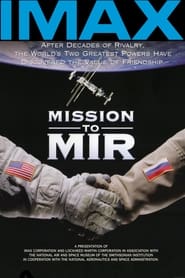
Mission to Mir
Scarica il sottotitolo English
Informazioni sulla release
Tag
Anteprima dei sottotitoli in English
Le prime 200 righe.
We're 1,000 miles southeast of Moscow on the plains of Kazakhstan.
A Soyuz rocket, the 300-ton workhorse of the Russian space program ...
rolls out to the launch pad.
This is the Cosmodrome at Baikonur ...
a sight few Western eyes have seen.
Under the old Soviet Union ...
it was so secret, it wasn't even on the maps.
Today you'll find outsiders here for every launch.
As often as not, a foreigner is a member of the crew.
The launch pad has a long history.
This reliable technology has launched over 1,000 rockets.
Most were never seen by the public.
Now the days of secrecy and suspicion are gone.
Nations of the world are banding together ...
to build the first permanent International Space Station.
Phase one, a series of joint missions and crew exchanges, is now under way.
Destination: The Russian space station Mir.
"Mir" is the Russian word for "peace."
There's a lot of hardware in orbit ...
but this space station with the hopeful name ...
is the most complex of all.
It's been home to scores of men and women ...
for more than a decade.
They come and go in a Soyuz spacecraft, docked there on the right.
In two's and three's they've lived in that central module ...
some for more than a year at a time.
At first, that was the whole of Mir.
The rest has been added over the years.
Moored on the left is Progress, an unmanned delivery truck ...
that brings up supplies.
Then it takes away the garbage ...
and burns up as it enters Earth's atmosphere.
And now, there's another visitor to Russia's Mir, an American citizen:
Astronaut and scientist Shannon Lucid.
She's a veteran of four shuttle flights ...
and has already logged over 800 hours in space.
She's the first American woman to live on Mir ...
and she's very much at home.
I think I'd been up on Mir about three months ...
when the first Progress came and we opened it up.
Then Yuri would say, "You can smell ...
all the fresh fruit and vegetables that are here."
So we dug around and we got those bags out ...
and for that lunch we had fresh tomatoes and onions.
That was one of the best meals I've ever eaten in my life.
It was just great.
Shannon grew up in Bethany, Oklahoma.
One of the cosmonauts was born in Russia, the other in Ukraine.
One night, Yuri and Yuri and I were sitting ...
sort of floating around, just talking about our childhood.
Here we were, three people, we grew up in two different countries ...
and we'd been working together, having a real good time together.
And that was just amazing to us, how the world had changed.
We got talking about when I was growing up ...
how afraid America was of Russia ...
and then they were explaining to me how afraid Russia was of America.
The Cold War was very, very dominant in our lives.
We would do bomb drills at school, and go underneath our desk.
An Iron Curtain has descended across the continent.
I remember very distinctly the night that Stalin died.
Russia was the enemy.
America had to be strong to be against Russia.
I remember when Sputnik was launched, standing outside the school door ...
and just thinking about the artificial satellite going around the Earth.
And I thought, "That's what I can do.
I can go and be a space explorer, because certainly ...
space won't be all explored by the time I grow up."
Says Mr. K., "The Soviets will overtake America ...
and then wave bye-bye."
Then I remember when the first seven were selected ...
and at that time, I wrote a letter to Time magazine and I asked them:
"Why were just males selected?"
But the Russians were first to launch a human to space.
The new superhero:
Yuri Gagarin.
I thought it was absolutely remarkable that a human being could go into space.
But then, it was the feeling of: "Why isn't America doing this too?"
And this generation does not intend ...
to founder in the backwash ...
of the coming age of space.
We mean to be a part of it. We mean to lead it.
I actually sold my bicycle to buy a telescope kit.
And then a friend of mine and I spent awhile out at night ...
making a map of the moon, just like real astronomers.
Tranquility Base here: The Eagle has landed.
That's one small step for man, one giant leap for mankind.
The space race was in the air.
More kids wanted to be astronauts than president.
But the Cold War continued to escalate.
Never in human history had so much death-dealing power been amassed.
But even the threat of annihilation ...
couldn't smother the human urge to explore.
In the U.S., Titan missile carriers also launched the scientific probes ...
Viking and Voyager, to survey the planets.
Some of the Soviet rockets that came off this weapons assembly line ...
were earmarked for space exploration too.
Then in 1975 ...
the first joint U.S.-Soviet mission in space, Apollo-Soyuz ...
ignited hope for future cooperation.
As tensions cooled further, new partnerships emerged ...
and American companies began successful joint ventures ...
with the rocket builders at Khrunichev.
Then it seemed almost overnight the Cold War ended.
The Soviet Union was gone.
These workers woke up in a brand-new country.
The new Russia now had the Mir station.
The U.S. had the shuttle.
American and Russian leaders agreed:
"Why not combine these great assets and explore space together?"
Ambitious new joint missions have begun.
Astronauts are here in Russia, training side by side with cosmonauts.
The first challenge to overcome: culture shock.
One of the reasons why I volunteered for this program is that ...
it would be a challenge to communicate with somebody in a different language.
You know, find out a little bit about life there in Russia.
These are the children of the new Russia.
They're also the children of cosmonauts.
Cosmonaut Vladimir Dezhurov and his family live here in Star City.
This is the Russian space complex in a forest on the outskirts of Moscow.
I really enjoyed my time in Star City.
It was sort of like living on an air force base ...
because it's a big complex and it was very community oriented ...
in a sense that most people walked to wherever they were going.
They didn't drive cars.
Star City is also home ...
to the only full-sized model of the Mir station.
Now it attracts a steady stream of American astronauts ...
who are getting acquainted with the station and how it operates.
Not only do they learn every detail about Mir ...
they do it in a different language.
In a typical day, we started at 9:00 in the morning ...
and we would listen to everything in Russian all day long.
There were weeks at a time where the only English I heard ...
was when we were walking back and forth to class.
Charlie Precourt isn't Russian.
He's an American astronaut, born in Massachusetts.
Now he's practicing in a Soyuz trainer.
I realized, when I started training and met the Russians ...
that if I couldn't go to the window with a cosmonaut —
A guy who flew MiGs across the border when I was on the West side flying F-15s.
— and marvel at the beauty of our planet and share that moment with him verbally ...
I was probably doing myself a disservice.
Soon Charlie will share that moment with these cosmonauts ...
when the shuttle docks with Mir for the first time.
Anatoly Solovyev, on the left, has already logged ...
more than six months in space.
Next to him is cosmonaut-engineer Nikolai Budarin, making his first flight.
If anything goes wrong in space, the Soyuz is their lifeboat.
Inside this centrifuge, cosmonauts condition themselves ...
for the forces they'll encounter during launch and landing ...
up to eight times Earth's gravity.
For cosmonaut and astronaut alike, the "Zero-G" experience is basic training.
And for a space traveler, the training never stops.
The cosmonaut gymnasium is a great place ...
for all cosmonauts and astronauts to get together ...
especially at the end of the day.
Where is your power?
You'll find not just Americans and Russians ...
but there are people from all different countries in Europe:
Claudie Deshays from the French Space Agency.
A lot of German astronauts getting ready to fly on the Mir.
Folks from many different countries training to fly with the Russians.
You get a chance to socialize and compare experiences.
Anatoly and his family live in a comfortable apartment in Star City.
I have lived in Star City for 20 years.
I have a wife and two sons, and I have a dog.
Anatoly and Nik will train for their shuttle launch in Texas.
Now it's their turn for some culture shock.
When we first came to Texas, it was quite unusual for us ...
that we were so popular.
Every day we were asked to a social occasion ...
and this was very pleasant for us.
This is the home of astronaut Ellen Baker.
She and crewmate Bonnie Dunbar ...
will join Charlie and the two cosmonauts aboard Atlantis ...
the first shuttle to dock with Mir.
- Chicken. - Chicken.
Pass the potatoes.
And the handoff has been completed.
This is the first mission to exchange Russian and American crews.
It'll bring back Norm Thagard, the first American to live on Mir.
Norm and his cosmonaut crewmates have been four months in space.
Ten, nine, eight, seven .... Go for main engines.
Five, four, three, two, one.
- Is that cool or what? - Pretty cool.
The pilot has to control eight parameters simultaneously ...
to make this a successful docking.
You have two 100-ton vehicles that are gonna collide ...
and you can cause great destruction if you don't do that exactly right.
If it is not in the right position — Left, right, up, down, in or out.
it will not mate correctly.
But even more complex, we had to combine our position ...
our orientation, our speed and our time of arrival ...
so we would be over Russia ...
for ground communications with Moscow, plus or minus two minutes.
Okay, I show us about ...
three feet.
Fifty seconds.
Okay, CCS has locked track.
The module looks pretty good here.
Mission to Mir subtitles in other languages
Commenti
No comments yet. Be the first to leave one.