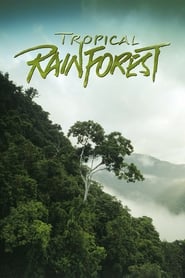
Tropical Rainforest
Scarica il sottotitolo English
Informazioni sulla release
Tag
Anteprima dei sottotitoli in English
Le prime 99 righe.
Imagine we are travelers in time, it's now 400 million years ago.
Some of the most primitive of plants, the ferns, cover almost all the land.
And now a hundred million years have passed.
The dominance of ferns is ending and the trees with different leaves ...
with trunks and spreading branches, are beginning to appear.
We've burst upon a new, fantastic era. Tropical rainforests have begun.
Imagine now it's 60 million years ago.
The dinosaurs have come − and gone.
The insects, who were here before, still thrive.
The forest is a tangled weave of plants, competing for the nutrients and light.
Multitudes of life forms are emerging. Static life-the fungi, plants and trees −
support a mobile world, the insects and the rest,
who move about in search of food.
Every morning, moist and sun − warmed air starts rising,
prelude to the mid-day clouds.
And every afternoon the rain descends ...
as tropical rainforests round the planet ...
live up to their hot and humid name.
Every day since time on Earth began, the sun has traced ...
a beam of energy and heat a band around the Earth's equator.
And so the daily dose of sun and water keeps the tropic landscape nourished,
slowly shaping, changing every form of life.
And still there's 50 million years or more to go ...
before the early humans come.
Coming out to taste the air, the forest's creatures of the night ...
are just as varied − and as numerous − as those of day.
At dawn the 12 hours night becomes another 12 of the day.
There are no seasons, only light and darkness,
rain and sunshine, week by week, and month on month, from year ...
to hundred million year.
Within this cycle grows the largest single living thing ...
the land has ever seen − the tree, the very fabric of the forest.
Many times the size of dinosaurs that trampled round their roots ...
so long ago, the trees are part of the variety of many thousand ...
different flowering plants.
But why so many shapes and colors?
How did they arrive at such complexity?
Many creatures blend in with their backgrounds.
How did they acquire this camouflage?
Every complicated organism has its origin in something simpler.
Every form of life has ancestors that were among the earliest on Earth.
Each individual is, by random chance,
just marginally different from its parents.
Just occasionally, variations proves a slight advantage for survival.
Under evolutionary pressure, those with an advantage tend to thrive ...
while other lines die out, they don't succeed.
And after millions of generations,
minute alterations, step by step emerge.
And so much time and evolution's passed ...
that life is able to perform what seems like magic as an everyday event.
All of evolution works this way.
Now it is 20 million years ago. The number and variety of species ...
is increasing rapidly and filling every nook and cranny in the forest.
Land which one day will be given names like Borneo, Sumatra, Java,
Queensland, Thailand, Burma, India, Madagascar, Congo,
Cameroon, the Amazon,
the central Isthmus of America, they all are covered by this luscious forest.
Diversity if undisturbed by major changes, leads to more diversity.
Birds - related to the dinosaurs − diversify to many shapes and sizes,
feeding off the different fruits and flowers, spreading seeds and pollen ...
through the forest.
The age of mammals has arrived.
The only mammals that can fly are bats,
which, by locating echoes, see with sound.
The lemurs, relatives of early primates,
look around with large and ghostly eyes.
By hour, by day, by decade, year and century, time, it rolls inexorably on.
Individual trees may live a hundred years or more ...
and then will fall or die.
The toppled giant leaves a gaping hole which plants ...
and younger trees will rush to fill.
The energy contained within the fabric of trees ...
is never lost or wasted.
Termites quickly go to work, and soon the forest floor reclaims ...
what it supplied, as everything recycles through the system.
The new trees race to fill the gap.
Within a year or so the surface of the woven canopy has been restored.
Everything is used and used again.
The need for food and space for living ...
leads to complicated patterns of behavior.
Time and circumstances lead one type of ant to harvest leaves ...
as food for fungus.
As it grows, the fungus breaks the chewed leaves down converting it ...
to food for ants.
Such intimate relationships are frail ...
and one can not exist without the other.
Symbiotic harmony like this is found across the forest.
While one species may rely on others for survival,
all of them rely upon the trees.
And now we've reached 2 million years ago. The monkeys, apes ...
and other agile primates have evolved, diversified, adapted.
Eating almost everything they can, they travel swiftly ...
through the upper branches.
Time travelers, we've nearly reached the present day,
it's just ten thousand years ago.
Humans have evolved and use the trees in ways ...
no animals have done before.
Within the last 200 years our tools have changed.
Our use of trees has much increased.
Tropical Rainforest subtitles in other languages
More English subtitles for Tropical Rainforest
- IMAX Tropical Rainforest HRHDTV Divx6 AC3 www mvgroup org · 17 downloads · 2010-01-15
Commenti
No comments yet. Be the first to leave one.