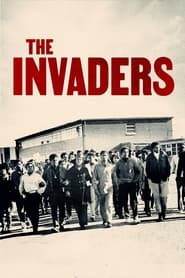
The Invaders
Scarica il sottotitolo English
Informazioni sulla release
Tag
Anteprima dei sottotitoli in English
Le prime 190 righe.
- Have you or your group
organized last night's burnings?
- We don't organize burnings essentially.
We organize people.
If people burn, they burn.
We've passed the time where people are gonna have
to seek to be respectable.
We've passed that period altogether
because none of us are gonna be respectable.
We never have been, we never will be.
We are Black
and we're proud of it.
- In 1968, all over the planet,
Paris, Prague, Mexico City,
young people are screaming for change.
Riots and bloodshed are the byproducts
of revolutionary new ideas.
But so is progress.
In Vietnam, America is locked into a battle
against communism, and at home,
the battle lines are drawn between the status quo
and young people who want something new.
- the draft.
- United under the banner of Black Power,
groups such as the Black Panthers
and the Student Nonviolent Coordinating Committee
were taking their revolutionary new politics
to the streets of America.
- Riots are a part of the ugly atmosphere
of our society now.
We are trying desperately to find an alternative.
- I don't give a crap what America says.
America is just a part of humanity.
And humanity is not ever going to make a change
about anything without what?
Some disruption, some actual disturbance.
- The attitude was that things were great
while everybody was suffering.
- Segregation wasn't just laws on the books.
It was a state of mind.
Black people understood what their place was
and they accepted that.
- When we were growing up, if you were Black,
that meant you were in the problem.
It did not mean that you had any opportunity
to be not a part of the problem.
So what we had was a community
that did not want to advance past plantation era.
And we had a community that had real needs.
- In the latter part of the '60s,
you began to see college students had returned to Memphis,
bringing back with them the kind of energies
and understandings they got while they were away.
- In Atlanta, Stokely Carmichael was the Chairman
of the Student Nonviolent Coordinating Committee.
After being arrested and beaten 27 times,
he became disillusioned with peaceful resistance
and took the nonviolent group
into a more militant direction.
Let me say first
that this march is a nonviolent expression
of our determination to be free.
- Mr. Carmichael, are you as committed
to the nonviolent approach as Dr. King is?
No, I'm not.
Why aren't you?
- No one in this country is asking the white community
in the South to be nonviolent.
And that, in a sense, is giving them a free license
to go ahead and shoot us at will.
I loved Stokely. He was young.
He was energetic.
If you hit me, I should be able to hit you back
without a whole lot of bull shit.
I loved it.
Two college students,
Charles Cabbage and Coby Smith met
while studying in Atlanta.
Carmichael's message of Black Power galvanized them
into action.
- So, we fell into a fast friendship at that point.
He wanted to do more things with SNCC
and become involved in the movement.
- Charles Cabbage, he was just a long, tall,
handsome drink of water and had the prettiest eyes.
And Coby was like the genius kind of dude.
- Coby Smith was a graduate Rhodes College.
It was Southwestern at Memphis at the time.
And you couldn't get in that school
unless you had a high IQ.
And being an African American,
you had to be an exemplary high IQ student.
- You gotta have someone who can put the theory together.
And I would say that Coby is probably one
of the best thinkers
in terms of what the problem is, how it is,
what the possible ways of working it out is.
That's Coby.
- I knew about Black Power 'cause it was on the TV,
but it wasn't a personal experience.
It was what people were doing other places.
You know, I was an American. I loved being an American.
And so, I was ready to defend America.
I grew up watching John Wayne.
I identified with his patriotism.
So, serving in Vietnam was just an extension of that idea
that I could serve my country, prove my manhood.
And then the country would be glad
that I did my part to defend it.
I returned to Memphis as a disabled veteran.
I was able to get a job at the Memphis Army Depot.
I had my own apartment.
I had my car.
I was looking forward to living the American dream.
- I was a student at Memphis State.
I happened to have been the only one
that was married at the time.
So, I had spent a great deal
of my time trying to figure out how we were going to eat.
But as I talked with Coby, as I talked with Cab,
I began to see that I was going to be able to provide
for them as I should.
When I left Atlanta,
Cab was due to graduate Morehouse College.
In fact, he was president of the senior class.
I didn't recognize the guy.
Total Black Power.
I'm like, "Who is this guy?
Did he get brainwashed? Or what?"
- We're the people who went to school.
And we all of a sudden understood that,
"Hey, this isn't gonna work.
We can't march down the street every day
and get people to do anything."
- After Cab came home, the talk turned to Black Power.
So for about two, three weeks,
we debating every day, heated debates.
- John was a gung-ho veteran of Vietnam.
He wouldn't have thought
of being against any established anything.
- So, this one particular night we were going over
to my apartment and I needed gas.
So, I stopped.
And the attendant, who's a white guy,
he comes out and he tells me I don't have a gas cap,
but he's got one just like it he can sell me.
And I'm like, "That's my gas cap."
So, I'm irate, man.
So, I go call the police
to get them to come,
'cause this guy's stolen my gas cap.
When the police arrive,
they brush past me and go over and talk to the white guy
and they ask him, "What's the trouble?"
He tells them, "There is no trouble."
That's it far as they're concerned.
But in the meantime,
this crowd starts together and the police call for backup.
And they're talking about crowd control.
This could be a riot.
One of the officers tell us that we had to leave
or they were going to arrest me.
So, some of these conversations
that Cab and I had been having over the last couple of weeks
about we not having rights
and the constitution doesn't apply to me.
And I was a fool for going to Vietnam
and fighting to defend a country that wouldn't defend me.
All of this is coming through my mind.
So I'm like,
"Arrest me then, 'cause I'm not leaving until I get my cap."
He was right.
It had nothing to do with serving the country.
I was a Black man.
I hate to make America sound
like it was not a free speech country,
but it was not.
Anytime you were near a white business
and there were two or three Negros together,
the police had to come
and protect whatever that establishment was.
- Policemen would do some terrible things
to the people that they would apprehend.
- Back up recording there.
- Police searched me like I was a man.
I had to do that upside the car.
They got happy up here.
They got equally happy down here
and they all down here
and it wasn't nothing.
Commenti
No comments yet. Be the first to leave one.